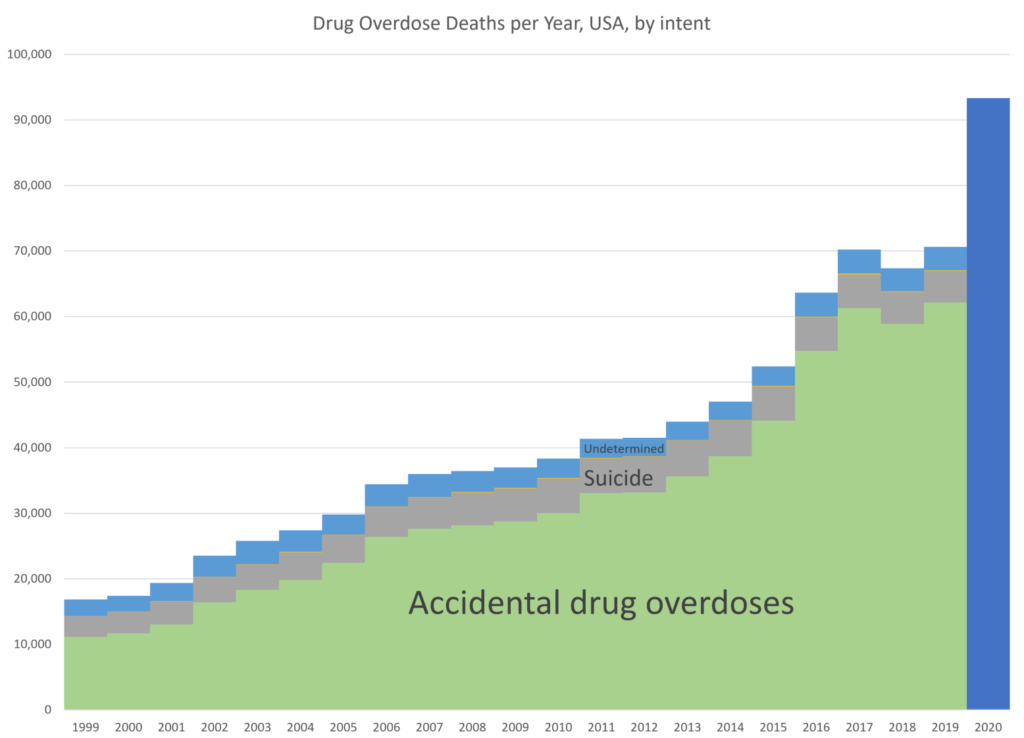
In 2020, there were over 93K deaths due to drug overdoses — a 30% increase over 2019.
This is super-bad, and worse than what I have seen for increases in other causes of death. I knew it was going to be bad, but I didn’t realize it was going to be this bad.
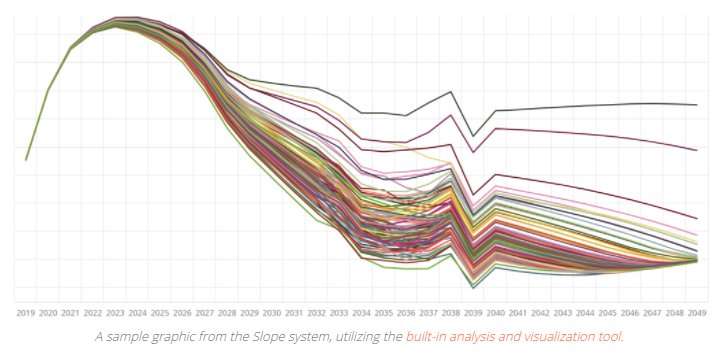
Not all 10% increases are created equal. And by that we mean, assumption effects are often more impactful in one direction than in the other. Especially when it comes to truncation models or those which use a CTE measure (conditional tail expectation).
Principles-based reserves, for example, use a CTE70 measure. [Take the average of the (100% – 70% = 30%) of the scenarios.] If your model increases expense 3% across the board, sure, on average, your asset funding need might increase by exactly that amount. However, because your final measurement isn’t the average across all the scenarios, but only the worst ones, it’s likely that your reserve amounts are going to increase by significantly more than the average. You might need to run a few different tests, at various magnitudes of change, to determine how your various outputs change as a function of the volatility of your inputs.
On Monday, July 19, the country is ditching all of its remaining pandemic-related restrictions. People will be able to go to nightclubs, or gather in groups as large as they like. They will not be legally compelled to wear masks at all, and can stop social distancing. The government, with an eye on media coverage, has dubbed it “Freedom Day,” and said the lifting of safety measures will be irreversible.
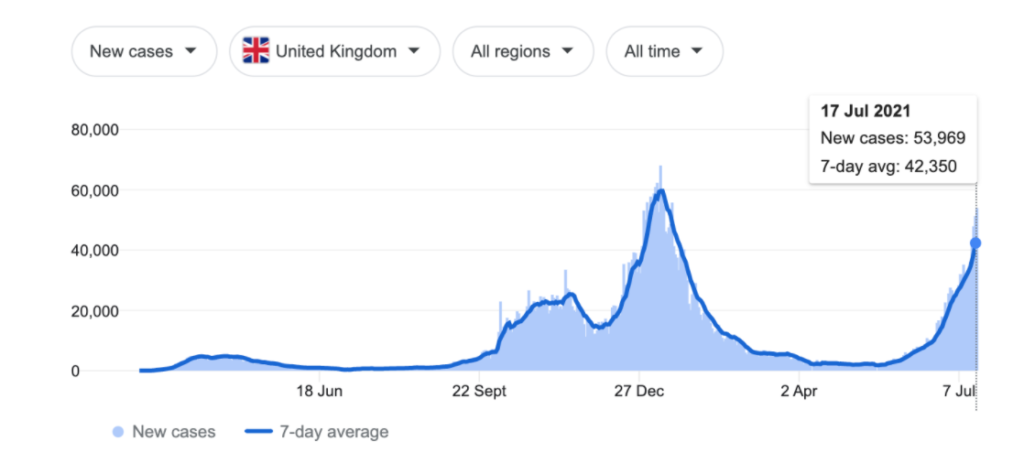
At the same time, coronavirus cases are rapidly rising in the UK. It recorded over 50,000 new cases on Friday, and its health minister says that the daily figure of new infections could climb to over 100,000 over the summer.
…..
The UK’s vaccination program is still under way, but it has been broadly successful so far. In all, 68% of the adult population is fully vaccinated, and about 88% of adults have received their first dose (this includes the 68% who have had both doses). Just 6% of Brits are hesitant about getting a shot, according to the Office for National Statistics.
…..
But the government seems to be betting that not all numbers are equally scary. It hopes that hospitalizations will stay low enough to stop the National Health Service from being completely overwhelmed. It is making the assumption that the link between cases and hospitalization rates has been weakened, if not broken.
“This wave is very different to previous ones,” says Oliver Geffen Obregon, an epidemiologist based in the UK, who has worked with the World Health Organization. “The proportion of hospitalization is way lower compared to similar points on the epidemic curve before the vaccination program.”
The pandemic and the work-from-home environment it spawned also led many economists to speculate that workers would become better adapted to technology, more efficient and strike a healthier balance between work and life. This, in turn, would leave them more mobile. A Microsoft Corp. workplace trends survey found that 40% of Americans are considering leaving their jobs this year. And many are doing just that, with 2.5% of the employed quitting their jobs in May, according to the Bureau of Labor Statistics’ Job Opening and Labor Turnover Survey. Although that’s down from the record 2.8% in April, it’s still higher than any other point since at least before 2001. Plus, consider that the quit rate was only 2.3% in 2019 when unemployment was just 3.6%, compared with 5.8% this May.
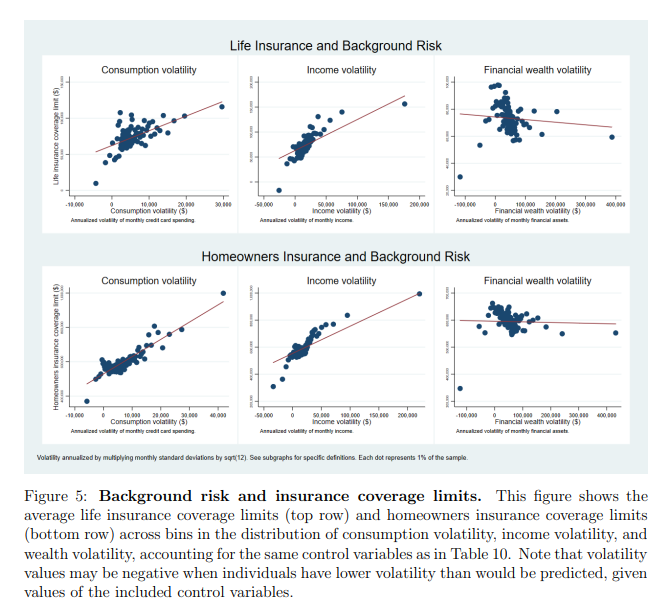
Theoretically, wealthier people should buy less insurance, and should self-insure through saving instead, as insurance entails monitoring costs. Here, we use administrative data for 63,000 individuals and, contrary to theory, find that the wealthier have better life and property insurance coverage. Wealth-related differences in background risk, legal risk, liquidity constraints, financial literacy, and pricing explain only a small fraction of the positive wealth-insurance correlation. This puzzling correlation persists in individual fixed-effects models estimated using 2,500,000 person-month observations. The fact that the less wealthy have less coverage, though intuitively they benefit more from insurance, might increase financial health disparities among households.
On Thursday, the California legislature unanimously passed a budget trailer bill that will create the state’s first guaranteed income pilot program.
Under the lawmakers’ plan, the state’s Department of Social Services (DSS) will get $35 million to dole out in grants to cities and counties that will then set up local basic income schemes. Grants will be prioritized for programs focusing on “pregnant individuals” and young adults 21 or older who’ve aged out of extended foster care programs.
State Sen. Dave Cortese (D–San Jose) said in a press release Thursday that participants of these pilot programs could end up receiving monthly payments of as much as $1,000 each.
Given Social Security’s dire financial condition, there is growing interest in attempting to harness the power of private capital markets to bail out the faltering system. However, despite its surface attractiveness, allowing the government to invest funds from the Social Security trust fund in private capital markets would be a terrible mistake that would have severe consequences for the U.S. economy.
…..
Allowing the government to invest the trust fund in private capital markets would amount to the “socialization” of a large portion of the U.S. economy. The federal government would become the nation’s largest shareholder, with a controlling interest in nearly every American company. Government ownership brings with it serious problems of government control and is a threat to the efficiency and competitiveness of the U.S. economy.
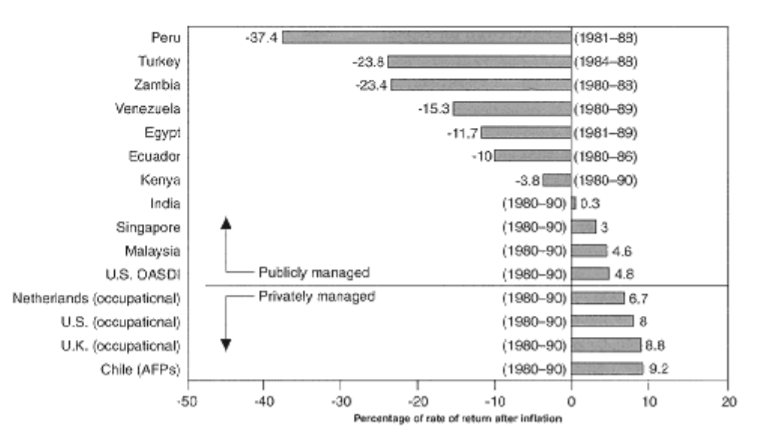
Moreover, experience in other countries has shown that government investments seldom achieve the rates of return seen in private investment. Attempts by the government to manipulate the markets could further undermine returns and threaten general market stability.
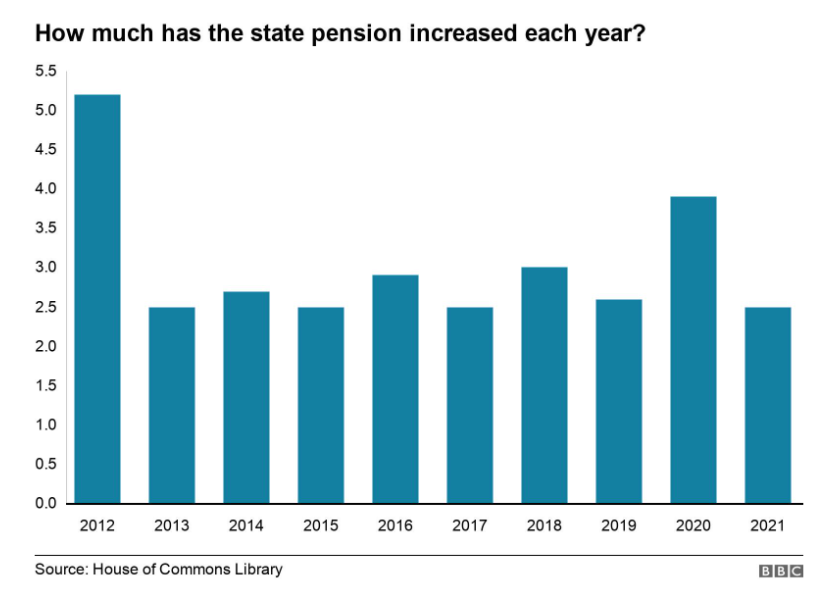
At present, the state pension increases each year in line with the rising cost of living seen in the Consumer Prices Index (CPI) measure of inflation, increasing average wages, or 2.5%, whichever is highest.
….
As people come off furlough and return to full pay, this is recorded as a large rise in average earnings. Job losses have also affected those in low-paid work too.
This leads to a unique situation, and one which economists describe as an anomaly.
Predictions by the Bank of England suggest that average earnings could go up by 8%, hence the equivalent rise in the state pension.
As many as two of every five Americans who’ve died from COVID-19 were suffering from diabetes, making the chronic disease one of the highest-risk conditions during the pandemic, an expert says.
About 40% of deaths from COVID-19 in the United States were among diabetics, a “really quite sobering” statistic that should prompt people with the ailment to get vaccinated, said Dr. Robert Gabbay, chief scientific and medical officer for the American Diabetes Association.
……
That diabetes was implicated in up to 40% of COVID-19 deaths is particularly staggering if you consider only 10% of the U.S. population suffers from the condition.
The study, conducted by scientists at the University of Texas at El Paso, also found that one in 10 people with diabetes hospitalized with COVID-19 die within one week.
At least 65% of Asian people have been vaccinated, on average, in states that Bloomberg is tracking. That compares with 45% of White people with at least one dose, 40% of Hispanics and 34% of Black people. In New Mexico, New York and Washington, more than three-quarters of the Asian population has been covered.
Even as rates slowed, Asians remained the most likely to get newly vaccinated, with an average of more than 5% getting their first dose over the past month compared to 3.5% or less for the other groups.
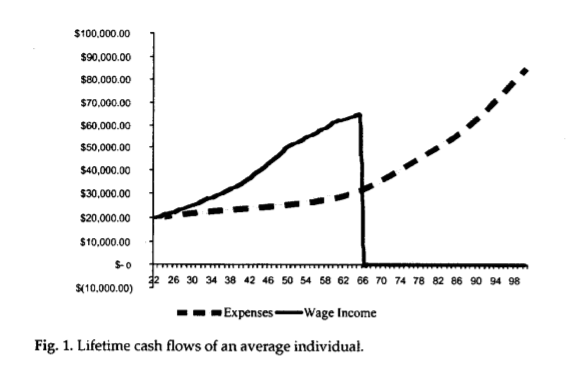
Life and disability insurance, as well as annuities, traditionally have been analyzed as products providing protection against random losses. This article proposed that these products can be viewed as derivative instruments created to address the uncertainties and inadequacies of an individual’s human capital, if human capital is viewed as a financial instrument. In short, life insurance (including disability insurance and annuities) is the business of human capital securitization.
Author(s): Krzysztof M. Ostaszewski, PhD, MAAA, FSA, CFA