Do You Get Your Money’s Worth From Buying An Annuity?

Link: https://www.forbes.com/sites/ebauer/2021/07/08/do-you-get-your-moneys-worth-from-buying-an-annuity/?sh=380f33612082&fbclid=IwAR1dlxEjlWlmPSetMplHWU6BdPjzzo7ju983c73QKr5KKKn29PjurCq_YmA

Excerpt:

But measuring the value of annuities, generally speaking, does tell us whether consumers are getting a fair deal from their purchases, and here, a recent working paper by two economists, James Poterba and Adam Solomon, “Discount Rates, Mortality Projections, and Money’s Worth Calculations for US Individual Annuities,” lends some insight.

Here’s some good news: using the costs of actual annuities available for consumers to purchase in June 2020, and comparing them to bond rates which were similar to the investment portfolios those insurance companies hold, the authors calculated “money’s worth ratios” that show that, for annuities purchased immediately at retirement, the value of the annuities was between 92% – 94% (give-or-take, depending on type) of its cost. That means that the value of the insurance protection is a comparatively modest 6 – 8% of the total investment.

But there’s a catch — or, rather, two of them.

In the first place, the authors calculate their ratios based on a standard mortality table for annuity purchasers — which makes sense if the goal is to judge the “fairness” of an annuity for the healthy retirees most likely to purchase one. But this doesn’t tell us whether an annuity is a smart purchase for someone who thinks of themselves as being in comparatively poorer health, or with a spottier family health history, and folks in these categories would benefit considerably from analysis that’s targeted at them, that evaluates, realistically, whether annuities are the right call and whether their prediction of their life expectancy is likely to be right or wrong.

Author(s): Elizabeth Bauer

Publication Date: 9 July 2021

Publication Site: Forbes
The Time Has Come To Talk About Senior Poverty In America

Link: https://www.forbes.com/sites/nextavenue/2021/07/09/the-time-has-come-to-talk-about-senior-poverty-in-america/

Excerpt:

If 40 million Americans were suffering from the same severe problem, you might think it would be the subject of considerable media attention, a host of government programs, infusions of business capital and a hot topic of national conversation.

That is certainly what I thought several years ago when I began researching the reality that nearly half of all people of over 55 — one in seven Americans — had no money saved and risked heading into poverty or certainly into dire conditions that would make their lives desperate for decades to come.

…..

The average Social Security check is a meager $1,543 a month and about 40% of older Americans rely entirely on Social Security for their income.

Author(s): Joe Seldner, Next Avenue

Publication Date: 9 July 2021

Publication Site: Forbes
Covid-19 deaths in Russia are soaring

Link: https://www.economist.com/europe/2021/07/10/covid-19-deaths-in-russia-are-soaring

Graphic:

Excerpt:

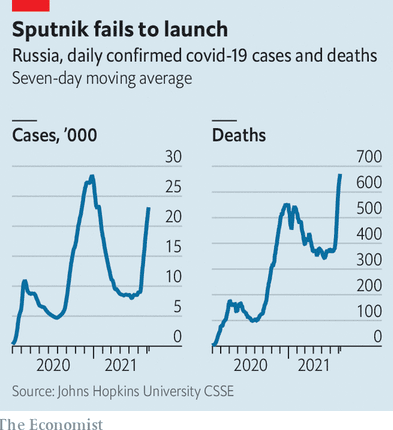
The number of new daily cases is currently around 25,000, somewhat fewer than in Britain, and rising. But whereas in Britain this surge has translated into an average of 18 daily deaths over the past week, in Russia it has resulted in an average of 670 deaths a day.

The contrast is all the more striking because Russia was the first country in the world to approve a working vaccine, one based on the same science as the British-Swedish AstraZeneca one and apparently just as effective. But whereas in Britain 78% of the population has received at least one jab, in Russia the proportion is only 20%. The difference is not the availability or the efficacy of the jab, but people’s trust in the government and its vaccines.

All of this could have been avoided. A year ago the government decided to lift a partial lockdown (Mr Putin called it “a holiday”), hoping to save itself money and to prop up the president’s faltering popularity after a prolonged slump in incomes. Mr Putin’s ratings did go back up—but so did the risk of infection.

Publication Date: 10 July 2021

Publication Site: The Economist

The Society of Actuaries Announces ASA Curriculum Changes, Micro-Credentials and Affiliate Membership

Press release: https://www.soa.org/resources/announcements/press-releases/2021/2021-asa-changes-member/

FAQ: https://www.soa.org/education/general-info/asa-micro-credentials/

Pathway comparison, more info: https://www.soa.org/globalassets/assets/files/edu/asa-pathway-changes.pdf

Graphic:

Excerpt:

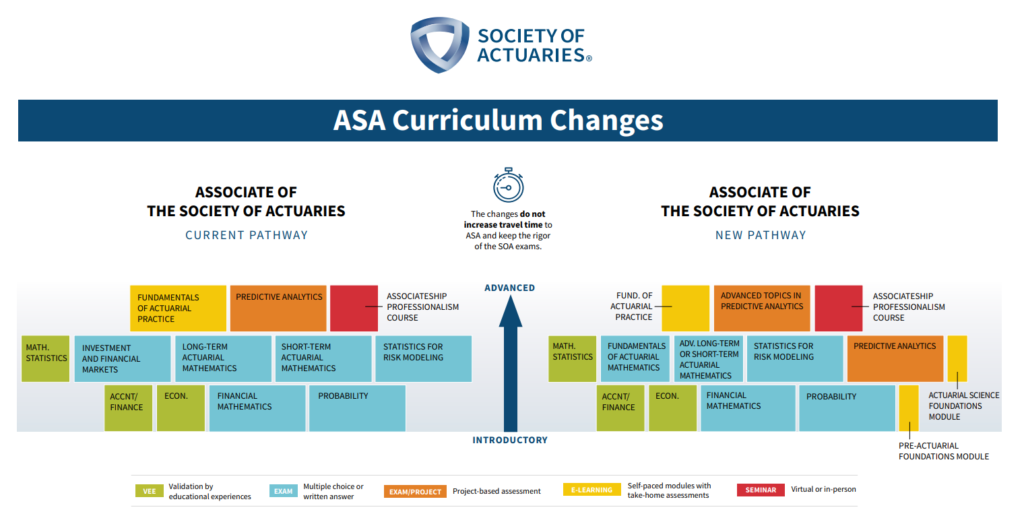
Beginning in January 2022, pre-ASA candidates will also be able to begin work to earn new micro-credentials that recognize and demonstrate to employers their knowledge and skills gained along the pathway to ASA. These “milestone markers” will remain with candidates if they decide to leave the ASA pathway and are also applicable for those choosing to enter the pathway to only earn one or more micro-credential. All elements required to earn these micro-credentials are part of the ASA pathway and count in full toward earning the ASA and FSA designations.

These micro-credentials group together pathway components that represent distinct knowledge and skills to demonstrate the level of achievement candidates earn to employers, co-workers and their professional network. AQ/EQ and data science skills are driving changes to the ASA curriculum and will be incorporated into requirements for each micro-credential, allowing candidates the ability to demonstrate and build on those skills for their resume and jobs.

These micro-credentials do not make candidates qualified or “signing” actuaries; that work is reserved for those who earn the ASA and FSA designations. However, they do provide critical marks of candidates’ progress through the system and signal to employers the knowledge they’ve gained. We will be conducting an outreach program to employers to build awareness and support for the micro-credentials over the coming months.

Author(s): SOA

Publication Date: 12 July 2021

Publication Site: Society of Actuaries

Biden’s Covid vaccine push crashes into reality

Link: https://www.politico.com/news/2021/07/07/biden-covid-vaccine-push-498479

Excerpt:

After falling short of its goal of administering at least one dose of the vaccine to 70 percent of adults by July 4th (it reached 67 percent) the White House is now turning its attention to the toughest populations in the country. That includes places like barber shops in Englewood, which are part of the “Shots at the Shops” effort by the White House. It’s also sending “surge teams” to some of the lowest vaccinated spots in the country, enlisting trusted messengers like church leaders to go door-to-door. And they’ll add mobile vaccination units at places like music festivals, sporting events or neighborhoods with low vaccination rates.

…..

It’s all in an effort to target the stubbornly resistant, or hard-to-reach populations as fear grows that the virus could reemerge thanks to the highly contagious Delta variant.

Much of the coverage of those populations has focused on Trump supporters who have resisted vaccination as a matter of political identity. And data show that vaccination rates do tend to overlap with partisan leanings. But there are other hard-to-reach communities, including young people, Black and minority groups that traditionally vote Democratic.

Author(s): Natasha Korecki

Publication Date: 7 July 2021

Publication Site: Politico

BlackRock Tweaked Some Models. It Triggered a Wave of Buying and Selling.

Link: https://www.wsj.com/articles/blackrock-tweaked-some-models-it-triggered-a-wave-of-buying-and-selling-11625857596?mod=itp_wsj&ru=yahoo

Excerpt:

In late May, an obscure BlackRock Inc. commodities fund took in more than $1 billion in new money in less than a week.

The iShares GSCI Commodity Dynamic Roll Strategy exchange-traded fund was a relatively small fund in BlackRock’s larger suite of funds. But on the week of May 26, the ETF—which trades under the ticker COMT and tracks futures contracts tied to commodities from energy to metals to agriculture—scored its biggest one-day influx of new cash on record, according to FactSet data.

The surge helped the ETF more than double its assets under management to more than $2 billion.

The answer for why so much money flowed into the fund wasn’t solely because Wall Street traders were up in arms with inflation fears that were helping to drive idle funds into commodity investments. According to BlackRock documents and people familiar with the matter, BlackRock had sent instructions to brokerages and other financial platforms to alter a series of “model portfolios” to include this fund.

Model portfolios are ready-made fund combos delivered through financial advisers and brokerages to everyday investors. Brokerages can design their own model portfolios, or rely on guidance from fund companies like BlackRock. The May surge in the BlackRock fund shows just how powerful that guidance can be.

Author(s): Dawn Lim

Publication Date: 9 July 2021

Publication Site: WSJ

PBGC Multiemployer Pension Bailout – The Weeds

Graphic:

Excerpt:

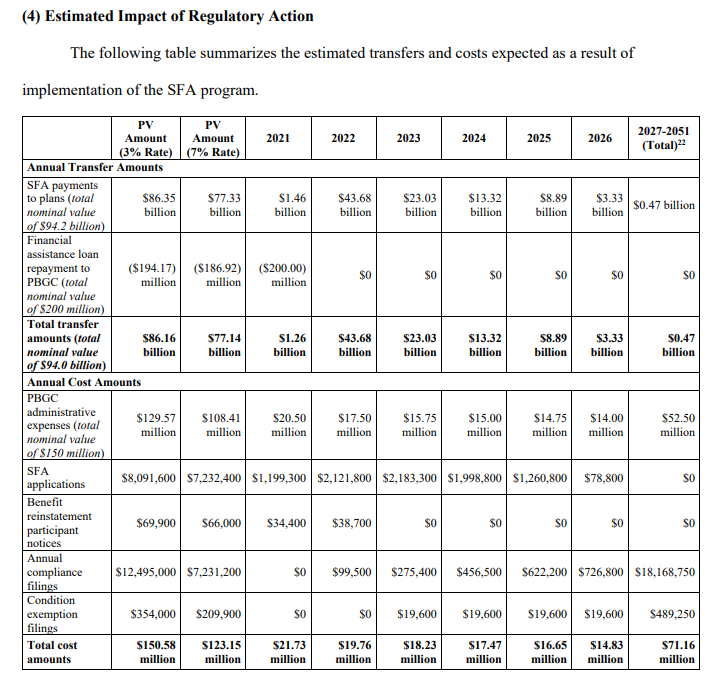
The Pension Benefit Guaranty Corporation (PBGC) on July 9, 2021 announced an interim final rule implementing a new Special Financial Assistance (SFA) Program for financially troubled multiemployer defined benefit pension plans.

What struck me:

…..

It is expected that over 100 plans that would have otherwise become insolvent during the next 15 years will instead forestall insolvency as a direct result of receiving SFA. Section 9704 of ARP amends section 4005 of ERISA to establish an eighth fund for SFA from which PBGC will provide SFA to multiemployer plans under the program created by the addition of section 4262 of ERISA. The eighth fund will be credited with amounts from time to time as the Secretary of the Treasury, in conjunction with the Director of PBGC, determines appropriate, from the general fund of the Treasury Department. Transfers from the general fund to the eighth fund cannot occur after September 30, 2030. (page 6)

Unlike the financial assistance provided under section 4261 of ERISA, which is in the form of a loan and provided in periodic payments, a plan receiving SFA under section 4262 has no obligation to repay SFA, and PBGC must pay SFA in the form of a single, lump sum payment. (page 7)

Author(s): John Bury

Publication Date: 10 July 2021

Publication Site: burypensions

PBGC to Provide Special Financial Assistance to Troubled Multiemployer Plans

Link: https://www.pbgc.gov/news/press/releases/pr21-05

Released rule pdf: https://www.pbgc.gov/sites/default/files/sfa/4262-ifr-final-posted.pdf

Excerpt:

WASHINGTON, D.C. — The Pension Benefit Guaranty Corporation (PBGC) today announced an interim final rule implementing a new Special Financial Assistance (SFA) Program for financially troubled multiemployer defined benefit pension plans.  

“The American Rescue Plan provides funding to severely underfunded pension plans that will ensure that over three million of America’s workers, retirees, and their families receive the pension benefits they earned through many years of hard work,” said PBGC Director Gordon Hartogensis. “These benefits are critical to the economic security of so many retirees and their families.” 

The American Rescue Plan (ARP) Act of 2021 (P.L. 117-2) — a historic law passed by Congress and signed by President Biden on March 11, 2021 — contains provisions to provide an estimated $94 billion in assistance to eligible plans that are severely underfunded. Additionally, it assists plans by providing funds to reinstate previously suspended benefits. ARP also addresses the solvency of PBGC’s Multiemployer Insurance Program, which was projected to become insolvent in 2026.  

The interim final rule sets forth what information a plan is required to file to demonstrate eligibility for SFA and the formula to determine the amount of SFA that PBGC will pay to an eligible plan. ARP authorizes PBGC to prioritize SFA applications of plans in specified groups, and the interim final rule identifies the priority order in which such plans are permitted to apply. The interim final rule also outlines a processing system, which will accommodate the filing and review of many applications in a limited amount of time. In addition, it specifies permissible investments for SFA funds and establishes certain restrictions and conditions on plans that receive SFA. 

The interim final rule is posted on PBGC’s website today, July 9, 2021. The rule is also on public inspection today at FederalRegister.gov and is scheduled for publication in the Federal Register on July 12, 2021. PBGC has included a 30-day public comment period in this rulemaking from the date of publication in the Federal Register. All interested parties may submit their comments, suggestions, and views on the rule’s provisions here: reg.comments@pbgc.gov or https://www.regulations.gov. 

Additional information, including Frequently Asked Questions, is available at PBGC.gov/arp. 

Author(s): PBGC press release

Publication Date: 9 July 2021

Publication Site: PBGC

PBGC Rules on Multiemployer Pension Bailout

Excerpt:

The Pension Benefit Guaranty Corporation (PBGC) today announced an interim final rule implementing a new Special Financial Assistance (SFA) Program for financially troubled multiemployer defined benefit pension plans.

Pertinent excerpts coming over the weekend but, for now, it looks like the bailout number moved from $86 billion to $94 billion per the PBGC press release:

Author(s): John Bury

Publication Date: 9 July 2021

Publication Site: burypensions

Update On The Multiemployer Pension Plan Bailout: New Regulations Finally Unveiled

Link: https://www.forbes.com/sites/ebauer/2021/07/11/update-on-the-multiemployer-pension-plan-bailout-new-regulations-finally-unveiled/?sh=29d66f215bb2

Excerpt:

The PBGC’s decisions here are not what organizations such as the NCCMP would have liked, although, clearly, it is the PBGC’s job to interpret the law, not to try to fix a poorly-written law.

At the same time, no multiemployer pension plan is worse off with this legislation than without it, even if it isn’t as generous as they would have liked. And nothing prohibits those plans from boosting contributions and using additional contributions to fund future accruals — which would mean that pension plans which express their contributions as fixed dollar amounts, rather than a percentage of pay, will be better positioned to provide for existing employees as well as retirees. What’s more, the calculation of future contributions is based on a one-time open group projection, without being revised from year to year, so that, in principle, if more workers join a plan, the plan will be better off. (Of course, if the projection is too optimistic about the number of future workers, the opposite will be true.)

But, of course, this is $86 billion that could have been spent for other needs, or not spent at all. And, however much advocates profess that they still hope for a more comprehensive revision of funding rules for multiemployer pensions, the poorly-conceived nature of this bailout makes it less, rather than more, likely that both sides of the aisle will come together to repair multiemployer pensions and prevent future bailouts.

Author(s): Elizabeth Bauer

Publication Date: 11 July 2021

Publication Site: Forbes

Searching for Supply-Side Effects of The Tax Cuts and Jobs Act

Link: https://www.taxpolicycenter.org/taxvox/searching-supply-side-effects-tax-cuts-and-jobs-act

Excerpt:

Did it work? In a new paper with my Tax Policy Center colleague Claire Haldeman, we conclude that, consistent with these goals, TCJA reduced marginal effective tax rates (METRs) on new investment and reduced the differences in METRs across asset types, financing methods, and organizational forms.

But it had little impact on business investment through 2019 (where we stopped the analysis, to avoid confounding TCJA effects with those of the COVID-related shutdowns that ensued). Investment growth increased after 2017, but several factors suggest that this was not a reaction to the TCJA’s changes in effective tax rates.

Author(s): William G. Gale

Publication Date: 6 July 2021

Publication Site: TaxVox at Tax Policy Center

State Pass-Through Entity Taxes Let Some Residents Avoid the SALT Cap at No Cost to The States

Link: https://www.taxpolicycenter.org/taxvox/state-pass-through-entity-taxes-let-some-residents-avoid-salt-cap-no-cost-states

Graphic:

Excerpt:

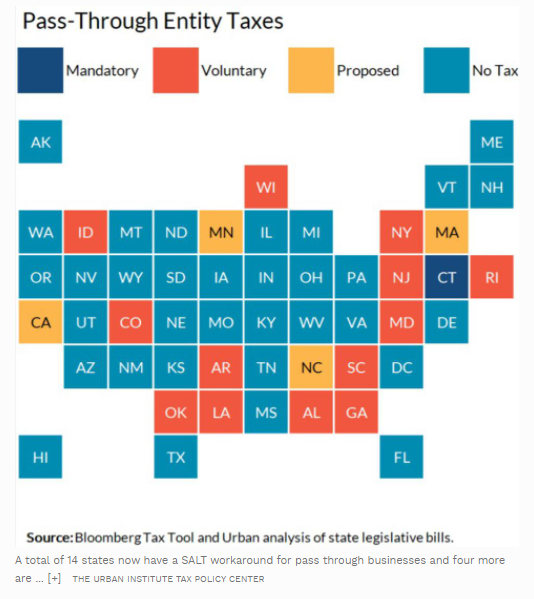
But PTE taxes create inequities based on type of income. For example, because these states now favor pass-through income over wages, a partner in a law firm can be effectively exempt from the SALT cap while an executive assistant or associate in the same firm remains subject to the deduction limitation. A doctor who is an employee of a corporation is barred from fully deducting state and local income taxes while a partner in a medical practice making the same income is exempt from the federal cap for these taxes.  

Because the rules differ across states, businesses need to consider where partners live and where business income is generated. For example, non-resident partners might not benefit from the credits in their home state. Like New York, some states of residence allow credits against the taxes these partners owe from other states. But that isn’t always the case.

Keep in mind that these PTE taxes may be just a temporary fix. Congress may consider changes to the SALT cap in coming legislation. And the cap, along with all other individual tax changes in the TCJA, is scheduled to expire at the end of 2025.

Author(s): Kim S. Rueben

Publication Date: 24 June 2021

Publication Site: TaxVox at Tax Policy Center