How States Are Letting Small Businesses Avoid The SALT Cap On Their Tax Returns

Link: https://www.forbes.com/sites/lizfarmer/2021/07/01/how-states-are-letting-small-businesses-avoid-the-salt-cap-on-their-tax-returns/?sh=7ef5a29127c5

Graphic:

Excerpt:

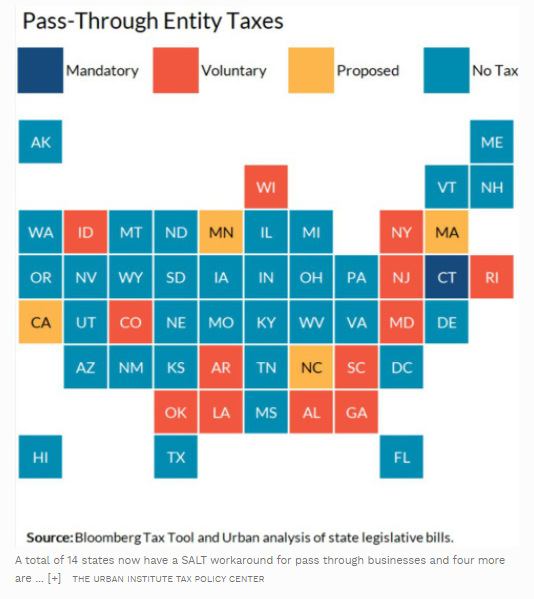
Colorado recently became the 14th state to enact the new workaround, which allows (or in Connecticut’s case, requires) pass-through businesses to pay state income taxes at the entity level rather than on their personal income tax returns. For small businesses like partnerships, declaring that income as a business instead of passing it through to their individual tax returns means the state taxes paid on that business income don’t count toward their SALT cap.

The new mechanism is called a pass-through entity (PTE) tax, which is exempt from the $10,000 cap on the state and local tax (SALT) deduction that was part of President Trump’s 2017 tax reform. For business owners in high property tax states like New Jersey and Connecticut, it’s a critical change because it allows those taxpayers to deduct more of their local taxes from their other personal income.

Author(s): Liz Farmer

Publication Date: 1 July 2021

Publication Site: Forbes
Why has America’s vaccination programme slowed so much?

Link: https://www.economist.com/graphic-detail/2021/07/08/why-has-americas-vaccination-programme-slowed-so-much?utm_campaign=the-economist-today&utm_medium=newsletter&utm_source=salesforce-marketing-cloud&utm_term=2021-07-08&utm_content=article-link-6&etear=nl_today_6

Graphic:

Excerpt:

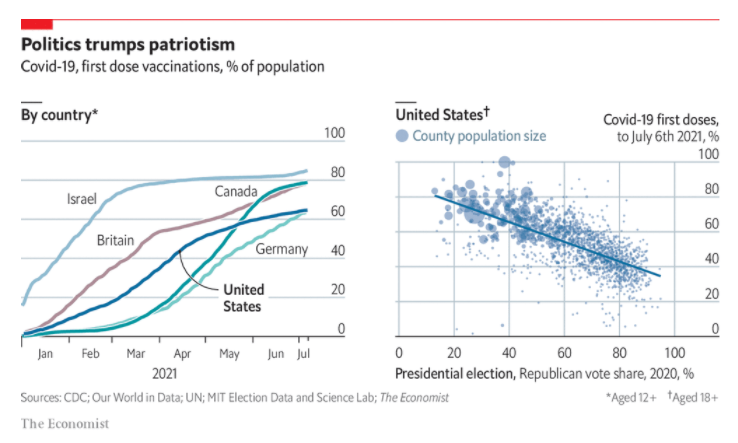
ON JULY 4TH President Joe Biden stood on the White House lawn to declare that America was nearing independence from the coronavirus. But with covid-19 not fully “vanquished”, he called upon his fellow citizens to get vaccinated, telling them that “it’s the most patriotic thing you can do.” About 55% of Americans over the age of 12 have now been fully vaccinated, and a further 10% have had the first of two doses. But in recent weeks America’s vaccination rate has slowed markedly. In April 3m doses were administered each day; since June that figure has fallen to an average of 1m per day.

There are three possible explanations for this slow-down. The first is that it is typical for vaccination rates to fall as more people are jabbed, since those in cities and other easy-to-reach areas are likely to have been targeted already. Yet America does not appear to have reached such a threshold. Other rich countries, such as sparsely populated Canada, continued to vaccinate at a decent clip until about 75% of their populations had received their first dose (see left-hand chart). Germany, which has vaccinated a similar proportion of its citizens as America, is currently vaccinating at nearly three times the rate.

Publication Date: 8 July 2021

Publication Site: The Economist

US bond funds rake in more cash despite inflation fears

Link: https://www.ft.com/content/787d1be6-e7d9-43a2-b77c-07916fe19f3e

Graphic:

Excerpt:

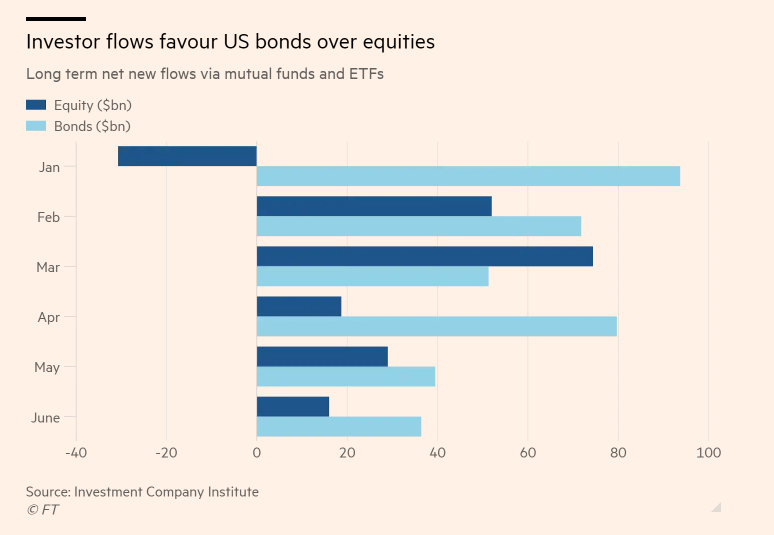
Analysts attributed the popularity of bond funds — which do not include money-market holdings — to concerns about lofty stock valuations and an ageing population’s need for steady income during retirement.

“Financial advisers follow asset allocation models and portfolio rebalancing and demographics are strong trends,” said Shelly Antoniewicz, ICI senior director of financial and industry research. “The cumulative flow to bond funds lines up nicely with the percentage of the population over 65 years.”

Author(s): Michael Mackenzie

Publication Date: 6 July 2021

Publication Site: Financial Times

How the government’s mistaken prices disclosure derailed a big follow-on solicitation

Link: https://federalnewsnetwork.com/contracting/2021/07/how-the-governments-mistaken-prices-disclosure-derailed-a-big-follow-on-solicitation/

Excerpt:

When the Defense Information Systems Agency sought a new satellite services acquisition on behalf of the Navy, it included a spreadsheet so bidders could fill in their prices. But the spreadsheet included the prices from the current contract, which were supposed to be inaccessible. For how things turned out, Smith Pachter McWhorter procurement attorney Joe Petrillo joined Federal Drive with Tom Temin.

…..

Joe Petrillo: Sure. This is another excel spreadsheet disaster, and we talked about one a few weeks ago. It involved an acquisition of satellite telecom services for the Navy’s Military Sealift Command. It was an acquisition of commercial satellite telecommunications services. And they were divided into both bandwidth and non-bandwidth services. And the contract would be able to run to for up to 10 years in duration. Part of the contract, as you said, was an excel spreadsheet of the various different line items with blanks for offers to include their price. Unfortunately, this spreadsheet had hidden tabs, 19 hidden tabs, and those included, among other things, historical pricing information from the current contract. So Inmarsat, which was the incumbent contractor, holding that contract, notified the government and said, look you’ve disclosed our pricing information, do something about it. So the government deleted the offending spreadsheet from the SAM.gov website. But they understood and this was the case, third party aggregators had already downloaded it, and it was out there, it was available.

Author(s): Tom Temin, Joe Petrillo

Publication Date: 8 July 2021

Publication Site: Federal News Network

The economic value of targeting aging

Link: https://www.nature.com/articles/s43587-021-00080-0?fbclid=IwAR30GYDrmx1ck_1CkFvkoJUR4EttL4OxkNOgD9ZYft_jvqYa-inOhhthZao

Graphic:

Excerpt:

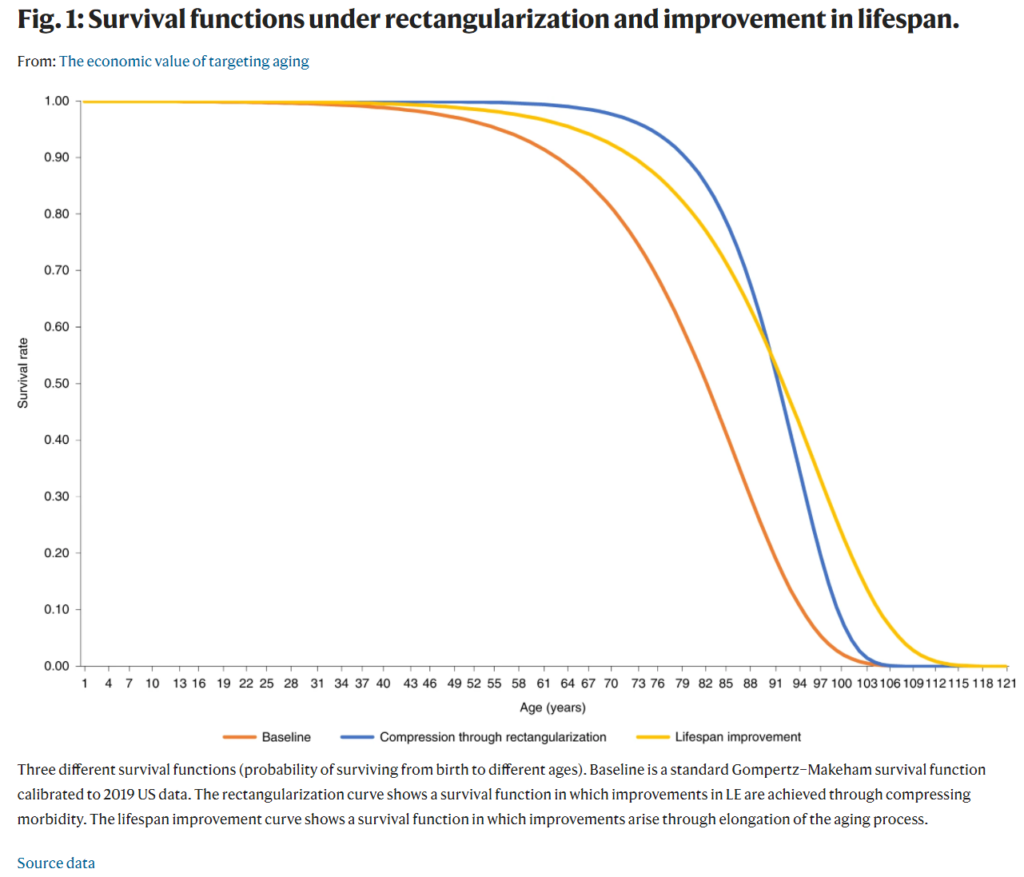
Developments in life expectancy and the growing emphasis on biological and ‘healthy’ aging raise a number of important questions for health scientists and economists alike. Is it preferable to make lives healthier by compressing morbidity, or longer by extending life? What are the gains from targeting aging itself compared to efforts to eradicate specific diseases? Here we analyze existing data to evaluate the economic value of increases in life expectancy, improvements in health and treatments that target aging. We show that a compression of morbidity that improves health is more valuable than further increases in life expectancy, and that targeting aging offers potentially larger economic gains than eradicating individual diseases. We show that a slowdown in aging that increases life expectancy by 1 year is worth US$38 trillion, and by 10 years, US$367 trillion. Ultimately, the more progress that is made in improving how we age, the greater the value of further improvements.

Author(s): Andrew J. Scott, Martin Ellison, David A. Sinclair

Publication Date: 5 July 2021

Publication Site: Nature Aging

Mortgage Rates Are Low: Why Aren’t Minority Homeowners Refinancing?

Excerpt:

The reasons behind the racial disparity in refinancing align with documented evidence about other inequities in housing, Keys said during an interview with Wharton Business Daily on SiriusXM. (Listen to the podcast above.) Structural racism built into both public policy and the private sector has led to longstanding asymmetry in income, credit scores, loan-to-value ratios and other risk factors that inhibit refinancing for minorities.

The coronavirus pandemic is exacerbating the problem, Keys said, because Black and Hispanic households are more likely to experience job loss than white households. The U.S. unemployment rate in May dropped to 5.8%, yet it was 7.3% for Hispanics and 9.1% for Blacks.

“Some of this may be a function of just measuring incomes and employment disruptions, but I think there is another factor, which is related to just how tight mortgage credit is right now,” Keys added. “Mortgage credit is perceived as being very tight. It can be a hard time to get a loan, and there are a lot of hoops to jump through when you’re refinancing.”

Author(s): Benjamin Keys interviewed on Wharton Business Daily

Publication Date: 6 July 2021

Publication Site: Knowledge @ Wharton

J&J and Delta update

Link: https://yourlocalepidemiologist.substack.com/p/j-and-j-and-delta-update

Graphic:

Excerpt:

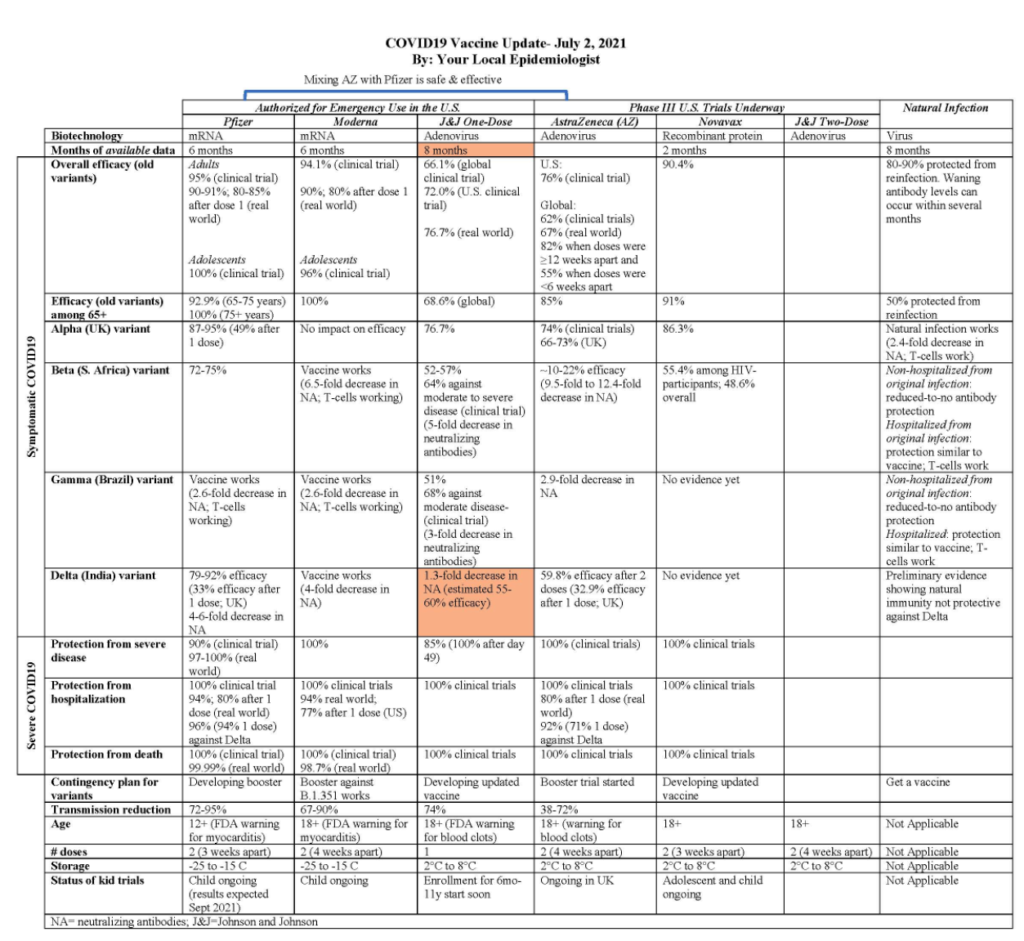
Neutralizing antibodies in a lab is difficult to map to real world efficacy. Thankfully, some scientists figured out a mathematical model (here). Using their model, this means the efficacy of J&J would be around 55-60% against symptomatic disease. It will still work well against severe disease.

In the same update, J&J said their vaccine continues to work over time, with strong responses for up to 8 months. This is because there’s only 8 months of data; we are optimistic it will last longer.

Author(s): Katelyn Jetelina

Publication Date: 2 July 2021

Publication Site: Your Local Epidemiologist on substack

U.S. Supreme Court to Hear University Pension Case

Link: https://www.insidehighered.com/quicktakes/2021/07/06/us-supreme-court-hear-university-pension-case

Excerpt:

The U.S. Supreme Court on Friday agreed to consider the appeal of Northwestern University employees who say the university mismanaged their 403(b) pension investments. The lawsuit against Northwestern was one of roughly 20 filed in 2016 charging that wealthy and prestigious universities failed to fulfill their fiduciary duty by charging unreasonable fees and offering too many investment options.

Lower federal courts sided with Northwestern in dismissing the employees’ claims, but in their appeal to the Supreme Court, lawyers for the plaintiffs argued that the federal appeals courts had issued divided rulings on key questions in similar lawsuits.

Author(s): Doug Lederman

Publication Date: 6 July 2021

Publication Site: Inside Higher Ed

Nearly a third of Gen Xers have inadequate pension savings

Link: https://www.pensions-expert.com/Investment/Nearly-a-third-of-Gen-Xers-have-inadequate-pension-savings?ct=true

Excerpt:

Almost one in three Generation Xers — individuals aged between 41 and 56 — have inadequate pension savings and face a minimum-at-best standard of living in retirement, according to research by the International Longevity Centre and Standard Life.

The ILC’s ‘Slipping between the cracks’ report found that 60 per cent of Gen Xers in a defined contribution scheme are not contributing enough for financial security or flexibility later in life, while 59 per cent of those with insufficient savings lack any other kind of income, for example property.

More than two-fifths (44 per cent) have gaps of at least 10 years in their contributions, a figure that rises to 48 per cent for women.

Author(s): Benjamin Mercer

Publication Date: 5 July 2021

Publication Site: Pensions Expert

GOP senators press TSP managers on fiduciary duty vs. ESG

Link: https://www.pionline.com/washington/gop-senators-press-tsp-managers-fiduciary-duty-vs-esg?utm_source=p-i-editor-s-pick&utm_medium=email&utm_campaign=20210702&utm_content=article3-headline&CSAuthResp=1625616942174%3A0%3A73393%3A0%3A24%3Asuccess%3AFEA86842B20E7441526766BAA1004F10#cci_r=

Excerpt:

Two Republican senators expressed concern that Thrift Savings Plan asset managers BlackRock and State Street Global Advisors are putting ESG and their CEOs’ “left-leaning” priorities ahead of their fiduciary duties when it comes to proxy voting.

In a letter Thursday to Federal Retirement Thrift Investment Board Acting Chairman David A. Jones, Sens. Pat Toomey of Pennsylvania and Ron Johnson of Wisconsin questioned the priorities of BlackRock and State Street Global Advisors, who between them manage nearly $500 billion for the $762.3 billion Thrift Savings Plan’s 6.2 million federal employees and members of the uniformed services. Of that, roughly $57 billion is managed by SSGA.

“We are concerned that BlackRock and SSGA may be prioritizing their CEOs’ personal policy views over retirees’ financial security,” the letter said.

Author(s): Hazel Bradford

Publication Date: 1 July 2021

Publication Site: Pensions & Investments

Editorial | When it comes to Illinois bond ratings, up definitely better than down

Link: https://www.news-gazette.com/opinion/editorials/editorial-when-it-comes-to-illinois-bond-ratings-up-definitely-better-than-down/article_d17d487c-5ff3-5da1-a958-60d7edd5c3e6.html

Excerpt:

Citing a “material improvement in state finances,” Moody’s Investor Services recently raised the state’s bond rating by one notch — up to Baa2 from Baa3.

Ordinary mortals won’t know what that means. But Illinois has climbed the ladder from being one notch above junk bond status to two notches.

It’s the first time Illinois’ bond rating has been raised in 20 years. The improvement comes after a steady spiral downward.

Author(s): Editorial Board

Publication Date: 4 July 2021

Publication Site: The News-Gazette

Public Pension Plans Need to Put a Year of Good Investment Returns In Perspective

Graphic:

Excerpt:

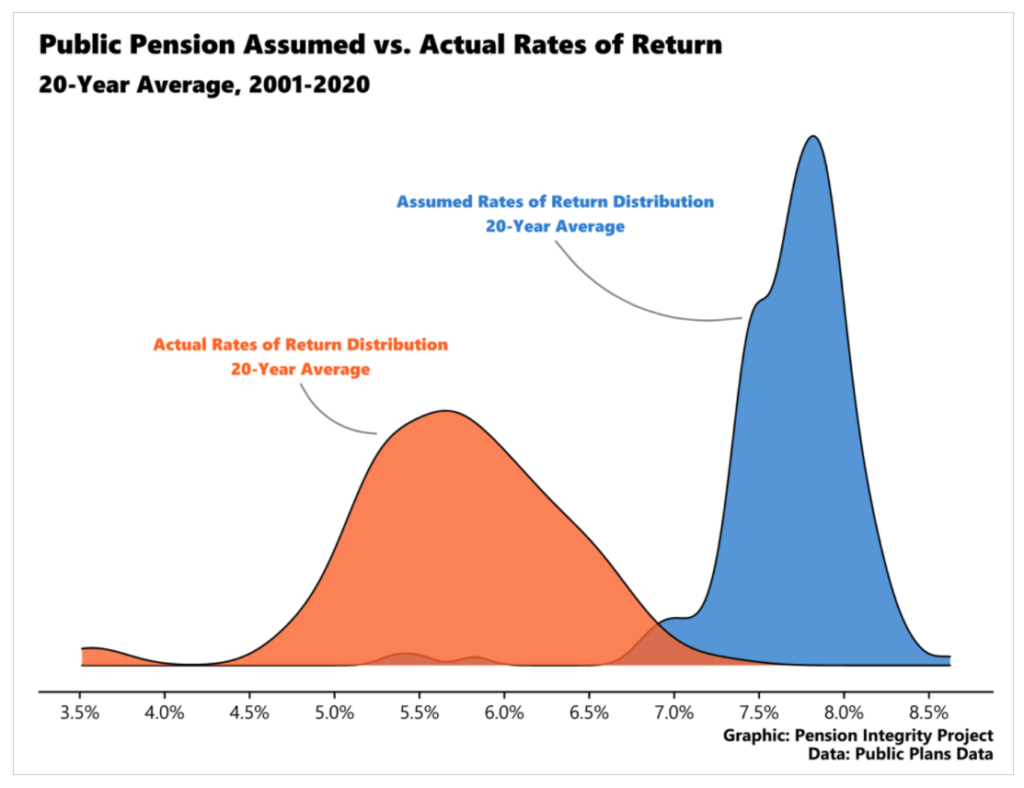
For the last 20 years, state and local pension plans’ assumed rates of return have been far too optimistic. The distributions of average (geometric mean) assumed investment returns and actual returns from 2001 to 2020 demonstrate this. The figure below shows the distribution of the average assumed investment return rate versus actual investment returns for 200 of the largest state and local pension plans in the United States. The median assumed rate of return over the last 20 years was 7.7 percent per year, the median actual rate of investment return for these public pension plans was 5.7 percent.

This two percent difference helps to explain the nearly 30 percent drop in the average pension plan funded ratio over the same period. In recent years, many pension plans lowered their assumed rates of return.

Author(s): Truong Bui, Jordan Campbell

Publication Date: 30 June 2021

Publication Site: Reason Foundation