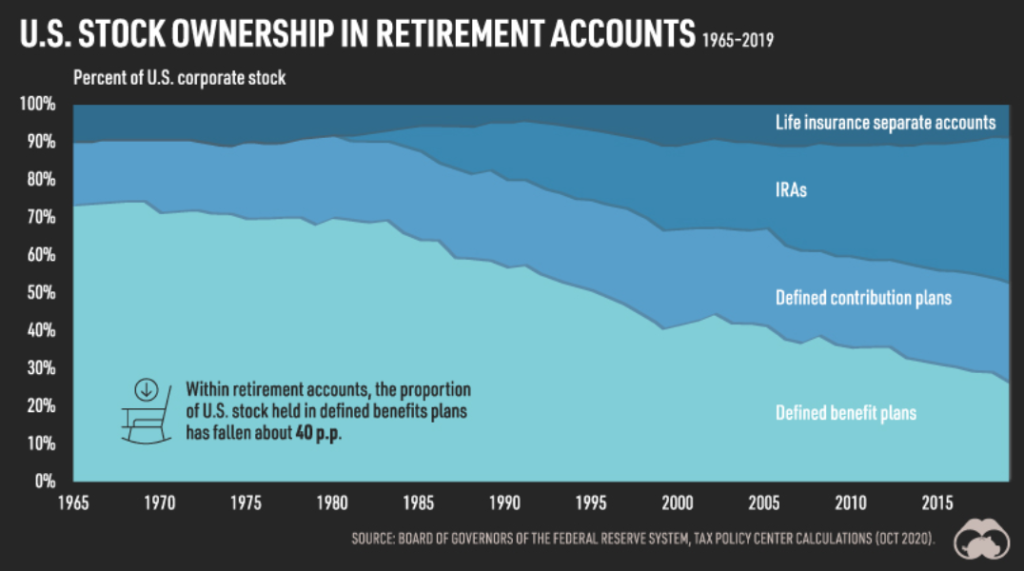
Visualizing U.S. Stock Ownership Over Time (1965-2019)

Graphic:

Excerpt:

The U.S. stock market is the largest in the world, with total U.S. stock ownership amounting to almost $40 trillion in 2019. But who owns all these equities?

In this Markets in a Minute from New York Life Investments, we show the percentage of U.S. stock owned by various groups, and how the proportions have changed over time.

Author(s): Jenna Ross

Publication Date: 31 March 2021

Publication Site: Visual Capitalism

Treasurer Muoio Announces New Jersey Has Paid the Full State-Funded Portion of the Pension Contribution for the First Time in More than 25 Years

Link: https://www.state.nj.us/treasury/news/2021/07012021.shtml

Excerpt:

State Treasurer Elizabeth Maher Muoio announced that the Treasury Department today kicked off the start of the new fiscal year by paying the full state-funded portion of the $6.9 billion pension contribution slated for Fiscal Year 2022 (FY 2022). This marks the first time in more than 25 years that New Jersey is making the full Actuarially Determined Contribution to the Pension Fund, plus an additional $505 million contribution, and also the first time in years that the state has made a lump sum payment, rather than quarterly payments.

The Treasurer also announced that by making the contribution in one lump sum, the State is now expected to save taxpayers roughly $2.2 billion over 30 years, rather than the $1.5 billion in savings initially anticipated if the state had made quarterly pension payments this year.

Publication Date: 1 July 2021

Publication Site: Dept of the Treasury, New Jersey state

Most New Jerseyans Are Fiscal Dullards

Excerpt:

That is what the Murphy administration has to believe for them to send out this piece of gripka:

….

treating $10.19 billion in Biden relief money as if it will never have to be repaid (one way or another).

Keep in mind when reading just this one excerpt below that $6.9 billion represents about six months worth of payments out of a pension system that is still accruing benefits at record levels and as of June 30, 2020 reported unfunded liabilities under GASB of $128 billion.

Author(s): John Bury

Publication Date: 2 July 2021

Publication Site: Burypensions

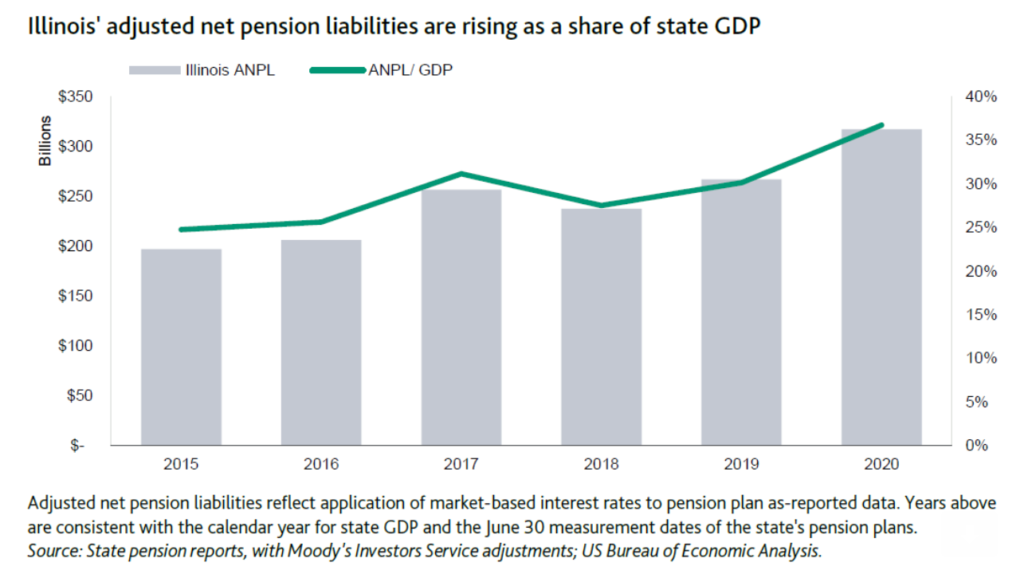
Op-ed: Illinois gets its first credit upgrade in 20 years, thanks to $138 billion in federal relief

Link: https://www.chicagotribune.com/opinion/commentary/ct-edit-illinois-credit-upgrade-federal-bailout-20210701-mccvijig6fbuzpuhmc4eorkobm-story.html

Graphic:

Excerpt:

The ratings firm Moody’s Investors Service this week upgraded Illinois’ credit rating one notch to Baa2, a level two notches above junk. It’s a major turnaround given that just one year ago Illinois faced the prospect of becoming the first state to ever be rated junk. In mid-2020, shutdowns ravaged the state’s tax base, Sen. Don Harmon asked for a $42 billion bailout from Congress and the state projected billions in multi-year budget shortfalls.

What changed so dramatically in such a short period of time? Ignore the claims by Illinois lawmakers of their heroic acts of “balanced budgets,” “fiscal discipline” and the like. Even if those claims were true – and they are not – they couldn’t by themselves create such a swing in Illinois’ short-term fortunes.

Credit, instead, the massive $138 billion in federal funds from the multiple COVID relief and stimulus packages – as compiled by the Committee for Responsible Federal Budget – that are now flooding Illinois’ public and private sectors. Those billions have significantly reduced the probability of a bond default – which is ultimately what Moody’s really cares about. 

Author(s): Ted Dabrowski, John Klingner

Publication Date: 1 July 2021

Publication Site: Chicago Tribune

Even With Federal Aid, States Slashed Spending By $4.1 Billion To Avoid Shortfalls

Link: https://www.forbes.com/sites/lizfarmer/2021/06/24/even-with-federal-aid-states-slashed-spending-by-41-billion-to-avoid-shortfalls/?sh=1a1c2ceb4a93

Graphic:

Excerpt:

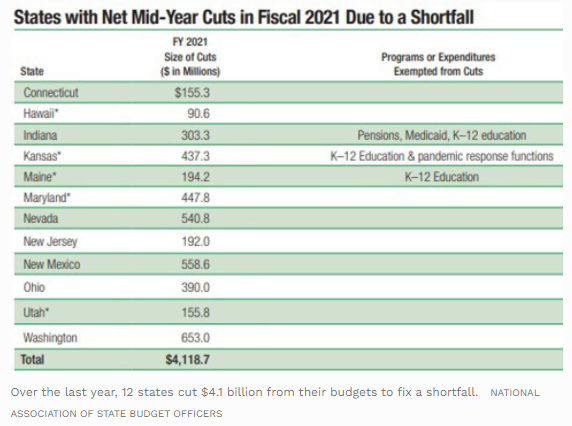
A total of 12 states had to cut a combined $4.1 billion from their budgets in order to balance out projected shortfalls before the end of their fiscal year, according to a new report released Thursday by the National Association of State Budget Officers (NASBO). (Most state fiscal years end on June 30.) Nevada, New Mexico and Washington state cut the most, accounting for 42% of the total.

Many of these states targeted staff for these cuts, including implementing hiring freezes, eliminating open positions, cutting salaries and ordering furloughs. They also turned to Medicaid, which saw more than $1 billion in combined cuts from the 12 shortfall states while higher education cuts totaled more than $500 million from the group. Washington State focused its cuts mainly on K-12 education, slashing more than $1 billion from the budget over the past year.

Author(s): Liz Farmer

Publication Date: 24 June 2021

Publication Site: Forbes

The tyranny of spreadsheets

Link: https://financialpost.com/fp-work/the-tyranny-of-spreadsheets-we-take-numbers-for-granted-until-we-run-out-of-them

Excerpt:

Somewhere in PHE’s data pipeline, someone had used the wrong Excel file format, XLS rather than the more recent XLSX. And XLS spreadsheets simply don’t have that many rows: 2 to the power of 16, about 64,000. This meant that during some automated process, cases had vanished off the bottom of the spreadsheet, and nobody had noticed.

The idea of simply running out of space to put the numbers was darkly amusing. A few weeks after the data-loss scandal, I found myself able to ask Bill Gates himself about what had happened. Gates no longer runs Microsoft, and I was interviewing him about vaccines for a BBC program called How to Vaccinate The World. But the opportunity to have a bit of fun quizzing him about XLS and XLSX was too good to pass up.

I expressed the question in the nerdiest way possible, and Gates’s response was so strait-laced I had to smile: “I guess… they overran the 64,000 limit, which is not there in the new format, so…” Well, indeed. Gates then added, “It’s good to have people double-check things, and I’m sorry that happened.”

Exactly how the outdated XLS format came to be used is unclear. PHE sent me an explanation, but it was rather vague. I didn’t understand it, so I showed it to some members of Eusprig, the European Spreadsheet Risks Group. They spend their lives analyzing what happens when spreadsheets go rogue. They’re my kind of people. But they didn’t understand what PHE had told me, either. It was all a little light on detail.

Author(s): Tim Harford

Publication Date: 29 June 2021

Publication Site: Financial Post
Moody’s upgrades Illinois’ credit rating

Link: https://capitolnewsillinois.com/NEWS/moodys-upgrades-illinois-credit-rating#new_tab

Excerpt:

Illinois received its first credit rating upgrade in 23 years on Tuesday when Moody’s Investors Services raised the state’s rating one notch, citing “material improvement in the state’s finances.”

Although the upgrade still leaves Illinois bonds rated just two notches above so-called “junk” status, Gov. JB Pritzker said it marked a turning point for the state, and he credited the General Assembly and members of his own administration for bringing greater fiscal discipline to the state’s budget.

Author(s): PETER HANCOCK

Publication Date: 29 June 2021

Publication Site: Capitol News Illinois

Mortality with Meep: U.S. Life Expectancy Fell 2.4% in 2020, and Death Rates Increased 16.1%

Link: https://marypatcampbell.substack.com/p/mortality-with-meep-us-life-expectancy

Graphic:

Excerpt:

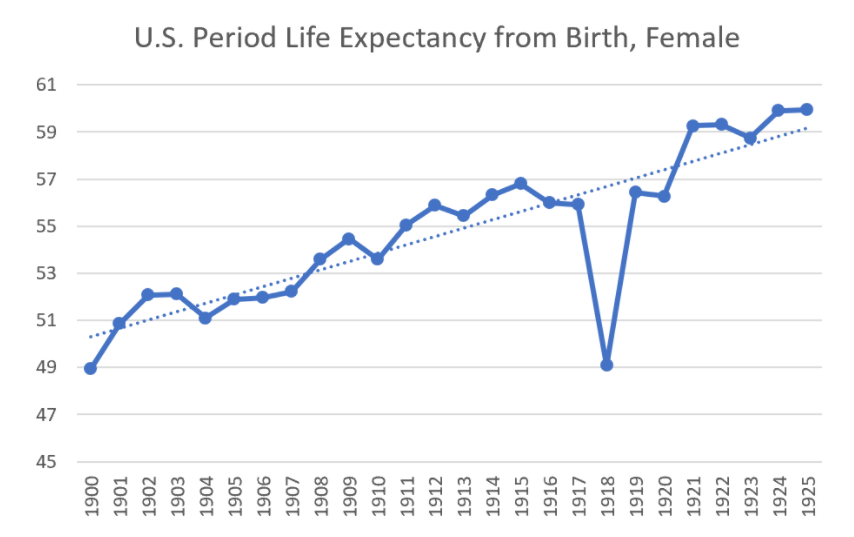
The Spanish flu pandemic gives us the demonstration of what happens when there is a short-term large increase in mortality.

Using Social Security records of period life expectancy, there was a huge drop in life expectancy in 1918…. and then a huge increase in 1919. But going from 1917 to 1919 wasn’t really that big of a difference.

The period life expectancy drop was 12% for females, 13% for males in 1918.

Then there was an increase of 15% for females, 20% for males in 1919. The Spanish flu hit the U.S. hard in 1918, and let up in 1919.

If you compare 1919 against 1917, the life expectancy from birth increase was 1% for females, and 4% increase for males — male life expectancy was down in 1917 compared to 1916, probably related to World War I.

Author(s): Mary Pat Campbell

Publication Date: 29 June 2021

Publication Site: STUMP at substack

Will Your Life Be Shortened By The Pandemic?

Link: https://www.forbes.com/sites/stevevernon/2021/06/25/will-your-life-be-shortened-by-the-pandemic/?sh=177b1c0f1952

Excerpt:

Now, because the pandemic produced higher death rates in 2020 compared to prior years, a period life expectancy calculated for 2020 produced lower life expectancies compared to period life expectancies calculated for prior years. That’s because it’s assumed that the elevated death rates we experienced in 2020 would apply to all future years. But if the death rates decline in 2021, then any period life expectancies calculated for 2021 would most likely be higher. And that’s certainly the hope, given that a large portion of the population has received a vaccine, which is already resulting in a dramatic decline in new infections and hospitalizations. 

If you’ve survived the pandemic with your health relatively intact and if you’ve also received the vaccine, then it’s highly likely the virus won’t shorten your lifespan. Of course, new deadly variants or future deadly viruses could change that conclusion, but for now, the outlook is positive.

“Cohort life expectancies” on the other hand, are calculated for a group of people reflecting their characteristics and the experience they might expect over their lifetimes. These life expectancies are calculated in the same way as period life expectancies, except that the death rates used to estimate someone’s remaining future years are modified to reflect anticipated future changes in death rates. If you want to estimate your own remaining lifespan, a cohort life expectancy is often most appropriate.

Author(s): Steve Vernon

Publication Date: 25 June 2021

Publication Site: Forbes

Delta is fast becoming the world’s dominant strain of SARS-CoV-2

Link: https://www.economist.com/graphic-detail/2021/06/29/delta-is-fast-becoming-the-worlds-dominant-strain-of-sars-cov-2

Graphic:

Excerpt:

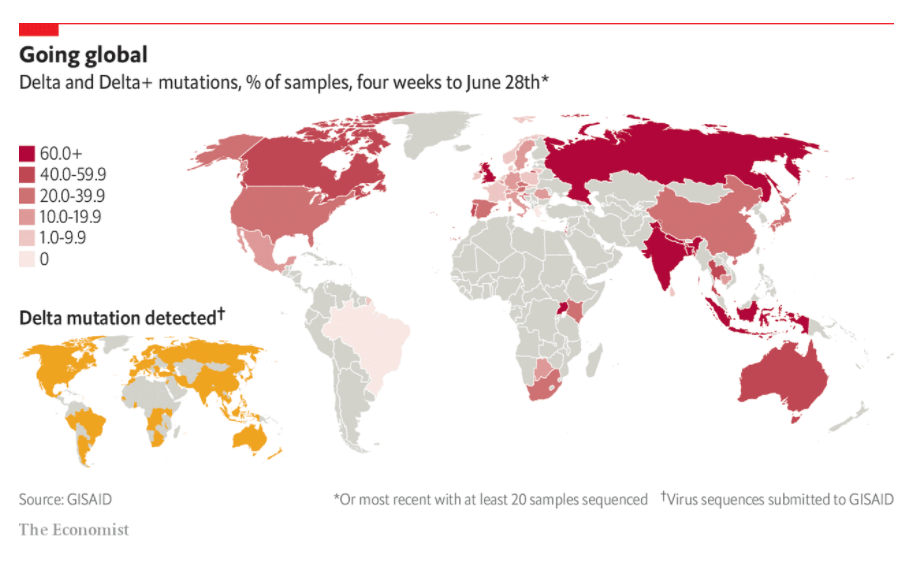
AT A PRESS conference at the White House on June 22nd Anthony Fauci, the director of America’s National Institute of Allergy and Infectious Diseases, issued a warning. The delta variant of the SARS-CoV-2 virus, first identified in India in February, was spreading in America—and quickly. “The delta variant is currently the greatest threat in the US to our attempt to eliminate covid-19,” declared Dr Fauci. Boris Johnson, Britain’s prime minister, issued a similar warning a week earlier. To contain the rapid spread of the variant, European countries and Hong Kong have tightened controls on travellers from Britain.

According to GISAID, a data-sharing initiative for corona- and influenza-virus sequences, the delta variant has been identified in 78 countries (see chart). The mutation is thought to be perhaps two or three times more transmissible than the original virus first spotted in Wuhan in China in 2019. It is rapidly gaining dominance over others. According to GISAID’s latest four-week average, it represents more than 85% of sequenced viruses in Bangladesh, Britain, India, Indonesia and Russia. It may soon be the most prevalent strain in America, France, Germany, Italy, Mexico, South Africa, Spain and Sweden. (GISAID does not, in its summary data, distinguish between delta, B.1.617.2, and the “delta plus” mutation, AY.1, AY.2.)

Publication Date: 29 June 2021

Publication Site: The Economist

Judge: Pension fund can’t claim Harvey, Illinois’ federal ARPA aid

Link: https://www.bondbuyer.com/news/judge-pension-fund-cant-claim-harvey-illinois-federal-arpa-aid

Excerpt:

A state judge refused to block distribution of Harvey, Illinois’ share of American Rescue Plan Act federal coronavirus aid relief funds after rejecting a pension fund’s claim to the money.

The financially stressed Chicago suburb, which has battled over the last decade with its public safety pension funds, Chicago, and bondholders over its obligations, settled a legal dispute in 2018 with its police and firefighters’ pension funds over past due payments. The settlement gives the funds a share of various funding that flows through the state government.

The firefighters’ fund recently sued Harvey to stake a claim to the ARPA money, arguing it is subject to the 10% claim on city tax and aid funds that are sent directly to the pension fund under the 2018 settlement. The fund asked the court to enjoin Comptroller Susana Mendoza, whose office manages the state’s pension intercept program, from distributing any funds until the case was argued.

Author(s): Yvette Shields

Publication Date: 28 June 2021

Publication Site: Bond Buyer

Seven Reasons to Be Extremely Optimistic About the Economy Right Now

Link: https://slate.com/business/2021/06/economy-optimism-inflation-wages-hiring-jobs.html?utm_source=digg&utm_medium=email

Graphic:

Excerpt:

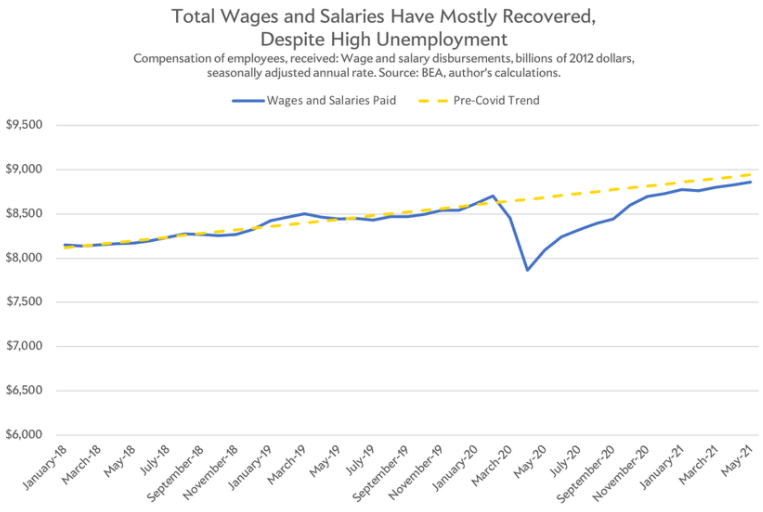
But there are good reasons to be upbeat about the answer. For starters, households saved record amounts of money while they were stuck at home in 2020, which suggests they still have pent-up spending power. Second, Americans have mostly recovered their collective earning power. Total wages and salaries quietly reached a new peak in May, and are trailing less than 1 percent behind their pre-plague trend. Pay has bounced back faster than employment, because the country’s missing jobs are largely concentrated in lower-wage service industries like hospitality.

Author(s): JORDAN WEISSMANN

Publication Date: 29 June 2021

Publication Site: Slate