The January report by former SEC Chairman Harvey Pitt lays bare deep divisions within the Public Company Accounting Oversight Board, which oversees the audits of companies valued in total at trillions of dollars.
It also alleges organizational dysfunction. There were no records documenting the rationale for several staff firings, and confusion about the roles of the PCAOB’s board members has “created some dysfunctional behavior” by them, the report found.
Current SEC Chairman Gary Gensler this month ousted William Duhnke as PCAOB chairman and is replacing the rest of the five-member board.
A PCAOB spokeswoman didn’t return a request for comment. An SEC spokesman declined to comment. Mr. Duhnke said he hasn’t seen the report and cannot comment on it.
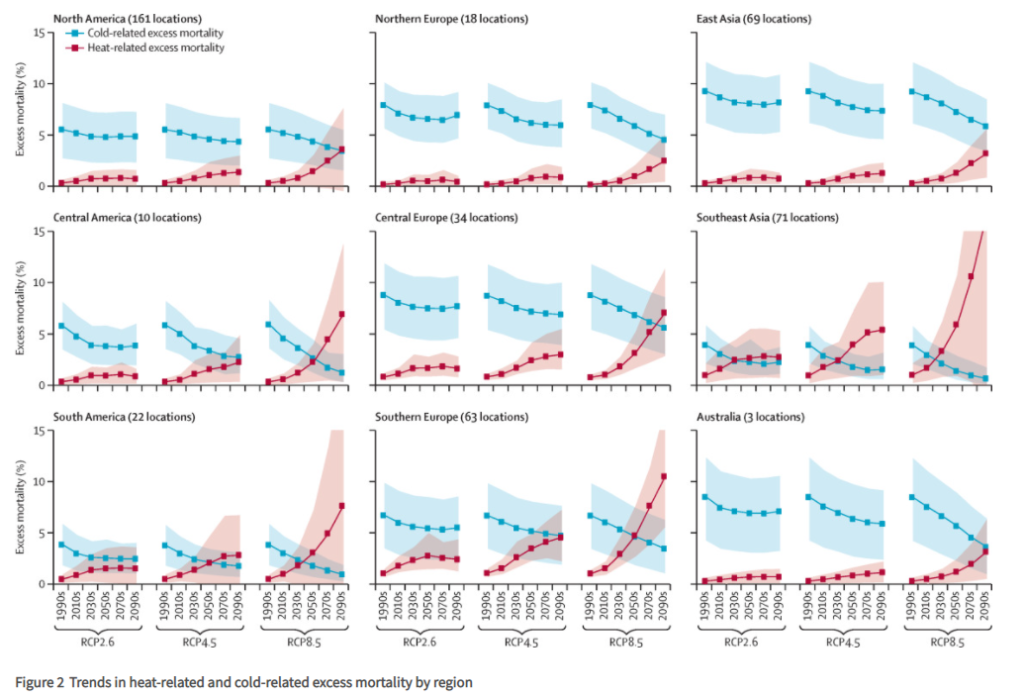
Our dataset comprised 451 locations in 23 countries across nine regions of the world, including 85 879 895 deaths. Results indicate, on average, a net increase in temperature-related excess mortality under high-emission scenarios, although with important geographical differences. In temperate areas such as northern Europe, east Asia, and Australia, the less intense warming and large decrease in cold-related excess would induce a null or marginally negative net effect, with the net change in 2090–99 compared with 2010–19 ranging from −1·2% (empirical 95% CI −3·6 to 1·4) in Australia to −0·1% (−2·1 to 1·6) in east Asia under the highest emission scenario, although the decreasing trends would reverse during the course of the century. Conversely, warmer regions, such as the central and southern parts of America or Europe, and especially southeast Asia, would experience a sharp surge in heat-related impacts and extremely large net increases, with the net change at the end of the century ranging from 3·0% (−3·0 to 9·3) in Central America to 12·7% (−4·7 to 28·1) in southeast Asia under the highest emission scenario. Most of the health effects directly due to temperature increase could be avoided under scenarios involving mitigation strategies to limit emissions and further warming of the planet.
Author(s):
Antonio Gasparrini, PhD Yuming Guo, PhD Francesco Sera, MSc Ana Maria Vicedo-Cabrera, PhD Veronika Huber, PhD Prof Shilu Tong, PhD Micheline de Sousa Zanotti Stagliorio Coelho, PhD Prof Paulo Hilario Nascimento Saldiva, PhD Eric Lavigne, PhD Patricia Matus Correa, MSc Nicolas Valdes Ortega, MSc Haidong Kan, PhD Samuel Osorio, MSc Jan Kyselý, PhD Aleš Urban, PhD Prof Jouni J K Jaakkola, PhD Niilo R I Ryti, PhD Mathilde Pascal, PhD Prof Patrick G Goodman, PhD Ariana Zeka, PhD Paola Michelozzi, MSc Matteo Scortichini, MSc Prof Masahiro Hashizume, PhD Prof Yasushi Honda, PhD Prof Magali Hurtado-Diaz, PhD Julio Cesar Cruz, MSc Xerxes Seposo, PhD Prof Ho Kim, PhD Aurelio Tobias, PhD Carmen Iñiguez, PhD Prof Bertil Forsberg, PhD Daniel Oudin Åström, PhD Martina S Ragettli, PhD Prof Yue Leon Guo, PhD Chang-fu Wu, PhD Antonella Zanobetti, PhD Prof Joel Schwartz, PhD Prof Michelle L Bell, PhD Tran Ngoc Dang, PhD Prof Dung Do Van, PhD Clare Heaviside, PhD Sotiris Vardoulakis, PhD Shakoor Hajat, PhD Prof Andy Haines, FMedSci Prof Ben Armstrong, PhD
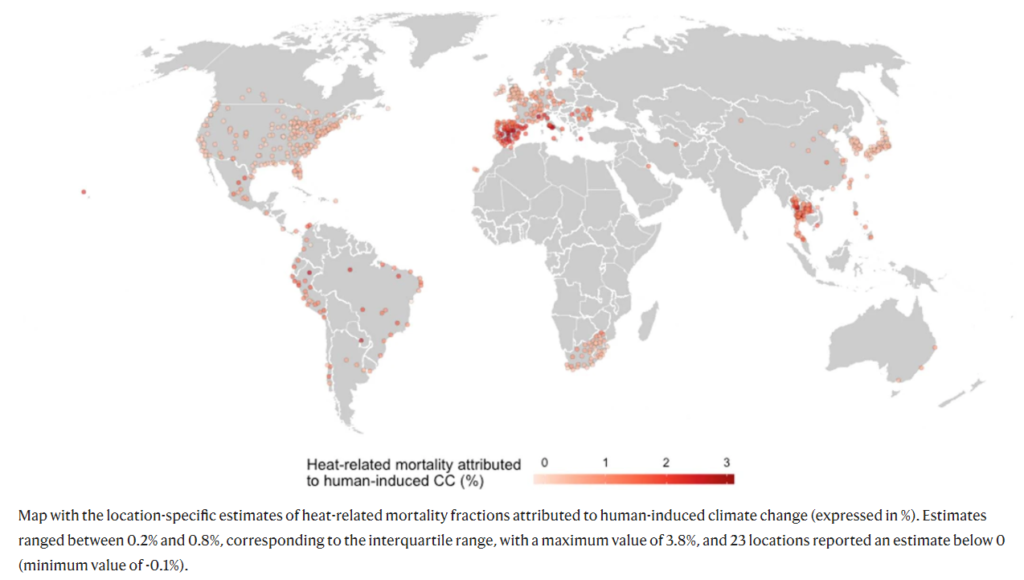
Climate change affects human health; however, there have been no large-scale, systematic efforts to quantify the heat-related human health impacts that have already occurred due to climate change. Here, we use empirical data from 732 locations in 43 countries to estimate the mortality burdens associated with the additional heat exposure that has resulted from recent human-induced warming, during the period 1991–2018. Across all study countries, we find that 37.0% (range 20.5–76.3%) of warm-season heat-related deaths can be attributed to anthropogenic climate change and that increased mortality is evident on every continent. Burdens varied geographically but were of the order of dozens to hundreds of deaths per year in many locations. Our findings support the urgent need for more ambitious mitigation and adaptation strategies to minimize the public health impacts of climate change.
Vicedo-Cabrera, A.M., Scovronick, N., Sera, F. et al. The burden of heat-related mortality attributable to recent human-induced climate change. Nat. Clim. Chang.11, 492–500 (2021). https://doi.org/10.1038/s41558-021-01058-x
Author(s): A. M. Vicedo-Cabrera, N. Scovronick, A. Gasparrini
Earlier this month, a landmark study in Nature made headlines around the world. Rising temperatures from global warming increase the number of heat deaths, now causing a third of all heat deaths, or about 100,000 deaths per year.
Obviously, this is a powerful narrative to justify urgent climate policies.
But the study left out glaring truths that even its own authors have abundantly documented. Heat deaths are declining in countries with good data, likely because of ever more air conditioning. This is abundantly clear for the US, which has seen increasing hot days since 1960 affecting a much greater population. Yet, the number of heat deaths has halved. So while global warming could result in more heat deaths, technological development in, for instance, the US, is actually resulting in fewer heat deaths.
Colorado’s Equal Pay for Equal Work Act — a set of laws aimed at ending wage discrimination, especially for women and minorities — went into effect earlier this year.
But instead of adhering to the legislation, some companies have decided to exclude Colorado-based remote employees in job listings.
Why?
The act specifies that employers hiring in Colorado must include an expected salary range and benefits in job posts. Some reports claim that companies don’t want to reveal their cards.
…..
Even if these rules are a good idea, they demand new systems and processes for any business hiring in Colorado. Many are balking, so it’s looking like a “cobra effect” law: when a well-intentioned rule backfires.
India has officially recorded more than 390,000 coronavirus deaths, but families who have lost loved ones, health experts and statisticians say that vastly undercounts the true toll. Families like Mrs. Singh’s have been left struggling to get compensation that some states have set up for Covid-19 victims.
India’s undercount has also left a huge gap in the world’s understanding of the impact of the Delta variant, which health experts believe helped drive one of the world’s worst Covid-19 surges in April and May. India was the first to detect the highly infectious variant, which has hopscotched around the world. It is fueling a surge in the U.K., and is expected to become the dominant variant in the U.S.
The undercounting of infections and deaths is a problem world-wide, even in countries with widespread testing. The World Health Organization said last month that the global Covid-19 death toll could be two or three times the official number. The problem, however, is particularly acute in the developing world, where access to healthcare and coronavirus testing is often more limited.
….. To qualify for its Covid-19 compensation payment of 400,000 rupees, equivalent to about $5,400, the state requires a report from a certified lab, which at the time were taking days to process.The family got a test strip from the lab indicating that Mrs. Singh was positive and rushed to a doctor. …… Health experts say many Covid-19 deaths have gone uncounted among India’s vast population of rural poor, who have little access to healthcare or Covid-19 testing.
Mr. Banaji, the mathematician, says the central government has tended to praise states with low death counts and castigate those with higher counts as incompetent. “This narrative of success and failure centered on fatality numbers is very dangerous,” he said.
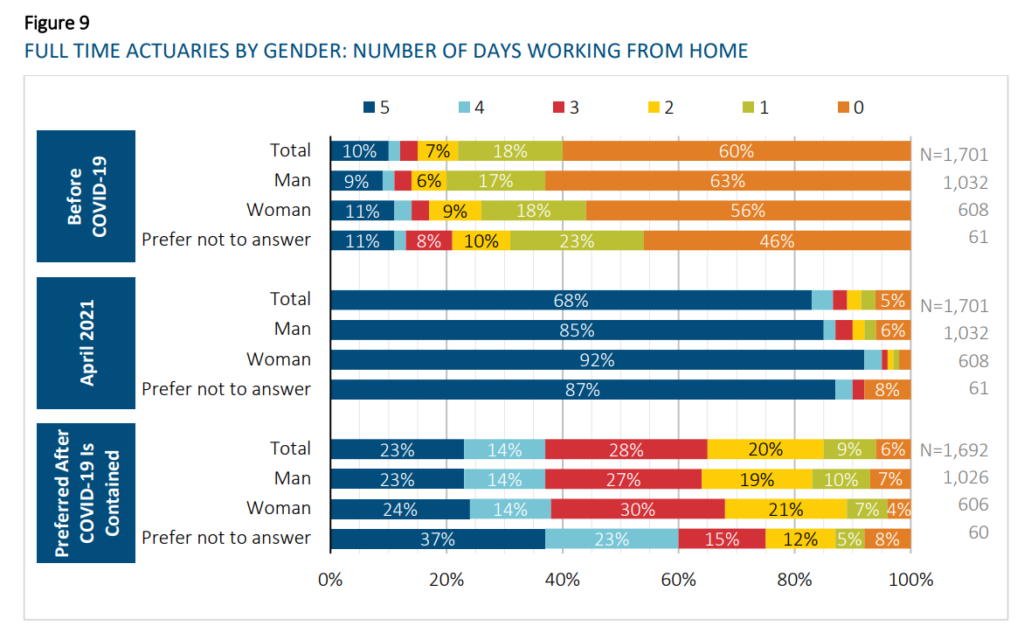
Working from home was a significant change for most actuaries. While some are looking forward to returning to work in the office, few would like to return to working in the office most or all of the time. After COVID-19 restrictions are fully lifted, approximately 65% of full-time respondents would prefer to work from home at least 3 days per week: 28% would prefer to work from home three days per week, 23% would like to work from home every day, and 14% would prefer to work from home 4 days per week.
In general, respondents who identify as women have a slight preference to work from home more frequently than do respondents who identify as men.
Since last winter, 1.8 million women have left the labor force entirely—neither working nor looking for work. At first, closed schools and the high cost of child-care options seemed responsible. But economists who have crunched the numbers argue that closed schools can’t explain higher female unemployment. Women with young children make up only 12 percent of the labor force and were only slightly more likely to leave the labor force than were women without young children. The exception? Women with young children who don’t hold college degrees—they constitute only 6 percent of the labor force but saw the biggest drop in employment. Their employment rate has fallen by almost eight percentage points since the pandemic started.
This suggests that women aren’t working for various reasons. For most families, several factors—child-care options, how much a given job will pay, and their partner’s employment prospects—determine whether they will decide to return to work. Rarely in economics does a single cause explain a phenomenon; policies often affect behavior on the margins. If you’re struggling to find good, affordable child care and you are being paid more to stay at home, that extra factor can tip the scales.
Indeed, several current policies seem to be discouraging women from returning to work.
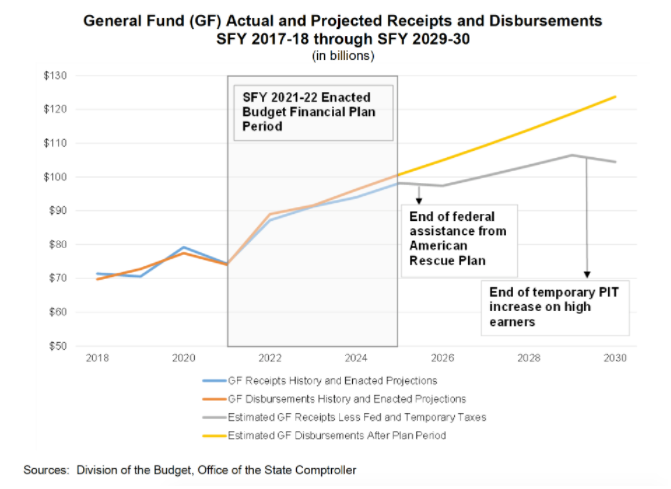
The dramatic reversal that shrank the state’s four-year budget gap from $38.7 billion in January to the current $3.4 billion occurred, incredibly, despite the Governor and legislature adopting a budget that increases state spending significantly in education and other areas. What turned the tide was a massive injection of federal aid—including $12.7 billion in no-strings federal aid awarded to the state in March under the American Rescue Plan—along with tax collections that defied earlier projections of vast, pandemic-induced revenue loss, and new tax hikes inflicted on high earners estimated to yield $2.75 billion in new revenue this year alone. As a result, the enacted budget financial plan the Governor’s budget office issued last month shows a balanced budget for this fiscal year and next. Even the red ink that starts accumulating in 2024 and 2025 looks manageable.
But looks are deceiving here. Extending the budget window—as does a chart on page nine of the Comptroller’s report, shown below—reveals large, yawning budget gaps growing from nearly $8 billion in 2026 to nearly $20 billion by the end of the decade. The dual expiration of American Rescue Plan funds in 2026 and a temporary hike in the PIT in 2027 sends the budget deep into the red.
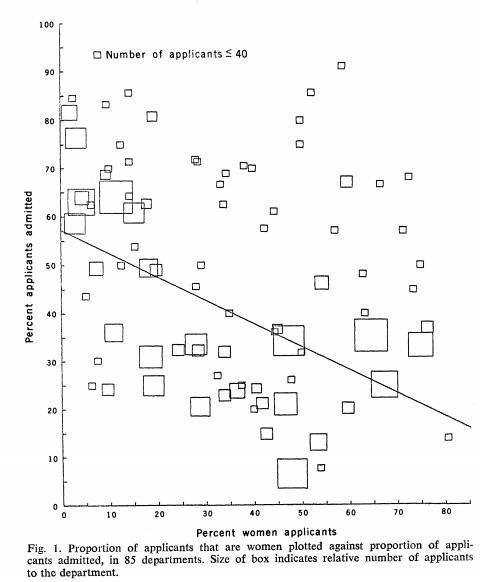
Examination of aggregate data on graduate admissions to the University of California, Berkeley, for fall 1973 shows a clear but misleading pattern of bias against female applicants. Examination of the disaggregated data reveals few decision-making units that show statistically significant departures from expected frequencies of female admissions, and about as many units appear to favor women as to favor men. If the data are properly pooled, taking into account the autonomy of departmental decision making, thus correcting for the tendency of women to apply to graduate departments that are more difficult for applicants of either sex to enter, there is a small but statistically significant bias in favor of women. The graduate departments that are easier to enter tend to be those that require more mathematics in the undergraduate preparatory curriculum. The bias in the aggregated data stems not from any pattern of discrimination on the part of admissions committees, which seem quite fair on the whole, but apparently from prior screening at earlier levels of the educational system. Women are shunted by their socialization and education toward fields of graduate study that are generally more crowded, less productive of completed degrees, and less well funded, and that frequently offer poorer professional employment prospects.
Science 07 Feb 1975: Vol. 187, Issue 4175, pp. 398-404 DOI: 10.1126/science.187.4175.398
Author(s): P. J. Bickel, E. A. Hammel, J. W. O’Connell
Life expectancy in the United States between 2018 and 2020 decreased by 1.87 years (to 76.87 years), which is 8.5 times the average decrease in other high-income nations. What’s more, decreases in life expectancy among Hispanic and non-Hispanic Black people were about two to three times greater than in the non-Hispanic White population, reversing years of progress in reducing racial and ethnic disparities. The life expectancy of Black men (67.73 years) is the lowest since 1998.
Those are key findings of a study conducted by researchers at the Virginia Commonwealth University School of Medicine, the University of Colorado Population Center and the Urban Institute in Washington, D.C., and published in The BMJ — a peer-reviewed medical trade journal of the British Medical Association.
Chan started emailing authors and journals to get the raw data she needed to more fully analyze what they had done. Making such data available is usually a condition of publication, but it can still be hard to obtain. After what she calls months of stonewalling, Chan finally lost her cool and blasted an accusation out from her browser. “I need the scientists + editors who are directly or indirectly covering up severe research integrity issues surrounding some of the key SARS-2-like viruses to stop and think for a bit,” she posted to Twitter. “If your actions obscure SARS2 origins, you’re playing a hand in the death of millions of people.”
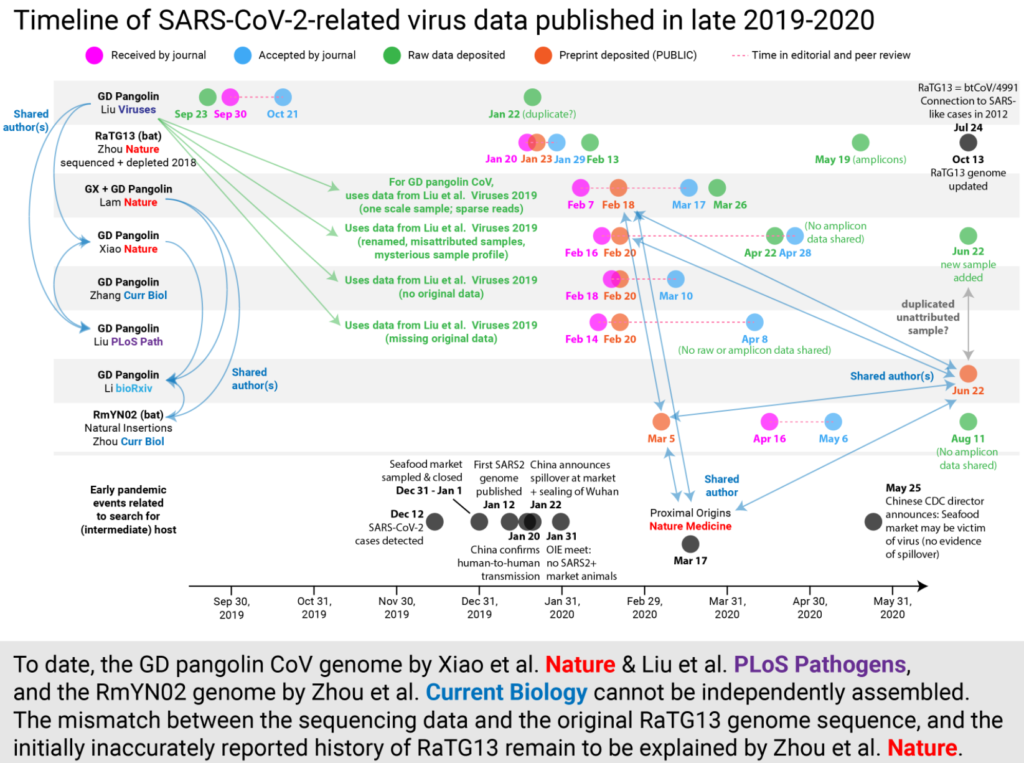
Eddie Holmes, a prominent Australian virologist and coauthor of one of those papers (as well as “Proximal Origins”), called the tweet “one of most despicable things I read on the origins issue.” He felt accused, but he wondered what he was being accused of, since his paper had correctly accounted for its pangolin data sources. Holmes then circulated an intricate time line prepared by Chan of the publication dates and past connections between the authors. The chart’s dense web of arrows and connections bore an unmistakable resemblance to an obsessive’s cork board covered with red string and thumbtacks.