A New Disease – Underwriting Without Evidence

Link: https://www.genre.com/knowledge/publications/uwfocus20-2-tiedemann-en.html

Excerpt:

As mentioned above, the selection of appropriate evidence is one of the most important steps in the derivation of evidence-based risk assessment guidelines. With little evidence available, this choice becomes easy, but the output may not always be satisfactory.

In the case of COVID‑19, it is not the lack of evidence as such, but the lack of long-term evidence that is a challenge. In contrast to this, the quantity of available short-term evidence is and has been record‑breaking.

This included numerous clinical studies. Since the beginning of the pandemic, new ones have been published seemingly almost every minute. While the quality of the studies may be good, they often look at small case counts only. In many instances, they were published in a preliminary stage to speed up the process of understanding the new disease. While this is reasonable to drive the scientific process, the level of certainty needed for decisions requires long-term evidence.

Author(s): Annika Tiedemann, Life/Health Underwriting Manager, Cologne

Publication Date: March 2021

Publication Site: Gen Re
Greensill Faces Possible Insolvency After Credit Suisse Suspends Investment Funds

Link: https://www.wsj.com/articles/credit-suisse-suspends-funds-tied-to-softbank-backed-greensill-11614599752

Excerpt:

Specialty finance firm Greensill Capital headed toward a rapid unraveling after Credit Suisse Group AG suspended $10 billion of investment funds that fueled the SoftBank Group Corp.-backed startup.

With a key source of financing frozen, Greensill appointed Grant Thornton to guide it through a possible restructuring, and it could file for insolvency, the U.K. equivalent of bankruptcy, within days, according to people familiar with the company.

….

U.K.-based Greensill is the brainchild of former Citigroup Inc. and Morgan Stanley financier Lex Greensill. Founded in 2011, Greensill specializes in an area known as supply-chain finance, a form of short-term cash advance that lets companies stretch out the time they have to pay their bills.

Greensill packages those cash advances into bondlike securities that give investors a higher return than they could get from bank deposits. Credit Suisse’s funds were a major buyer of those securities.

Author(s): Julie Steinberg, Duncan Mavin, Ben Dummett, Maureen Farrell

Publication Date: 1 March 2021

Publication Site: Wall Street Journal

Many Businesses Support a Minimum-Wage Increase—Just Not Biden’s $15-an-Hour Plan

Link: https://www.wsj.com/articles/many-businesses-support-a-minimum-wage-increasejust-not-bidens-15-an-hour-plan-11614604077

Excerpt:

Still, a higher minimum wage puts pressure on smaller businesses that can’t raise wages as easily as large companies, which can adapt by deploying labor-saving technology or modestly adjusting hours for large workforces, said Jonathan Meer, an economist at Texas A&M University.

“It’s a lot harder for Joe’s Hardware,” he said. “We should take note that Amazon — the place with no cashiers — is the one calling for a higher minimum wage.”

Fewer than 250,000 people in the nation’s workforce of 140 million last year were paid exactly the federal minimum wage, which hasn’t changed since 2009, the Labor Department said last week.

Author(s): Eric Morath and Heather Haddon

Publication Date: 1 March 2021

Publication Site: Wall Street Journal

J&J Covid-19 Vaccine Shipments Head for States

Link: https://www.wsj.com/articles/j-j-covid-19-vaccine-to-start-arriving-as-soon-as-tuesday-u-s-administration-says-11614603239

Excerpt:

The U.S. Food and Drug Administration on Saturday authorized use of the J&J vaccine. The drug company had made nearly four million doses for initial shipment. The administration said it expected about 20 million doses to be delivered by the end of March.

Distribution will be uneven early on as the company increases production, it said, meaning the bulk of the additional 16 million doses will arrive later in the month.

“We’re getting these doses out the door as soon as they’re available to ensure vaccines get into arms as quickly as possible,” a senior Biden administration official said Sunday.

Author(s): Peter Loftus and Ken Thomas

Publication Date: 1 March 2021

Publication Site: Wall Street Journal

Covid-19 Virus Studies Yield New Clues on Pandemic’s Origin

Link: https://www.wsj.com/articles/covid-19-virus-studies-yield-new-clues-on-pandemics-origin-11614594600

Excerpt:

At least four recent studies have identified coronaviruses closely related to the pandemic strain in bats and pangolins in Southeast Asia and Japan, a sign that these pathogens are more widespread than previously known and that there was ample opportunity for the virus to evolve.

Another new study suggests that a change in a single amino acid in a key component of the virus enabled or at least helped the virus become infectious in humans. Amino acids are organic compounds that form proteins.

Public-health officials say it is critical to identify the origin of the pandemic to take steps to avert future outbreaks, though it may take years to do so. These latest pieces of research add to evidence that the virus, called SARS-CoV-2, likely originated in bats and then evolved naturally to infect humans, possibly through an intermediary animal.

Author(s): Betsy McKay

Publication Date: 1 March 2021

Publication Site: Wall Street Journal

Most U.S. Treasury Yields Close Lower

Link: https://www.wsj.com/articles/u-s-treasury-yields-fall-after-notching-big-gains-last-week-11614619970

Excerpt:

Yields on most U.S. government bonds fell Monday, showing further signs of stabilizing after soaring to multi-month highs last week.

The yield on the benchmark 10-year Treasury note settled at 1.444%, according to Tradeweb, down from 1.459% Friday.

Shorter-dated yields also headed lower, in a reversal from last week when investors bet that the Federal Reserve will start raising interest rates earlier than previously anticipated in response to an expected burst of economic growth and inflation.

The five-year yield settled at 0.708%, from 0.775% Friday. Yields fall when bond prices rise.

Author(s): Sebastian Pellejero and Sam Goldfarb

Publication Date: 1 March 2021

Publication Site: Wall Street Journal

Banks in Germany Tell Customers to Take Deposits Elsewhere

Link: https://www.wsj.com/articles/banks-in-germany-tell-customers-to-take-deposits-elsewhere-11614594601?mod=djemwhatsnews

Excerpt:

Germany’s biggest lenders, Deutsche Bank AG and Commerzbank AG , have told new customers since last year to pay a 0.5% annual rate to keep large sums of money with them. The banks say they can no longer absorb the negative interest rates the European Central Bank charges them. The more customer deposits banks have, the more they have to park with the central bank.

That is creating an unusual incentive, where banks that usually want deposits as an inexpensive form of financing, are essentially telling customers to go away. Banks are even providing new online tools to help customers take their deposits elsewhere.

Banks in Europe resisted passing negative rates on to customers when the ECB first introduced them in 2014, fearing backlash. Some did it only with corporate depositors, who were less likely to complain to local politicians. The banks resorted to other ways to pass on the costs of negative rates, charging higher fees, for instance.

Author(s): Patricia Kowsmann

Publication Date: 1 March 2021

Publication Site: Wall Street Journal

Recent Judge Rakoff Decision May Curb Private Equity Leverage Abuses By Pinning Liability on Directors of Selling Company

Excerpt:

For decades, authorities and experts have tried restricting excessive borrowing by private equity investors, since it’s been repeatedly shown that they leave lots of bankruptcies in their wake. And these abuses continue because private equity looting fee structures result in general partners making out handsomely whether or not the business does well. In 1987 (no typo), the Treasury proposed limiting the deduction of interest on highly leveraged transactions. That idea went by the wayside thanks to the 1987 crash. Other proposals to restrict debt levels have similarly not gone anywhere. Yet now an important ruling looks set to deliver where regulators and legislators have failed.

The decision is related to bankruptcy ruling, In re Nine West LBO Securities Litigation, in early December. I’m late to it; several readers called it to my attention via a William S. Cohan op ed in the New York Times, The Private Equity Party Might Be Ending. It’s About Time. I think Cohan is overstating its significance; investment bankers and lawyers are prone to howling loudly about anything that might reduce the size of their meal tickets while working full bore to preserve them. But Nine West does appear likely to restrict very highly leveraged deals by pinning the liability tail for likely insolvencies on the directors and officers of the selling company.

The very short version of this story is that the directors of the selling company approved a sale transaction that they knew would saddle the company, renamed Nine West, with more debt than its own bankers had said it could support while removing its best assets. They sat pat as the buyer revised the deal to load even more borrowings on the acquisition, despite having a fiduciary “out” clause.

Author(s): Yves Smith

Publication Date:

Publication Site: naked capitalism

How does the Johnson & Johnson vaccine compare to other coronavirus vaccines? 4 questions answered

Link: https://theconversation.com/how-does-the-johnson-and-johnson-vaccine-compare-to-other-coronavirus-vaccines-4-questions-answered-155944

Excerpt:

The FDA’s analysis found that, in the U.S., the Johnson & Johnson COVID-19 vaccine was 72% effective at preventing all COVID-19 and 86% effective at preventing severe cases of the disease. While there is still a chance a vaccinated person could get sick, this suggests they would be much less likely to need hospitalization or to die from COVID-19.

A similar trial in South Africa, where a new, more contagious variant is dominant, produced similar results. Researchers found the Johnson & Johnson vaccine to be slightly less effective at preventing all illness there – 64% overall – but was still 82% effective at preventing severe disease. The FDA report also indicates that the vaccine protects against other variants from Britain and Brazil too.

Author(s): Maureen Ferran

Publication Date: 27 February 2021

Publication Site: The Conversation

What happens if bitcoin succeeds?

Link: https://voxeu.org/article/what-happens-if-bitcoin-succeeds

Excerpt:

In a week when bitcoin is setting records with a market value exceeding a trillion dollars, what would it mean if cryptocurrencies succeed? 

The only reason all the bitcoins are worth a trillion dollars is the expectation of success, as they are not very useful today. Cryptocurrencies must provide some valuable service if they are to justify their high valuation, otherwise holding bitcoin is just like collecting stamps or beanie babies – a minority activity that does not justify the current $51,000 price.

But what is the valuable service that makes bitcoin successful? 

Author(s): Jon Danielsson

Publication Date: 26 February 2021

Publication Site: Vox EU

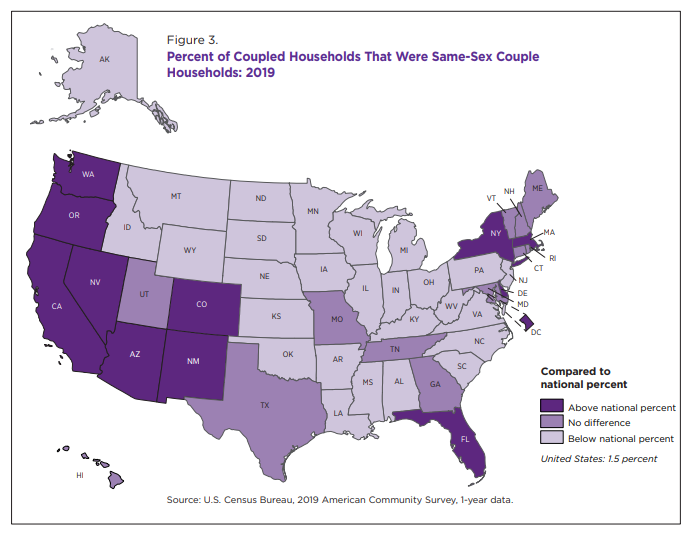
Same-Sex Couple Households: 2019

Link: https://www.census.gov/library/publications/2021/acs/acsbr-005.html

Graphic:

Excerpt:

This brief highlights the geographic distribution of same-sex couple households, and explores selected characteristics of opposite sex and same-sex couples using data from the 2019 American Community Survey. In addition, the brief examines the presence of children based on couple type.

Author(s): LAQUITTA WALKER AND DANIELLE TAYLOR

Publication Date: 23 February 2021

Publication Site: U.S. Census Bureau

Eviction Moratorium Deemed Unconstitutional by Federal Judge in Texas

Excerpt:

Judge J. Campbell Barker of the Eastern District of Texas, sided with plaintiffs who challenged the CDC’s eviction moratorium on Constitutional grounds. We’ve embedded the opinion for Terkel v. Centers for Disease Control and Prevention at the end of this post. Even though some will be inclined to dismiss the ruling as politically-motivated (Barker was a Trump nominee), recall that it was the Trump Administration that first launched the eviction freeze. It initially ran through December 31, and covered tenants who gave their landlord a declaration attesting that the made less than $100,000 a year, had suffered a large hit to their income, were seeking assistance and would pay as much rent as they could. The Biden Administration planned to extend the moratorium to the end of March.

Bear in mind that the eviction halt dumped the cost of keeping coronavirus-whacked workers housed on landlords, rather than having the government provide income or rental subsidies.

Before we turn to the reasoning of the ruling, keep in mind that Judge Barker did not issue an injunction against the CDC’s moratorium, since the CDC apparently made noises at trial that they’d withdraw the moratorium if they lost. However, Barker told the plaintiffs they could come back and seek an injunction if the CDC didn’t play nice. There is no indication yet as to whether the Administration will appeal.

Author(s): Yves Smith

Publication Date: 26 February 2021

Publication Site: naked capitalism