Group files records requests for Michigan school, state employee pension information

Link: https://www.lansingstatejournal.com/story/news/2021/03/02/two-transparency-groups-seek-salary-pension-information-michigan-workers/6834356002/

Excerpt:

Sain and other Michigan public school retirees who are part of the state pension system were notified this week their names and pension information were released through the Freedom of Information Act request, Department of Technology, Management and Budget spokesperson Caleb Buhs said in an email. 

Steven Schupbach, who works for the Illinois nonprofit American Transparency, which tracks government spending, asked for retired public school workers’ first and last names, middle initials, residential zip codes, last employer zip code and monthly payment amount. 

Author(s): Carol Thompson

Publication Date: 1 March 2021

Publication Site: Lansing State Journal

‘Markets Are Wrong’: $2 Trillion of Pension Funds Skip Bond Rout

Link: https://finance.yahoo.com/news/markets-wrong-2-trillion-pension-065920871.html

Graphic:

Excerpt:

As interest-rate jitters supercharged a meltdown in the world’s biggest bond market, Sam Sicilia barely blinked.

“The markets are wrong” about inflation expectations, said Sicilia, chief investment officer of the A$56 billion ($43 billion) Host-Plus Pty pension fund in Melbourne. “Deflationary forces are bigger. Interest rates are going to stay at effectively zero.”

With governments around the globe still adding to trillions of dollars of stimulus to ride out the pandemic, pension fund managers who are trying to discern the long-term effects are posing the question: Will inflation make a comeback? If it does, more than $46 trillion of global pension assets would be affected as central banks pivoted toward sustained higher interest rates.

Author(s): Ruth Carson, Matthew Burgess

Publication Date: 1 March 2021

Publication Site: Yahoo Finance

A look at NJ’s budget proposal: Taxes, schools, pension

Link: https://www.inquirer.com/wires/ap/look-njs-budget-proposal-taxes-schools-pension-20210301.html

Excerpt:

New Jersey Gov. Phil Murphy’s $44.8 billion budget proposal, unveiled last week, is a boon for labor and public sector pensioners, thousands of middle class residents and schools across the state.

….

New Jersey’s public worker pension plan has been underfunded for decades, but lawmakers and former Gov. Chris Christie began a ramped-up payment plan. Murphy wants to supercharge that plan and reach full payment a year early under the budget.

The payment would climb by $1.6 billion over the current fiscal year. The payment doesn’t translate to a boost in pensions for retirees. But it meets what actuaries have determined is the amount the state must pay to carry its share of the cost of pension payments to hundreds of thousands of retirees.

Author(s): Mike Catalini

Publication Date: 1 March 2021

Publication Site: Philadelphia Inquirer

Senate Rules-Keeper OKs Pension, Health Items: Stimulus Update

Link: https://finance.yahoo.com/news/senate-rules-keeper-oks-pension-014128087.html

Excerpt:

The Senate parliamentarian approved provisions in Joe Biden’s $1.9 trillion pandemic-relief bill aiding multi-employer pensions and providing laid-off workers with health-care premium subsidies.

….

Senate parliamentarian Elizabeth MacDonough has found that provisions bailing out multi-employer pensions and providing laid-off workers with health-care premium subsidies are eligible for the simple-majority process Democrats are using to pass the pandemic-relief bill.

“This economic crisis has hit already struggling pension plans like a wrecking ball, and the retirement security of millions of American workers depends on getting this package across the finish line,” Senate Finance Chair Ron Wyden said in a statement after his office said the parliamentarian made the two approvals.

Author(s): Bloomberg News

Publication Date: 1 March 2021

Publication Site: Yahoo Finance

Pension Crisis Is Challenge DOL Nominee Is Positioned to Handle

Link: https://news.bloomberglaw.com/daily-labor-report/pension-crisis-is-challenge-dol-nominee-is-positioned-to-handle

Excerpt:

Boston Mayor Marty Walsh has vowed to work with both parties as Labor Department secretary to address the hundreds of underfunded multiemployer pension plans in the U.S. that are now in danger of collapsing.

The big problem standing in his way? Congress has that power, not the U.S. Labor Department, according to labor attorneys and industry insiders. Which means that if Walsh is confirmed by the full Senate for the Cabinet spot, the two-term mayor will have to rely on his organized-labor background and a unique propensity to bridge divides and broker deals outside DOL’s scope to help rescue the tapped-out plans.

“The thing that is going to be pretty neat about going in to see Secretary Walsh is you’re not going to spend the first 20 minutes trying to explain what the heck a multiemployer pension plan is,” said Timothy Lynch, a senior director at Morgan Lewis in Washington who testified in 2018 before the now-defunct Joint Select Committee on the Solvency of Multiemployer Pension Plans.

Author(s): Austin R. Ramsey

Publication Date: 1 March 2021

Publication Site: Bloomberg Law

The COVID-19 Pandemic—An Opportune Time to Update Medical Licensing

Link: https://jamanetwork.com/journals/jamainternalmedicine/fullarticle/2775345?guestAccessKey=759005fe-3396-4df8-b388-110fefb7e499&utm_source=silverchair&utm_medium=email&utm_campaign=article_alert-jamainternalmedicine&utm_content=etoc&utm_term=030121

Excerpt:

Congress could regulate telemedicine across state lines as interstate commerce and establish the “place of service” of a telehealth visit as the location of the clinician, not the location of the patient.5 This definition would allow physicians to provide telehealth services if licensed by the state from which they would conduct telehealth visits. Such legislative action would not override state licensure or insurance regulations but would increase access to telehealth services by removing state licensing as a barrier.

State-based medical licensing is inherently linked to state-based consumer protection, including oversight by state licensing boards and the recourse of malpractice litigation in state courts. Therefore, if telemedicine were regulated as interstate commerce, Congress would need to provide a framework for consumer protections, in particular to guard against states protecting the interests of in-state physicians against claims from out-of-state telehealth patients. For example, Congress could decide that a physician’s home state medical board would be responsible for disciplinary investigations, while the state in which the patient lives would be the jurisdiction for malpractice litigation.

Author(s): Samyukta Mullangi, MD, MBA; Mohit Agrawal, MS, MBA; Kevin Schulman, MD

Publication Date: 13 January 2021

Publication Site: JAMA

Number Needed to Treat (NNT): Just Another Magic Number?

Link: https://towardsdatascience.com/number-needed-to-treat-nnt-7950d84acc8f

Excerpt:

Nomograms are a trending term in evidence-based medicine, and COVID-19 research is no exception. In this context, a nomogram is usually a web-based tool, a graphic interface, or an on-line calculator in which patient data on several variables is entered as input, and a single summary statistic is calculated as output, such as the likelihood of successful response to treatment. Many medical researchers and data scientists have put forward nomograms derived from multivariate clinical progression models, to assist in decisions about COVID-19 triage.

Is this enthusiasm for reducing complex clinical decisions to the use of multivariate calculators a leap forward in personalized medicine, enabled by modern computing? There is a sketchy “black box” side to all this, to say nothing of the risk of incorporating statistical design errors or untenable inferential claims into a nomogram being rolled out for immediate, untested use in the middle of pandemic. So let’s treat the history of the “number needed to treat” as a “teachable moment” in the history of nomograms in medicine. What have we learned so far?

Author(s): Savanna Reid

Publication Date: 26 February 2021

Publication Site: Towards Data Science

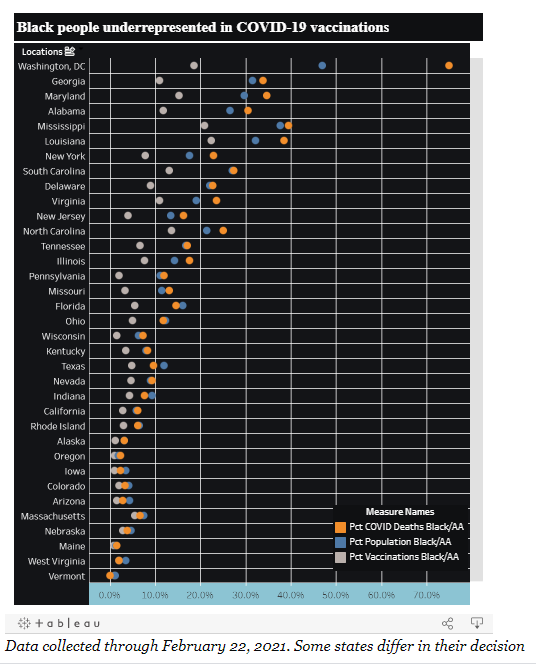
Black Health in America: Exploring Racial Disparities in COVID-19 Vaccination Data

Link: https://blog.d4bl.org/racial-disparities-in-covid19-vaccination-data/

Graphic:

Excerpt:

Below is a chart containing data from a number of states and Washington, D.C. to help visualize the gap between how many Black people are dying from COVID-19 and how many are receiving the vaccine. U.S. states and the percentages of Black people are respectively on the y- and x-axes. For each location, there are 3 data points:

Percent of State’s Black Population (Pct Population Black/AA): How many residents of the state identify as Black/African-American. Displayed as the blue dot.

Percent of State’s Vaccinated Population that are Black (Pct Vaccinations Black/AA): How many residents of the state have received at least one vaccine dose and identify as Black/African-American. Displayed as the gray dot.

Percent of State’s COVID-19 Deaths that are Black (Pct COVID Deaths Black/AA): How many residents of the state who died from COVID-19 identified as Black/African-American. Displayed as the orange dot.

Author(s): Paul Watkins

Publication Date: 25 February 2021

Publication Site: Data for Black Lives Blog

Lawmakers Want to Be More Careful With Pension Funds

Link: https://www.mackinac.org/lawmakers-want-to-be-more-careful-with-pension-funds

Excerpt:

One of the most important assumptions built into pensions is the guess at how much investments will grow over time. If investments provide high returns, then lawmakers don’t need to set aside as much money today to pay for pensions to be paid out in the future. If investments do not return as much as assumed, a gap develops between what has been promised and what has been saved. The bills cap the rate at which administrators can assume their investments will grow, allowing them to be no more risky than current policy allows. They also let administrators use less risky assumptions if they think it is prudent.

This is a smart approach. Much of the current pension debt exists because administrators overestimated investment returns. Taxpayers now owe more to the pensioners than they do to the lenders and bondholders who willingly lent the state money. Putting a cap on the assumptions administrators make can prevent future pension debt.

Author(s): James M. Hohman

Publication Date: 1 March 2021

Publication Site: Mackinac Center for Public Policy

Tensions over vaccine equity pit rural against urban America

Link: https://nypost.com/2021/03/01/tensions-over-vaccine-equity-pit-rural-against-urban-america/

Excerpt:

The U.S. vaccine campaign has heightened tensions between rural and urban America, where from Oregon to Tennessee to upstate New York complaints are surfacing of a real — or perceived — inequity in vaccine allocation.

In some cases, recriminations over how scarce vaccines are distributed have taken on partisan tones, with rural Republican lawmakers in Democrat-led states complaining of “picking winners and losers,” and urbanites traveling hours to rural GOP-leaning communities to score COVID-19 shots when there are none in their city.

In Oregon, state GOP lawmakers walked out of a Legislative session last week over the Democratic governor’s vaccine plans, citing rural vaccine distribution among their concerns. In upstate New York, public health officials in rural counties have complained of disparities in vaccine allocation and in North Carolina, rural lawmakers say too many doses were going to mass vaccine centers in big cities.

Author(s): Associated Press

Publication Date: 1 March 2021

Publication Site: NY Post

CalSTRS Aims for New $2 Billion Sustainable Portfolio

Link: https://www.ai-cio.com/news/calstrs-aims-new-2-billion-sustainable-portfolio/

Excerpt:

The California State Teachers’ Retirement System (CalSTRS) plans to build a private markets sustainable investment portfolio to go greener while aiming to maintain its investment returns.

The investment committee of the $282.5 billion pension system, the largest teachers’ retirement fund in the world, is expected to approve the new portfolio at its meetings next week. 

The pension system’s plan calls for investments of $1 billion to $2 billion in the next couple of years—much of it in real estate affordable housing investments, as well as in private equity and infrastructure—according to CalSTRS investment committee material. 

Author(s): Randy Diamond

Publication Date: 24 February 2021

Publication Site: ai-CIO

Wisconsin Treasurer Recommends Creating State-Run Retirement Plan

Link: https://www.ai-cio.com/news/wisconsin-treasurer-recommends-creating-state-run-retirement-plan/

Excerpt:

A task force headed by Wisconsin’s state treasurer has recommended that Wisconsin establish a state-run program that provides a retirement benefit plan for employers that don’t offer one.

The task force, which was created by Wisconsin Gov. Tony Evers in 2019, issued a report outlining the causes of the state’s “retirement security crisis” and provided several recommendations it said would strengthen the financial security of Wisconsin’s retirees.

“Wisconsin is in trouble when it comes to retirement security,” the task force’s report began ominously. “Even before the COVID-19 pandemic, our retirement system was not working for a significant number of Wisconsin workers.”

Author(s): Michael Katz

Publication Date: 24 February 2021

Publication Site: ai-CIO