PFRS Boost & NJ Active Update – December, 2020

Excerpt:

This is a good time to review who will be impacted as state pension data on active participants in the retirement system has just been updated through December, 2020. There are no dates of birth so it is impossible to get an accurate count as some of those members who have between 18 and 25 years of service may already be age 55 but here is my cost estimate anyway.

All PFRS members: 40,532 with average salary of $96,364

Already with 25 years of service: 3,252 with average salary of $143,156

18 to 25 years of service: 10,543 with average salary of $118,750

If half of those eligible decide to retiree on their 50% pension for an extra 3.5 years that would come to an extra billion dollars coming out of the retirement system which is about double what the OLS estimated as the maximum.

Author(s): John Bury

Publication Date: 2 March 2021

Publication Site: Burypensions

The trillion dollar upside to longevity

Graphic:

Excerpt:

This model allowed the researchers to place a monetary value on the financial gain from longer life, better health and changes in the rate at which we age [4,5]. VSL represents the sum of the value of each remaining year of life, discounted to the present day and weighted by the survival rate.

The study revealed that a compression of morbidity that improves health is more valuable than further increases in life expectancy. However, in order to raise economic gains, longevity has to improve too. Slowing down aging reduces the rate at which biological damage occurs and improves both health and mortality.

Publication Date: 16 February 2021

Publication Site: Longevity Technology

All’s Well That Ages Well: The Economic Value of Targeting Aging

Link: https://longevitydividend.london.edu/wp-content/uploads/2021/01/allswell_080121.pdf

Graphic:

Excerpt:

Human lifespans are increasing with advances in medicine, but the economic value of these gains are poorly understood. Based on U.S. data, we show a compression of morbidity that improves health
is more valuable than further increases in life expectancy. However, economic gains to better health diminish unless longevity also improves. Treatments that target aging are hence particularly valuable,
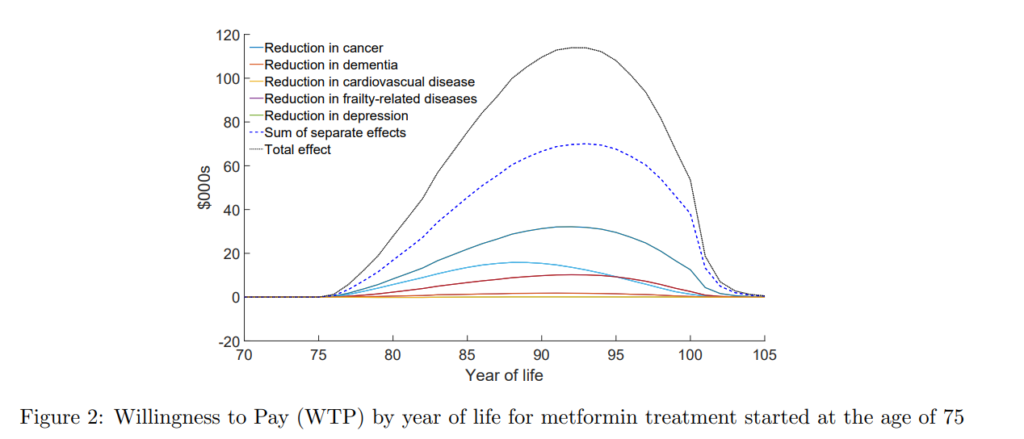
as they produce both healthier and longer lives. We calculate a slowdown in aging that increases life expectancy by one year is worth $38 trillion, and for ten years $367 trillion. Evaluating the impact
of metformin shows targeting aging offers potentially larger economic gains than eradicating individual diseases. Complementarities between health, longevity and age lead to a virtuous circle that means
improvements in aging increase the value of further gains. Aligned with trends in demographics and disease, this implies the gains from age targeting treatments will increase further in the decades ahead.

Author(s): Martin Ellison, Andrew J. Scott, David A. Sinclair

Publication Date: 8 January 2021

Publication Site: London Business School

Economic Research on Treating Aging to Extend Healthy Longevity

Link: https://www.fightaging.org/archives/2021/02/economic-research-on-treating-aging-to-extend-healthy-longevity/

Excerpt:

In one sense, there is an enormous wealth of research on the economics of longer lives. This is a byproduct of the operations of sizable pensions and life insurance industries, dependent as they are on successfully predicting future trends in life span. On the other hand, outside this somewhat narrow scope, most concerned with the gain of a tenth of a year here and the loss of a tenth of a year there, there is comparatively little economic work that is directly tied to the research and advocacy communities engaged in trying to treat aging and greatly lengthen healthy human lifespan. That will change as the longevity industry both grows and succeeds in introducing age-slowing and rejuvenating therapies into the clinic.

The paper and commentary that I point out today might be taken as a sample of what lies ahead for the economics profession. At least some economists are at present managing to convince grant-awarding bodies in their field that, yes, there is real movement towards the treatment of aging, and perhaps someone should look into how that will likely play out in markets and societies. It should come as no great surprise to the audience here that even modest gains in slowing or reversing aging have vast economic benefits when they occur across an entire population. The cost of coping with aging is vast, the cost of incapacity and lost knowledge and death due to aging equally vast. It is by far the biggest and most pressing issue that faces humanity, and now we enter an era in which we can finally start to do something about it.

Publication Date: 24 February 2021

Publication Site: Fight Aging

Virus Did Not Bring Financial Rout That Many States Feared

Link: https://www.nytimes.com/2021/03/01/business/covid-state-tax-revenue.html

Graphic:

Excerpt:

Throughout the debate over stimulus measures, one question has repeatedly brought gridlock in Washington: Should the states get no-strings federal aid?

Republicans have mostly said no, casting it as a bailout for spendthrift blue states. Democrats have argued the opposite, saying that states face dire fiscal consequences without aid, and included $350 billion in relief for state and local governments in President Biden’s $1.9 trillion federal stimulus bill, which narrowly passed the House this past weekend. It faces a much tougher fight in the Senate.

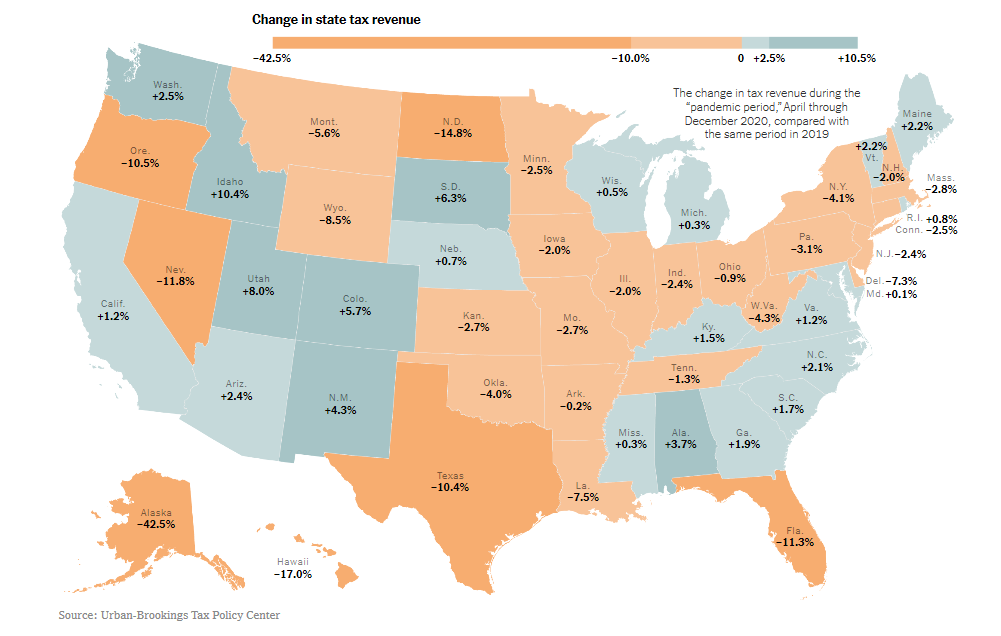
As it turns out, new data shows that a year after the pandemic wrought economic devastation around the country, forcing states to revise their revenue forecasts and prepare for the worst, for many the worst didn’t come. One big reason: $600-a-week federal supplements that allowed people to keep spending — and states to keep collecting sales tax revenue — even when they were jobless, along with the usual state unemployment benefits.

Author(s): Mary Williams Walsh, Karl Russell

Publication Date: 1 March 2021

Publication Site: New York Times

Israel’s “green pass” is an early vision of how we leave lockdown

Link: https://www.technologyreview.com/2021/03/01/1020154/israels-green-pass-is-an-early-vision-of-how-we-leave-lockdown/

Excerpt:

Israel’s vaccine passport was released on February 21, to help the country emerge from a month-long lockdown. Vaccinated people can download an app that displays their “green pass” when they are asked to show it. The app can also display proof that someone has recovered from covid-19. (Many proposed passport systems offer multiple ways to show you are not a danger, such as proof of a recent negative test. The Israeli government says that option will come to the app soon, which will be especially useful for children too young to receive an approved vaccine.) Officials hope the benefits of the green pass will encourage vaccination among Israelis who have been hesitant, many of whom are young. 

“People who get vaccinated need to know that something has changed for them, that they can ease up,” says Nadav Eyal, a prominent television journalist. “People want to know that they can have some normalcy back.”

Author(s): Cat Ferguson, Joshua Mitnick

Publication Date: 1 March 2021

Publication Site: MIT Technology Review

UK finds vaccines 80% effective at preventing hospitalisations in over-80s

Link: https://www.reuters.com/article/uk-health-coronavirus-britain-vaccines/uk-finds-vaccines-80-effective-at-preventing-hospitalisations-in-over-80s-idUSKCN2AT38I

Excerpt:

The Pfizer and AstraZeneca vaccines are more than 80% effective at preventing hospitalisations from COVID-19 in those over 80 after one dose of either shot, Public Health England (PHE) said on Monday, citing a pre-print study.

Author(s): Alistair Smout

Publication Date: 2 March 2021

Publication Site: Reuters

Recovering from the SolarWinds hack could take 18 months

Link: https://www.technologyreview.com/2021/03/02/1020166/solarwinds-brandon-wales-hack-recovery-18-months/

Excerpt:

Brandon Wales, the acting director of CISA, the US Cybersecurity and Infrastructure Agency, says that it will be well into 2022 before officials have fully secured the government networks compromised by Russian hackers. The list includes at least nine federal agencies, including the Department of Homeland Security and the State Department. Even fully understanding the extent of the damage will take months.

“I wouldn’t call this simple,” Wales says. “There are two phases for response to this incident. There is the short-term remediation effort, where we look to remove the adversary from the network, shutting down accounts they control, and shutting down entry points the adversary used to access networks. But given the amount of time they were inside these networks—months—strategic recovery will take time.”

Author(s): Patrick Howell O’Neill

Publication Date: 2 March 2021

Publication Site: MIT Technology Review

Florida Filters Public COVID Data While Virus Takes a Toll

Link: https://www.governing.com/now/Florida-Filters-Public-COVID-Data-While-Virus-Takes-a-Toll.html

Excerpt:

Most of the public isn’t worried about people testing negative for COVID-19, but for researchers that data is an essential tool to understanding the path of the virus as it courses through Florida, killing more than 30,000 and infecting more than 1.9 million people.

“They’re definitely not releasing everything,” Hladish said last week. “It has a huge impact on scientists’ ability to understand what’s going on.”

The Herald/ Times interviewed more than two dozen researchers, journalists and legislators about their experience with open records in the last year and the common conclusion was: Florida health officials are reluctant to release new data related to COVID-19 that contradicts the governor’s upbeat narrative and they frequently withhold information until they are either threatened with a lawsuit, or convinced the trend lines have improved. (See: Timeline of Florida’s Dark Year for Sunshine.)

Author(s): MARY ELLEN KLAS, THE MIAMI HERALD

Publication Date: 1 March 2021

Publication Site: Governing

“They Can’t Hold The Nursing Homes Responsible”

Link: https://www.dailyposter.com/p/they-cant-hold-the-nursing-homes

Excerpt:

Attorneys insist nursing home negligence cases are not designed to target nursing home employees and other frontline workers caring for facility residents during the pandemic. As Mosher notes, “In most cases, these people are just as much victims as the residents.” 

Instead, the lawsuits are going after nursing home owners and operators, a population that has become increasingly dominated by private equity firms, shell companies, and other secretive for-profit operations, which make staffing and other decisions about quality of care in boardrooms and corporate offices far removed from those who are impacted.

The results of these cases are not about simply scoring million-dollar settlements and padding lawyers’ pockets, say legal experts. Torts and class action suits are an important deterrent to bad behaviors in an industry that has become known for lax oversight. 

Author(s): Joel Warner

Publication Date: 2 March 2021

Publication Site: The Daily Poster

CVS, Walgreens Look for Big Data Reward From Covid-19 Vaccinations

Link: https://www.wsj.com/articles/cvs-walgreens-look-for-big-data-reward-from-covid-19-vaccinations-11614681180?mod=djemwhatsnews

Excerpt:

Administering Covid-19 vaccines comes with a valuable perk for retail pharmacies: access to troves of consumer data.

Chains such as CVS Health Corp., Walmart Inc. and Walgreens-Boots Alliance, Inc. are collecting data from millions of customers as they sign up for shots, enrolling them in patient systems and having recipients register customer profiles.

The retailers say they are using the information to promote their stores and services, tailor marketing and keep in touch with consumers. The companies also say the information is critical in streamlining vaccinations and improving record-keeping, while ensuring only qualified people are receiving shots.

Author(s): Sharon Terlep

Publication Date: 2 March 2021

Publication Site: Wall Street Journal

A Letter Sealed for Centuries Has Been Read—Without Even Opening It

Link: https://www.wsj.com/articles/a-letter-sealed-for-centuries-has-been-readwithout-even-opening-it-11614679203?mod=djemwhatsnews

Excerpt:

The “virtual unfolding” of the letter—the culmination of a four-year project described in a paper published Tuesday in the journal Nature Communications—points to a new line of historical research into the centuries-old practice of letterlocking. That’s the term used to describe the use of origami-like folds to hide the content of letters before envelopes came into wide use in the mid-1800s.

“This is a dream come true in the field of conservation,” said Jana Dambrogio, the conservator at the research library at the Massachusetts Institute of Technology and one of 11 authors of the paper.

Experts say the technique used to reveal the text of the letter, which includes a type of imaging called X-ray microtomography, could also have applications in healthcare and engineering.

Author(s): Sara Castellanos

Publication Date: 2 March 2021

Publication Site: Wall Street Journal