Working Paper — State and Local Pensions: The Case for Fundamental Reforms

Link: https://benefitslink.com/src/dol/working-paper-on-state-and-local-pensions-the-case-for-fundamental-reforms.pdf

Graphic:

Excerpt:

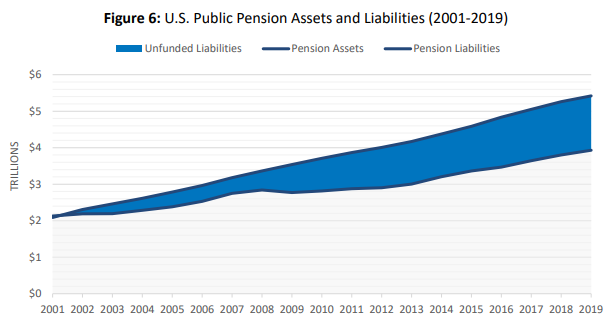
This Report addresses the widespread underfunding of the retirement systems in the nation’s state and local governments. It begins by summarizing some past, current, and probable future trends of unfunded pension liability at the state and local levels. It describes the scope of unfunded pension debt in various state and local jurisdictions and calculates both their aggregate debt and per capita debt, based on states’ self-assessments; it then incorporates a variety of other measurements of unfunded liability. Results from many of those other measures suggest that the magnitude of unfunded pension liability may be considerably larger than previously indicated.


This Report then describes and analyzes the inherent dynamics of government retirement systems that have produced this underfunding, finding that there are a variety of pressures and processes within these retirement systems that can operate to the disadvantage of employees, beneficiaries, and the public generally. It then summarizes attempts to reform pension systems in several states. Some of those states now have relatively sound retirement systems; others less so. It then contrasts the requirements that govern most private-sector pensions to the relatively relaxed regulatory regimes of state and local government pensions, concluding that adoption of rules similar to those governing private sector requirements would likely have positive consequences if implemented for state and local government pension plans and their beneficiaries.

The nation’s experience with unfunded pension liability at the state and local government levels may provide some lessons for policymakers; this Report concludes with several recommendations in this area.

Author(s): Daniel Greenberg: Senior Policy Advisor in the Veterans’ Employment and Training Service; Jay Sirot: Special Assistant in the Office of the Assistant Secretary for Policy

Publication Date: 15 January 2021

Publication Site: Benefits Link
Temporal dynamics in total excess mortality and COVID-19 deaths in Italian cities

Link: https://bmcpublichealth.biomedcentral.com/articles/10.1186/s12889-020-09335-8

Graphic:

Abstract:

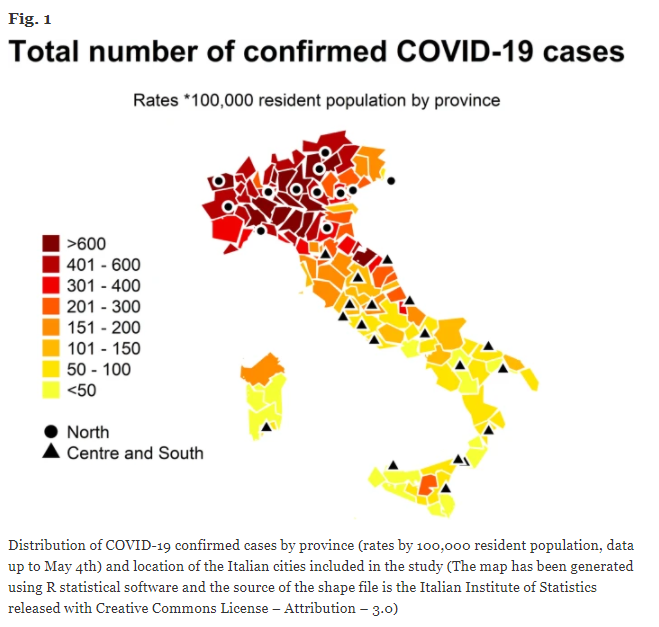
COVID-19 had a greater impact in northern Italian cities among subjects aged 75–84 and 85+ years. COVID-19 deaths accounted for half of total excess mortality in both areas, with differences by age: almost all excess deaths were from COVID-19 among adults, while among the elderly only one third of the excess was coded as COVID-19. When taking into account the mortality deficit in the pre-pandemic period, different trends were observed by area: all excess mortality during COVID-19 was explained by deficit mortality in the centre and south, while only a 16% overlap was estimated in northern cities, with quotas decreasing by age, from 67% in the 15–64 years old to 1% only among subjects 85+ years old.

Author(s): Paola Michelozzi, Francesca de’Donato, Matteo Scortichini, Patrizio Pezzotti, Massimo Stafoggia, Manuela De Sario, Giuseppe Costa, Fiammetta Noccioli, Flavia Riccardo, Antonino Bella, Moreno Demaria, Pasqualino Rossi, Silvio Brusaferro, Giovanni Rezza & Marina Davoli

Publication Date: 27 August 2020

Publication Site: BMC Public Health

The Racial Wealth Gap

Link: https://observablehq.com/@asg017/the-racial-wealth-gap

Graphic:

Excerpt:

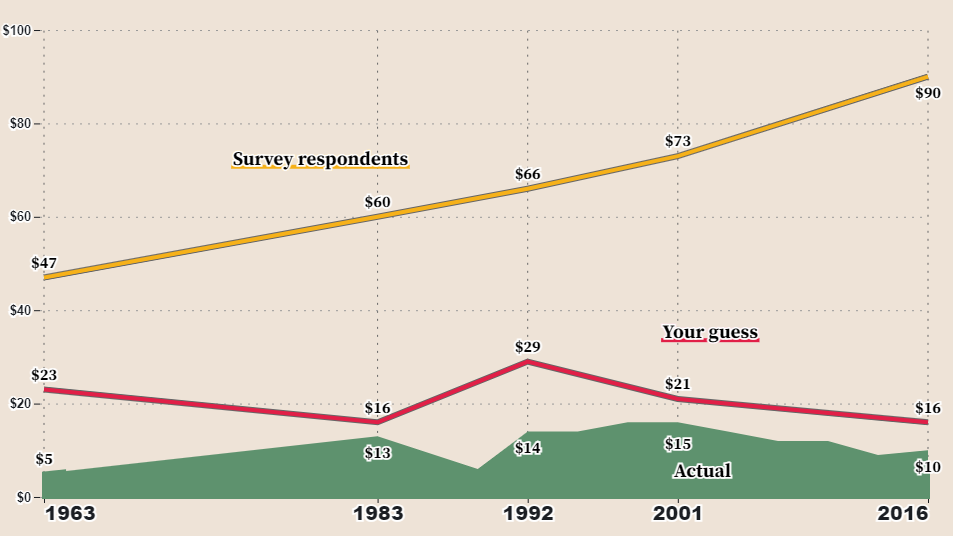
This is the racial wealth gap: the stark wealth difference between white and Black families in the United States. There are several ways to measure this gap, but in 2016 the median wealth for white households was $149,903, while Black households had $13,024.

There’s a myth in the United States that the racial wealth gap has somehow improved over time. This study shows that: many Americans falsely believe that the gap has improved linearly over time, when in reality, it has barely changed and has even gotten worse in some places in the United States.

Granted, other forms of racial injustive have improved since the 60’s. Black representation in politics, media, and academics have improved. Discrimination based on race in the workplace, schools, and in social life have improved. But the racial wealth gap has not improved.

Author(s): Alex Garcia

Publication Date: 20 February 2021

Publication Site: Observable

Third Wave of COVID-19 Continues to Ease

Link: https://www.thinkadvisor.com/2021/02/17/third-wave-of-covid-19-continues-to-ease/

Excerpt:

The seven-day moving average number of daily cases is about 100,000.

The seven-day moving average number of daily deaths has been over 2,000 for 10 weeks.

As of Feb. 11, about 35 million U.S. residents had received at least one COVID-19 vaccine dose.

Author(s): Allison Bell

Publication Date: 17 February 2021

Publication Site: Think Advisor

Saving Social Security Is a Bipartisan Issue: Survey

Link: https://www.thinkadvisor.com/2021/02/22/saving-social-security-is-a-bipartisan-issue-survey/

Excerpt:

Most Americans of both political parties agree there Is a retirement crisis ahead.

A majority of those surveyed say COVID-19 has delayed their retirement plans.

Many stated that pension plans are better than 401(k) plans.

Author(s):  Ginger Szala

Publication Date: 22 February 2021

Publication Site: Think Advisor

Facebook political ad ban blocks pro-vaccine messages

Link: https://www.politico.com/news/2021/02/21/facebook-ad-pro-vaccine-ban-470304?mc_cid=ca5c411eb5&mc_eid=983bcf5922

Excerpt:

Facebook’s efforts to police online ads for vaccine misinformation are unintentionally blocking messages from cities, health care providers and community and faith-based groups promoting Covid shots.

Paid-for messages from at least 110 groups aimed at raising awareness of how the vaccines work or where to get inoculated were flagged and sent to Facebook’s register of political messages, a POLITICO review of barred ads dating from last September shows.

….

Facebook acknowledged that it’s misidentified some ads and said it was restoring two — from the Centers for Disease Control and the Forsyth County, N.C. department of public health — to the ad rotation.

Author(s): DARIUS TAHIR

Publication Date: 21 February 2021

Publication Site: Politico

Grocery store workers ‘disgusted’ with Lamont’s new COVID-19 vaccine policy

Excerpt:

Lamont abandoned the state’s previous methodology for a vaccination rollout, which had prioritized people with underlying medical conditions and certain types of workers in essential, high-risk jobs.

But the governor’s announcement Monday — which ironically was made the same day the national Food Industry Association celebrated “Supermarket Employee Day” — shifted to a priority system that is strictly age-based, with one exception: school employees and child care providers. The next round of shots will open March 1 to people who are between ages 55 and 64, teachers and others who work in schools, and day care workers.

Besides grocery story workers, the administration also had been considering giving priority in this next phase to transportation workers, as well as people 16 and older who have underlying health conditions like heart disease and diabetes, and teachers and other school staff. Only the last group is being given priority in Lamont’s new plan.

Author(s): Keith Phaneuf

Publication Date: 23 February 2021

Publication Site: CT Mirror

With lower returns on the horizon, public pensions will turn to riskier assets, Moody’s says

Link: https://www.marketwatch.com/amp/story/with-lower-returns-on-the-horizon-public-pensions-will-turn-to-riskier-assets-moodys-says-11614289692?mod=dist_amp_social

Excerpt:

State and local government pension systems are increasingly dependent on investment returns, and at risk of increasingly volatile results, as funding levels remain depressed and systems increasingly start to pay out more than they take in, according to a new report from Moody’s.

The credit-ratings agency anticipates higher volatility and lower returns across asset classes in 2021 compared to 2020, even as many pension sponsors have spent the past few years lowering their assumed returns from previous loftier targets that they rarely hit.

“With persistently low interest rates for high-grade fixed-income securities, public pension systems continue to rely on highly volatile equities and alternatives to meet return targets, posing a material credit risk for some governments,” the Moody’s analysts wrote.

Author(s): Andrea Riquier

Publication Date: 25 February 2021

Publication Site: MarketWatch

Monetary policy and the corporate bond market: How important is the Fed information effect?

Link: https://www.federalreserve.gov/econres/feds/monetary-policy-and-the-corporate-bond-market-how-important-is-the-fed-information-effect.htm

Abstract:

Does expansionary monetary policy drive up prices of risky assets? Or, do investors interpret monetary policy easing as a signal that economic fundamentals are weaker than they previously believed, prompting riskier asset prices to fall? We test these competing hypotheses within the U.S. corporate bond market and find evidence strongly in favor of the second explanation—known as the “Fed information effect”. Following an unanticipated monetary policy tightening (easing), returns on corporate bonds with higher credit risk outperform (underperform). We conclude that monetary policy surprises are predominantly interpreted by market participants as signaling information about the state of the economy.

DOI: https://doi.org/10.17016/FEDS.2021.010

PDF: Full Paper

Author(s): Michael Smolyansky and Gustavo Suarez

Publication Date: 16 February 2021

Publication Site: Federal Reserve Board

When ‘closing corporate loopholes’ goes wrong

Link: https://www.chicagobusiness.com/greg-hinz-politics/when-closing-corporate-loopholes-goes-wrong

Excerpt:

And that’s the context of that big $932 million tax hike on business Gov. J.B. Pritzker is pushing as part of his proposed 2022 budget.

Pritzker calls the proposal “closing corporate loopholes.” Arguably that’s true, at least in the sense that any tax break I don’t receive must be someone else’s undeserved loophole. But the proposal comes at the very time when population and jobs have begun to drop not only statewide but in the metropolitan area, and at a time when the state refuses to confront its ever-rising pension debt. Not to mention Chicago’s murder and car-jacking wave. Or what Cook County Assessor Fritz Kaegi is up to.

…..

In fairness to Pritzker, Illinois is not the only state to be moving its tax structure in his proposed direction, at least in part. For instance, according to the Tax Foundation, a Washington research group that’s fairly conservative but also frequently cited in economic circles, only 16 states grant the full accelerated depreciation that’s now in federal tax code. Pritzker’s proposed change there is worth $214 million a year.

Author(s): Greg Hinz

Publication Date:

Publication Site: Crain’s Chicago Business

If Pritzker and Welch really want voters’ trust, they’ll do this

Link: https://www.chicagobusiness.com/joe-cahill-business/if-pritzker-and-welch-really-want-voters-trust-theyll-do

Excerpt:

If Pritzker and Welch are serious about winning trust, they’ll allow Illinoisans to vote on a standalone constitutional amendment repealing the so-called “pension protection clause.” To build public support and treat retirees fairly, such an amendment could be narrowly drawn to permit only reductions in future pension increases under the COLA mechanism.

Sure, public employee unions are likely to fight any change in pensions. But it’s worth trying to win their support. It can be done; Arizona unions backed a narrow amendment to a pension protection clause in that state’s constitution. If unions won’t cooperate, Pritzker and Welch should forge ahead anyway, as Rhode Island officials—led by Democrat Gina Raimondo—did in tackling a similar pension crisis.

Only after passing such an amendment and reducing the overall pension obligation can state officials justifiably ask taxpayers for money to close the remaining gap. Would a graduated income tax be the right way to raise the necessary revenue? Maybe. I’m not opposed to it on principle. The vast majority of states with an income tax charge higher rates on higher incomes. And the necessity of a constitutional amendment would give voters the final say.

Author(s): Joe Cahill

Publication Date: 25 February 2021

Publication Site: Crain’s Chicago Business

St. Louis mayor vetoes firefighters’ pension change; action sets up a veto override fight when aldermen reconvene April 19

Link: https://www.stltoday.com/news/local/govt-and-politics/st-louis-mayor-vetoes-firefighters-pension-change-action-sets-up-a-veto-override-fight-when/article_b2c1a7d3-3c7c-52d1-b2ff-98fb5096d473.html

Excerpt:

Warning that it would be “fiscally irresponsible,” Mayor Lyda Krewson on Thursday vetoed a bill that would return supervision of all city Fire Department pensions to a firefighter-controlled board.

The Board of Aldermen earlier this month approved the bill despite warnings from Comptroller Darlene Green, Budget Director Paul Payne and others that the measure would reverse some reforms enacted in 2012 that put a check on the city’s pension liabilities.

Krewson, in her veto message to aldermen, said she shared those concerns.

Author(s): Mark Schlinkmann

Publication Date: 25 February 2021

Publication Site: St. Louis Post-Dispatch