Hong Kong Stock Market’s Record Year Slams Into a Big Tax Increase

Link: https://www.wsj.com/articles/hong-kong-stock-markets-record-year-slams-into-a-big-tax-increase-11614153184

Excerpt:

Hong Kong moved unexpectedly to raise taxes on share trading by 30%, putting a damper on the city’s stock-exchange operator just as it was unveiling record annual sales and profits.

….

Paul Chan, the city’s financial secretary, proposed lifting the so-called stamp duty on stocks to 0.13% from 0.1%, as part of Hong Kong’s annual budget. The increase, which is the first in nearly three decades, would effectively add $3 to the cost of each $10,000 of stock traded, for both buyers and sellers. Some securities are exempt.

The looming tax increase pummeled Hong Kong Exchanges shares, even as it reported the equivalent of $1.48 billion in net profit for 2020, a 23% increase and its biggest-ever haul. The company’s stock, which has recently hit record highs, fell as much as 12% before paring some losses to close 8.8% lower. The city’s benchmark Hang Seng Index fell 3%.

Author(s): Joanne Chiu

Publication Date: 24 February 2021

Publication Site: Wall Street Journal
Federal Reserve Financial-Services Systems Disrupted for Hour

Link: https://www.wsj.com/articles/federal-reserve-reports-several-business-lines-disrupted-by-operational-error-11614194912

Excerpt:

One of the services taken offline was the Fedwire Funds Service, which the Fed describes as “the premier electronic funds-transfer service that banks, businesses and government agencies rely on for mission-critical, same-day transactions.” Entities use the service to send or receive payments, settle positions with other financial institutions and to submit tax payments, among other activities.

Also affected were FedACH, an automated clearinghouse network that enables debit and credit transactions, and Fedwire Securities, which provides transfer and settlement services for securities issued by the U.S. Treasury, government agencies and government-sponsored housing enterprises.

The first service to be restored — at 2:17 p.m. ET — was the Fed’s central bank programs, which include setting interest rates and allowing financial institutions to review and manage the money they hold at the Fed, called reserves. Fedwire and FedACH were back shortly before 3 p.m.

Author(s): Paul Kiernan and Orla McCaffrey

Publication Date: 24 February 2021

Publication Site: Wall Street Journal
The Black-white life expectancy gap grew in 2020 — but it can be reversed

Link: https://www.vox.com/22285868/black-white-life-expectancy-gap-covid-19-health

Graphic:

Excerpt:

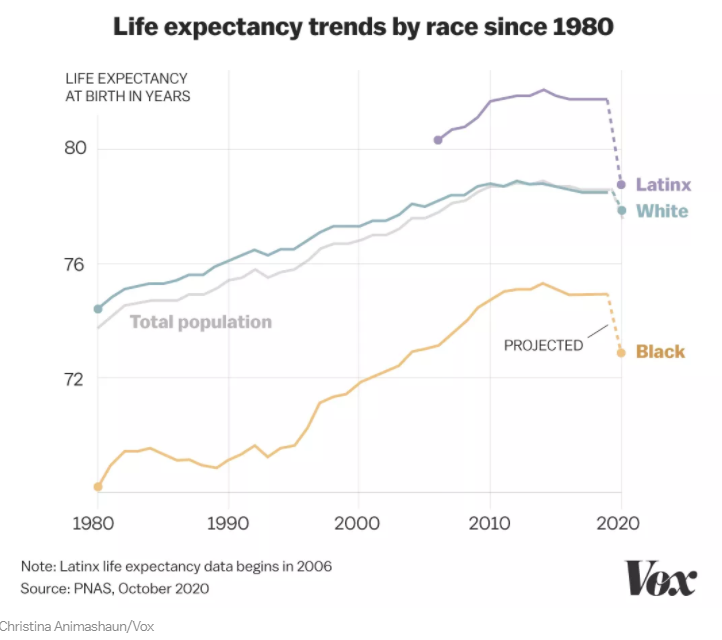
That’s not to say every single white American has it great — that’s obviously not true. But, on average, Black people tend to face much bigger challenges for living the healthiest life possible. That shows up in the life expectancy gap: White people were expected to live nearly 79 years on average before Covid-19 and almost 78 years after, while Black people were expected to live nearly 75 years before Covid-19 and almost 73 after, according to the PNAS study. The Black life expectancy even before Covid-19 was equivalent to what the white life expectancy was in the 1970s — as though decades of progress in well-being and health care were suddenly erased.

Author(s): German Lopez

Publication Date: 23 February 2021

Publication Site: Vox

“We’ve made it so complicated”: Vaccine campaigns are failing to reach the most vulnerable

Link: https://www.vox.com/22275309/covid-19-vaccine-registration-sign-up-moderna-pfizer-johnson-jnj

Excerpt:

From signing up for appointments to securing transportation to clinics, many of the people at the highest risk for severe outcomes and death from Covid-19 — older adults, essential workers, and minority communities — are having trouble getting vaccinated when it’s their turn. At the same time, some wealthier people or people at lower risk have gamed vaccine registration systems to get to the head of the line.

“A lot of my older patients are struggling to figure out how to do it in general,” said Margot Savoy, chair of the family and community medicine department at Temple University in Philadelphia. “We’ve made it so complicated.”

Right now, the priority for many states is scale. Some are setting up mass vaccination sites at public venues like stadiums to get as many shots into arms as possible, as fast as possible. However, some health experts argue that in addition to going big, communities should also go small, working through local clinics and community groups in order to reach the most vulnerable. It may come at the expense of speed, but it would help ensure equity in who’s getting vaccinated for Covid-19.

Author(s): Umair Irfan

Publication Date: 25 February 2021

Publication Site: Vox

Deal reached to cut Puerto Rico bond debt, pensions a sticking point

Link: https://www.reuters.com/article/usa-puertorico-bankruptcy/deal-reached-to-cut-puerto-rico-bond-debt-pensions-a-sticking-point-idUSL1N2KT1WO

Excerpt:

Puerto Rico would substantially reduce its core government debt load under a new deal announced on Tuesday, but obstacles remain for the U.S. territory’s exit from bankruptcy. The island’s federally created financial oversight board said its agreement with certain bondholders was a major step toward resolving the bankruptcy, which began in 2017 in an effort to restructure about $120 billion of debt and other liabilities, including unfunded pensions.

“I’m hopeful that people over time will understand this is likely to be the most fair and confirmable resolution to exit bankruptcy,” Natalie Jaresko, the board’s executive director, told reporters.

The deal will be included in a plan of adjustment the board expects to file in March in federal court, with the hope of court approval in the fall.

Author(s): Karen Pierog

Publication Date: 23 February 2021

Publication Site: Reuters

COVAX delivers its first vaccine shots with shipment to Ghana

Link: https://www.reuters.com/article/us-health-coronavirus-ghana-vaccines/first-covid-19-vaccine-doses-dispatched-by-covax-arrive-in-ghana-idUSKBN2AO0S2

Excerpt:

The delivery comes eight months after the launch of the COVAX initiative, aimed at pooling funds from wealthier countries and non-profits to distribute vaccines equitably around the world.

The shots, part of an initial tranche for low and middle-income countries, will be used by Ghana to start a vaccination drive from March 2 that will prioritise frontline health workers and others at high risk.

“The first segment of the population that will receive the 600,000 doses will be health workers, adults 60 years and over, people with underlying health conditions,” Ghana’s government said on Wednesday.

Author(s): Christian Akorlie

Publication Date: 24 February 2021

Publication Site: Reuters

Why a failure to vaccinate the world will put us all at risk

Link: https://www.technologyreview.com/2021/02/13/1018259/why-a-failure-to-vaccinate-the-world-will-put-us-all-at-risk/

Excerpt:

The supply to poorer countries is low mostly because the majority of the available vaccines have been purchased or promised to richer countries in North America and Europe. To address this vaccine inequity, a coalition of international organizations, including the World Health Organization and governments, created a nonprofit called Covax in April 2020.

The idea was to create a global supply of vaccines for 92 low- and middle-income countries. In December, the nonprofit announced that it had secured access to some 2 billion doses for 2021 through donations and commitments from some manufacturers, but it is unclear how many of those will actually be delivered this year. The problem becomes more complicated because many countries are both working through Covax and trying to secure deals with drug makers themselves—making it more challenging for Covax to make deals with those manufacturers at the same time. 

The group aims to vaccinate about 20% of the people in the world, focusing on hard-to-reach populations in Africa, Latin America, and Asia. To do so, it needs another $4.9 billion in addition to the $2.1 billion it has already raised. But there are other problems. The cheaper and easier-to-transport vaccines like the ones pledged by AstraZeneca have been slower to gain regulatory approval. Meanwhile, other companies seem less interested in pitching in: Doctors Without Borders found that only 2% of Pfizer’s global supply had been granted to Covax, and Moderna is still “in talks” with the organization.

Author(s): Katharine Gammon

Publication Date: 13 February 2021

Publication Site: MIT Technology Review

Why Early 401(k) Withdrawals Are a Bad Idea

Link: https://knowledge.wharton.upenn.edu/article/why-early-401k-withdrawals-are-a-bad-idea/

Excerpt:

Wharton Business Daily: What are your thoughts on the move by Congress to allow people to be able to dip into their 401(k) accounts? You are not a fan of that idea in general.

Olivia Mitchell: That’s true. This got started in March 2020, when the CARES Act was passed by Congress, allowing people who had 401(k) accounts and who were younger than age 59.5 to access up to $100,000 from their retirement accounts without paying the 10% penalty. Congress permitted this in the throes of COVID and then they allowed the income taxes on those withdrawals to be spread over three years unless the money was repaid to the account. That option ended in December 2020.

Congress passed a new bill in December that did not extend penalty-free access to everyone, but it did permit people who experienced federally declared disasters, aside from COVID, to withdraw some of their 401(k) money. So, there are still eligible people who, in 2021, can withdraw up to $100,000 from their retirement accounts without penalties. Again, they can spread it over three years for tax purposes. In general, this is not a good idea.

Author(s): Olivia S. Mitchell

Publication Date: 23 February 2021

Publication Site: Knowledge @ Wharton

2020 Excess Deaths in the US general population by Age and Sex

Link: https://www.soa.org/resources/research-reports/2021/excess-deaths-gen-population/

Report link: https://www.soa.org/globalassets/assets/files/resources/research-report/2021/excess-deaths-gen-population.pdf

Graphic:

Excerpt:

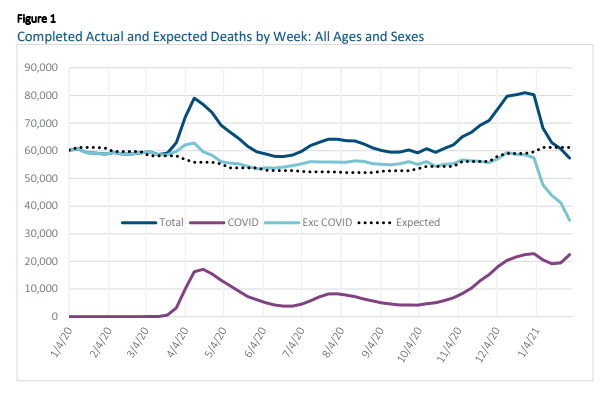
Excluding the first two and a half months of 2020 before COVID-19 deaths were prevalent, the total U.S. mortality A/E ratio ranged between 119% and 121%, with about 84% of the excess deaths identified as due to COVID-19. Considering the full year of 2020, the A/E ranged between 114% and 116%.

Deaths for people under age 15 were lower than expected, but all older ages showed excess mortality. The following table considers the A/E ratios for the period after the emergence of COVID-19 and uses a fiveyear trend on death rates by ages and sex to set the expected deaths.

Author(s): Rick Leavitt, ASA, MAAA

Publication Date: February 2021

Publication Site: Society of Actuaries

U.S. Death Counts Have Climbed for All Adult Age Groups: Actuary

Link: https://www.thinkadvisor.com/2021/02/25/u-s-death-counts-have-climbed-for-all-adult-age-groups-actuary/

Excerpt:

The actual number of deaths for people of all ages has been 18.4% higher than the expected number.

For women, the worst actual-to-expected death ratio is for the 35-44 age group.

For men, the highest percentage of excess deaths was was for the 35-54 age group.

Author(s): Allison Bell

Publication Date: 25 February 2021

Publication Site: Think Advisor

Diverse Population Uses Nursing Homes Less

Excerpt:

Eight states have seen the biggest drops in nursing home use: Florida, Georgia, Louisiana, New Jersey, New Mexico, North Carolina, South Carolina, and Tennessee. Many of these states have experienced fast growth in their minority populations or have more generous state allocations of Medicaid funds for long-term care services delivered in the home.

Growing diversity is actually the second-biggest reason for lower nursing home residence, accounting for one-fifth of the decline, according to the study, which was funded by the U.S. Social Security Administration and is based on U.S. Census data.

Publication Date: 25 February 2021

Publication Site: Squared Away Blog

Murphy’s full pension payment revives debate over New Jersey overhaul

Link: https://fixedincome.fidelity.com/ftgw/fi/FINewsArticle?id=202102241328SM______BNDBUYER_00000177-cf67-de3f-a9f7-ffef66580001_110.1

Excerpt:

Gov. Phil Murphy?s call for New Jersey to make its first full pension contribution in 25 years is generating questions about retirement-system overhaul in one of the nation’s lowest-rated states, and how might the capital markets respond.

Murphy on Tuesday revealed the proposal to pay toward pensions roughly $6.4 billion, or about 14% of his $44.8 billion fiscal 2022 budget proposal to lawmakers. Overall spending would rise 10%. Democrat Murphy’s election-year budget would increase aid to schools and provide income-tax rebates to low- and middle-income families.

Making the full actuarially required contribution will need an additional $1.6 billion expense, according to Murphy. New Jersey was initially scheduled to earmark 90% of its full contribution this year under a ramp-up plan.

Author(s): Paul Burton

Publication Date: 24 February 2021

Publication Site: Fidelity Fixed Income