Municipal bond yields rise, swept up in Treasuries surge

Link: https://www.reuters.com/article/usa-municipals-treasuries/muni-bond-yields-rise-swept-up-in-treasuries-surge-idUSL1N2KV2H1

Excerpt:

Earlier this year, the $3.9 trillion market where states, cities, schools and other issuers sell debt had been resisting a steep sell off in Treasuries that lifted yields, putting the historically close correlation between the two markets out of whack.

Now, munis are catching up, with the 10-year yield on Municipal Market Data’s (MMD) benchmark triple-A scale, which started 2021 at 0.720%, climbing 45 basis points since Feb. 12. It closed up 5 basis points at 1.14% on Thursday.

The iShares National Municipal Bond exchange-traded fund (ETF) fell on Thursday to its lowest level since November at 115.14. The largest muni ETF, which reached an 11-month high of 117.95 on Feb. 11, was last down 0.43% at 115.30.

Author(s): Karen Pierog

Publication Date: 25 February 2021

Publication Site: Reuters
How Drawing Makes Us Better at Data Visualization

Graphic:

Excerpt:

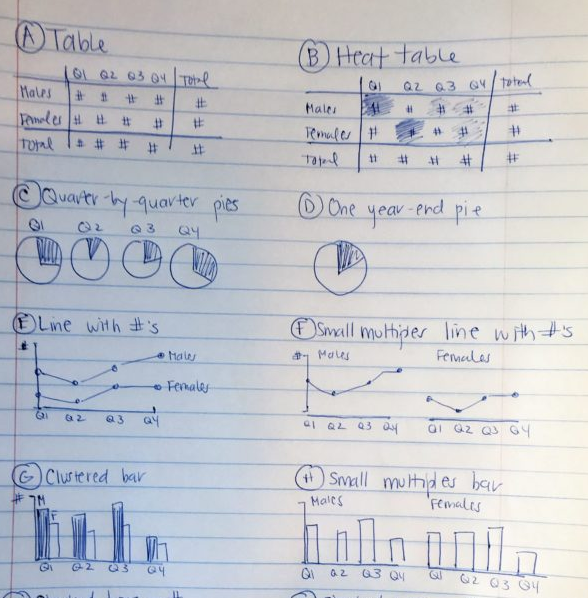
Once I’ve selected lots of individual graphs to use, I often need to arrange them together on a page or screen.

For example, if I’m designing an infographic, the one-page summary might involve three, four, or five individual graphs.

Or, if I’m designing a dashboard, the screen might involve three, four, or five individual graphs.

I need to decide which graph should be displayed first, second, or third. Is there a natural sequence?

I also need to decide which graphs “go together.” Is there a natural grouping? A categorization? Similar graphs should be next to each other on the infographic or dashboard.

I use a pen and paper to sketch what that page could look like.

Author(s): Ann K. Emery

Publication Date: 23 February 2021

Publication Site: Depict Data Studio

How Spending Changed for Different Income Groups

Link: https://flowingdata.com/2021/02/24/how-spending-changed-for-different-income-groups/

Graphic:

Excerpt:

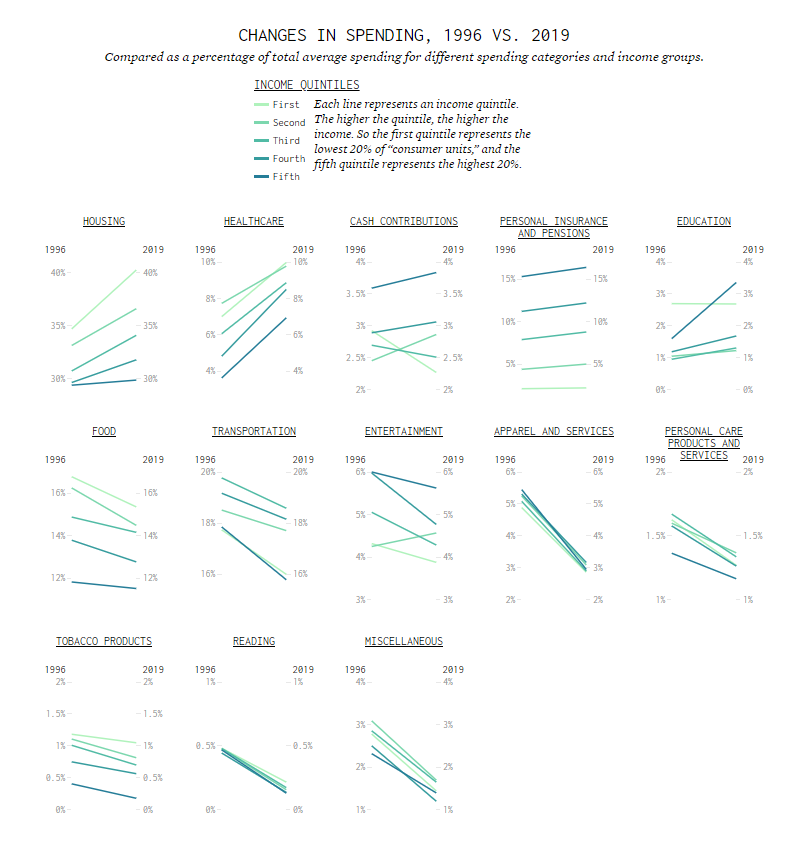
The categories are roughly ordered from increased spending to decreased spending. So you see by how much the cost of housing and healthcare has gone up over a couple of decades, especially for the lower income groups.

For the lowest income quintile, housing and healthcare make up more than half of spending on average.

In contrast, the higher income groups are spending more in retirement savings, education, and entertainment, and their cost of housing changed little.

Author(s): Nathan Yau

Publication Date: 24 February 2021

Publication Site: Flowing Data

The Never-Ending Economic Tragedy of Argentina

Graphic:

Excerpt:

I’m tempted to say the big takeaway from today’s column is that wealth taxes are a bad idea.

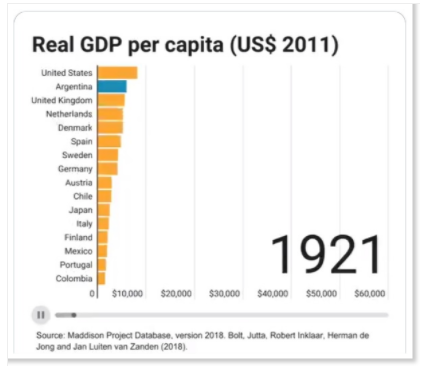
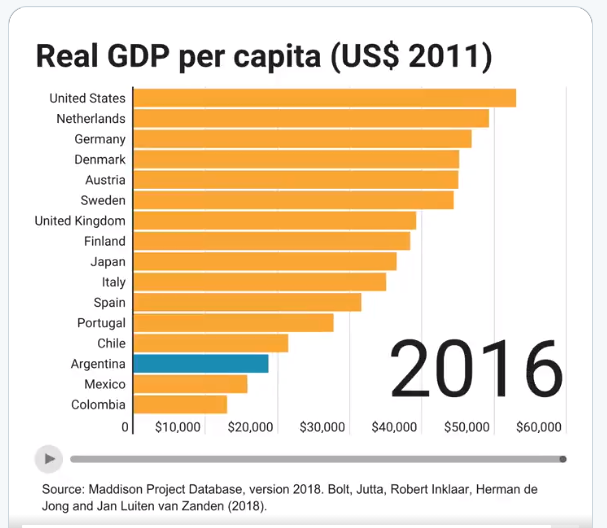
That’s true, of course, but the bigger lesson we should absorb is that a rich nation can become a poor nation.

Simply stated, if a government imposes enough bad policies – as has been the case in Argentina – then it’s just a matter of time before it declines relative to nations with sensible policies.

Author(s): Dan Mitchell

Publication Date: 10 July 2020

Publication Site: International Liberty

Puerto Rico governor rejects key deal with creditors to reduce debt due to pension cuts

Link: https://www.nbcnews.com/news/latino/puerto-rico-governor-rejects-key-deal-creditors-reduce-debt-due-n1258610

Excerpt:

The impasse between the governor and a board that oversees Puerto Rico’s finances threatens to throw into limbo attempts to end a bankruptcy-like process for a government that six years ago declared unpayable its more than $70 billion public debt load.

The deal was reached with creditors who hold general obligation bonds and Public Building Authority bonds sold by Puerto Rico’s government and would resolve $35 billion worth of debt and non-debt claims, according to the board. It also would reduce debt held by those creditors from $18.8 billion to $7.4 billion, a 61 percent reduction, and would provide them with $7.4 billion in bonds and $7 billion in cash, among other things.

The board said the deal would free up more than $300 million a year for government services, and that instead of 30 cents for every dollar in taxes and fees that Puerto Rico’s government collects going to creditors, it would be less than 8 cents.

Author(s): Associated Press

Publication Date: 23 February 2021

Publication Site: NBC News

Jason Riley: Thomas Sowell’s Unique Insights on Race, Economics, and Politics

Excerpt:

Thomas Sowell is one of the most influential economists, syndicated columnists, and social critics of the past half-century, having authored provocative, best-selling books on everything from race relations to childhood development to, most recently, Charter Schools and Their Enemies. His masterworks include Knowledge and Decisions, which uses Friedrich Hayek’s insights about distributed information to explain both how markets work and why intellectuals disdain markets; A Conflict of Visions, which explores the ideological origins of political struggles; and Basic Economics, a best-selling primer now in its fifth edition.

Sowell’s inspiring life—he was born black and poor in North Carolina in 1930 and received his Ph.D. from the University of Chicago at the age of 38—and expansive work are now the subjects of a new documentary, Common Sense in a Senseless World (watch here) and a forthcoming biography titled Maverick.

Author(s): NICK GILLESPIE

Publication Date: 24 February 2021

Publication Site: Reason

Does Every State Really Need a Big Biden Bailout?

Link: https://www.governing.com/finance/Does-Every-State-Really-Need-a-Big-Biden-Bailout.html

Excerpt:

Then there are states like Hawaii, where cratering tourism has left the state in a $1.8 billion budget hole, with tax revenues not expected to recover until 2024. Florida and Nevada are also missing their frequent flyers after tax receipts plummeted by 7.9 percent and 13 percent, respectively. States dependent on taxing energy and mining, such as Alaska, North Dakota, Texas and West Virginia, have seen their own devastating budget hits. And sales-tax-dependent states like New York wound up in worse shape than those reliant on less volatile revenue streams like Vermont, where 32 percent of revenues come from property taxes. In all, 26 states saw their tax revenues decline in the first 10 months of 2020.

But every state’s been a winner this past year with the federal government, whose aid to states and localities rose an astonishing 42 percent. What might have been a $331 billion budget shortfall due to COVID-19 instead came to a $165.5 billion dip, according to Moody’s, and that’s before counting $79 billion in state rainy day funds. Federal aid also propped up businesses and households, which led to economic activity and hiring that boosted state and local tax revenues, while also hiking taxable unemployment benefits. Having the Federal Reserve goose the stock and housing markets with super-low interest rates didn’t hurt either.

Author(s): MICHAEL HENDRIX, MANHATTAN INSTITUTE

Publication Date: 24 February 2021

Publication Site: Governing

ILLINOIS HOUSE SPEAKER UNWILLING TO TAKE VOTERS’ ‘NO’ ON ‘FAIR TAX’ FOR AN ANSWER

Link: https://www.illinoispolicy.org/illinois-house-speaker-unwilling-to-take-voters-no-on-fair-tax-for-an-answer/

Graphic:

Excerpt:

Pension costs are already eating away at Illinois government services. The ballooning costs caused a nearly one-third cut since 2000 in core services such as child protection, state police, mental health and college money for low-income students.

Pension contributions accounted for less than 4% of Illinois’ general funds budget from 1990 through 1997 but have grown to consume 28.5% of the budget. Still, the pension debt has mushroomed to $144.4 billion by the state’s estimates, which more realistically was at an all-time high of $261 billion at the end of fiscal year 2020 according to Moody’s Investors Service calculations using more realistic assumptions. In any case, public pension debt is eating a larger chunk of Illinois’ gross domestic product than anywhere else.

Author(s): Adam Schuster

Publication Date: 25 February 2021

Publication Site: Illinois Policy Institute

Covid Vaccine Websites Violate Disability Laws, Create Inequity for the Blind

Excerpt:

In at least seven states, blind residents said they were unable to register for the vaccine through their state or local governments without help. Phone alternatives, when available, have been beset with their own issues, such as long hold times and not being available at all hours like websites.

Even the federal Centers for Disease Control and Prevention’s Vaccine Administration Management System, which a small number of states and counties opted to use after its rocky rollout, has been inaccessible for blind users.

Those problems violate the Rehabilitation Act of 1973, which established the right to communications in an accessible format, multiple legal experts and disability advocates said. The federal Americans with Disabilities Act, a civil rights law that prohibits governments and private businesses from discriminating based on disability, further enshrined this protection in 1990.

Author(s): Lauren Weber and Hannah Recht

Publication Date: 25 February 2021

Publication Site: Kaiser Health News

GameStop Follies: The Long and the Short of It

Link: https://marypatcampbell.substack.com/p/gamestop-follies-the-long-and-the

Excerpt:

Activist short-sellers are different in the types of actions they advocate. These are people who are shorting the stock, and are arguing the current market value for the shares is too high. They may claim something is stinky about the financial reporting of results, and that regulators should audit the books. They may point out that management is engaged in some value-destroying activity that shareholders were unaware of. The activist shorts aren’t trying to destroy value — they claim that the true economic value was already much lower than the stock price would indicate, and that’s because the information the market has about the company is just plain wrong.

They’re being activists not because of altruism, obviously, but that the faster the market prices adjust to what they think the true value is, the less they’re exposed to the risk of getting squeezed out of their short position before they can profit.

Author(s): Mary Pat Campbell

Publication Date: 25 February 2021

Publication Site: STUMP at Substack

Reliance on Social Insurance Tax Revenue in Europe

Graphic:

Excerpt:

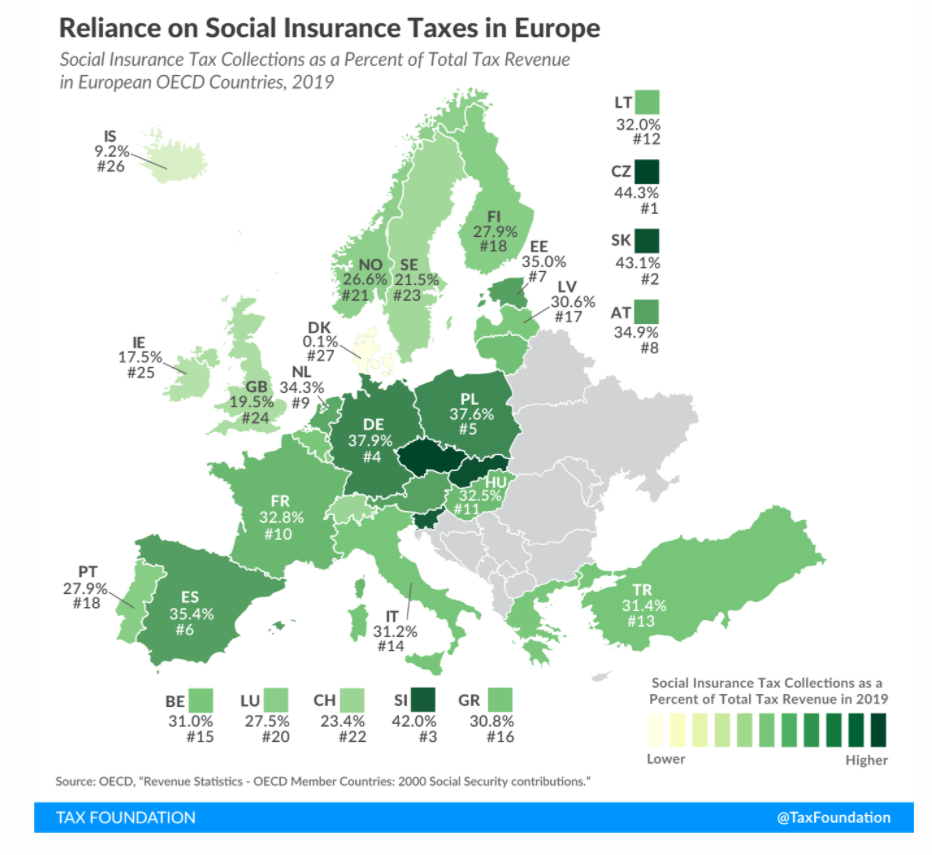
A recent report on tax revenue sources shows that social insurance taxes—also referred to as social security contributions or payroll taxes—are an important revenue source for European governments. Social insurance taxes, as opposed to individual income taxes, are usually levied at a flat rate. The revenue is generally used to fund specific social programs, such as unemployment insurance, health insurance, and old age insurance.

In 2019 (the most recent data available), social insurance taxes were the second largest tax revenue source in European OECD countries, at an average of 29.5 percent of total tax revenue. Only consumption taxes were on average a larger source of tax revenue, at 32.4 percent.

Author(s): Elke Asen

Publication Date: 25 February 2021

Publication Site: Tax Foundation

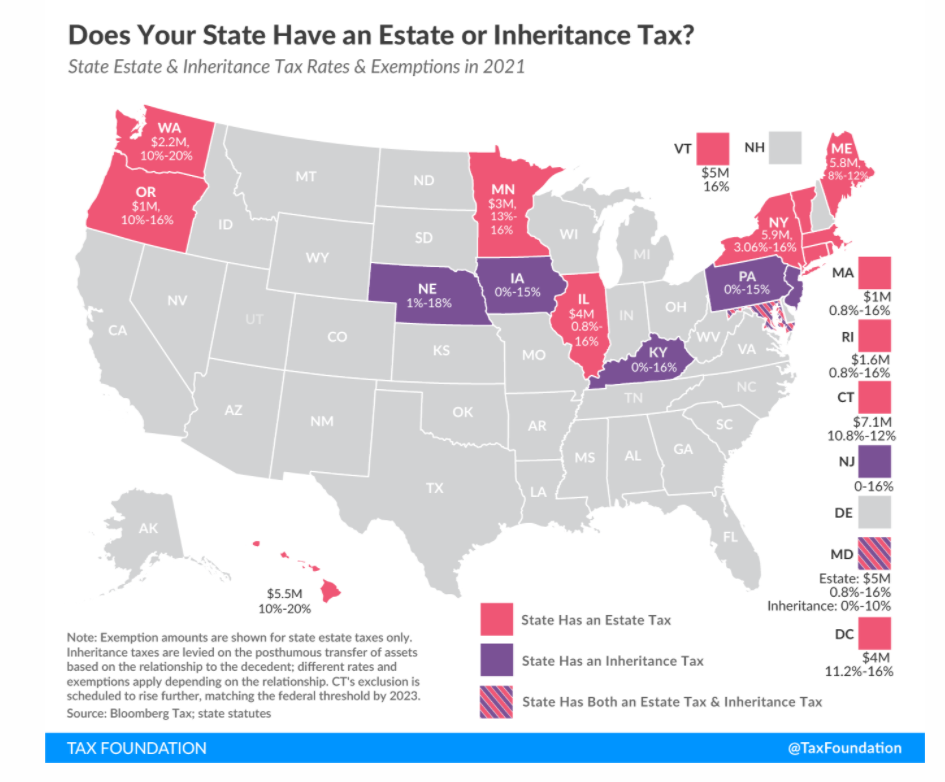
Does Your State Have an Estate or Inheritance Tax?

Graphic:

Excerpt:

In addition to the federal estate tax, with a top rate of 40 percent, some states levy an additional estate or inheritance tax. Twelve states and the District of Columbia impose estate taxes and six impose inheritance taxes. Maryland is the only state to impose both.

Hawaii and Washington State have the highest estate tax top rates in the nation at 20 percent. Eight states and the District of Columbia are next with a top rate of 16 percent. Massachusetts and Oregon have the lowest exemption levels at $1 million, and Connecticut has the highest exemption level at $7.1 million.

Of the six states with inheritance taxes, Nebraska has the highest top rate at 18 percent. Maryland imposes the lowest top rate at 10 percent. All six states exempt spouses, and some fully or partially exempt immediate relatives.

Author(s): Janelle Cammenga

Publication Date: 24 February 2021

Publication Site: Tax Foundation