Robinhood and Redditors: Who’s robbin’ who?

Excerpt:

Robinhood is a broker. It is a FINRA-regulated broker-dealer. It relies on a clearing house to clear its transactions. The clearing house it uses is the National Securities Clearing Corporation (NSCC), which is a subsidiary of the Depository Trust & Clearing Corporation (DTCC). Thus, Robinhood is a “member” of NSCC. The NSCC is a “designated financial market utility” as defined in the 2010 Dodd-Frank Act. Thus, it is “a financial market utility that the Council has designated as a systemically important.” (“The Council” is a regulatory body created by Dodd-Frank. Its ten voting members include the Treasury Secretary, the Fed chair, and the comptroller of the currency.) NSCC is a provider of “financial market infrastructure” (FMI). As such, it must publicly promulgate rules for the computation of the “Clearing Fund” every “member” must maintain with it. While the FMI is responsible for designing its own rules for determining the clearing fund, they are subject to approval or rejection by the regulatory authorities. In particular, the SEC may prohibit any changes NSCC wants to make in its formula for computing the clearing fund of each member. The Bank for International Settlements (BIS) has promulgated a set of “principles” that member states should adhere to in regulating payment and settlement systems. These include, “An FMI should maintain sufficient financial resources to cover its credit exposure to each participant fully with a high degree of confidence.” 

Thus, the regulatory authorities require clearing houses to require members to keep a risk-adjusted balance with them as a guard against credit risk. In the case of Robinhood, the short squeeze drove this formulaic value up sharply. Robinhood didn’t really have much of a choice about how to respond. It had to both pony up more money for the clearing fund and act to hold off (to the extent possible) further increases in it. Robinhood had to borrow a lot of money to maintain its clearing fund.

Author(s): Roger Koppl

Publication Date: 2 February 2021

Publication Site: EconLib
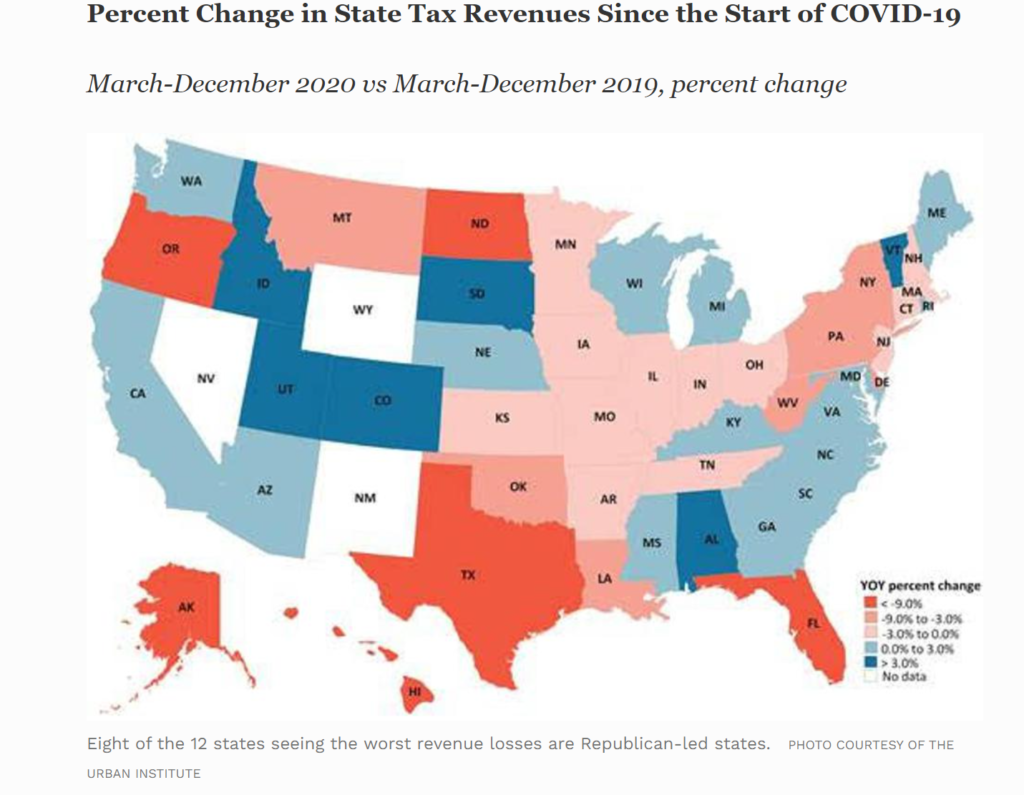
Red State Budgets Are Suffering The Most In This Recession

Link: https://www.forbes.com/sites/lizfarmer/2021/02/18/red-state-budgets-are-suffering-the-most-in-this-recession/?utm_source=newsletter&utm_medium=email&utm_campaign=follow&cdlcid=5f3d53896be319c3c36cff29&sh=7f2620337b69

Graphic:

Excerpt:

Of those states suffering at least a 3% drop in revenue since the start of the pandemic in March 2020, two-thirds (eight in 12) are red states. Alaska, Florida, North Dakota and Texas are seeing some of the worst revenue losses of 9% or higher over the comparable period in 2019, according to the latest data from the Urban Institute.

Across the 47 states from which the institute has full data, total state tax revenues were down by $14 billion in the first ten months of the pandemic (between March and December 2020) compared to the same period a year earlier. That’s an average drop of 1.8% and is largely driven by declines in sales tax revenue.

Author(s): Liz Farmer

Publication Date: 18 February 2021

Publication Site: Forbes

Puerto Rico Bonds, MBIA Stock Jump on Restructuring Settlement

Link: https://www.wsj.com/articles/puerto-rico-bonds-mbia-stocks-jump-on-restructuring-settlement-11614179542

Excerpt:

A settlement between creditors in Puerto Rico’s bankruptcy case lifted prices of the commonwealth’s municipal bonds and shares of insurance companies that guaranteed payments on the bonds.

Traders have driven up prices of the island’s benchmark $3.5 billion general obligation bond due 2035 by 3.3% to around 78 cents on the dollar after the Tuesday deal removed one of the last logjams in Puerto Rico’s nearly four-year journey through bankruptcy court. Roughly $400 million face amount of the bond changed hands Tuesday and Wednesday, making it one of the most actively traded securities in the municipal-bond market, according to data from Electronic Municipal Market Access.

Shares of the insurers that guaranteed payments on billions of dollars of Puerto Rico’s defaulted bonds also rose as the settlement removed some uncertainty about the amount of claims they would need to pay. MBIA Inc.’s stock has jumped around 13% this week, while Ambac Financial Group Inc.’s shares have gained about 7.2%.

Author(s): Matt Wirz

Publication Date: 24 February 2021

Publication Site: Wall Street Journal

The Economist’s tracker for covid-19 excess deaths

Link: https://github.com/TheEconomist/covid-19-excess-deaths-tracker

Excerpt:

This repository contains the data behind The Economist’s tracker for covid-19 excess deaths and the code that we have used to clean, analyse and present the numbers.

….

Our tracker uses data from a number of statistical bureaus, government departments and academic projects. For many of the countries, we have imported total_deaths from the Human Mortality Database, which collates detailed weekly breakdowns from official sources around the world. For other countries, you can find a full list of sources and links in a file called list_of_sources.csv, as well as spreadsheets in the /source-data/ folder.

For most countries, we have imported national figures on official covid deaths from a time series maintained by Johns Hopkins University and Our World In Data. For some countries, we have provided a regional breakdown of mortality. In these cases, we have imported regional covid_deaths from a variety of sources, including a Latin American time series maintained by Data Science Research Peru.

Date accessed: 25 February 2021

Publication Site: github

Biden’s retirement idea getting the cold shoulder

Link: https://www.pionline.com/defined-contribution/bidens-retirement-idea-getting-cold-shoulder

Excerpt:

Equalized tax advantage proposal being met with skepticism by industry

Alicia Munnell doesn’t think the shift would help because workers typically don’t look at tax incentives.

Trade groups representing plan sponsors have snubbed a proposal floated by President Joe Biden to give individuals across all pay grades equal tax advantages for their retirement savings.

Author(s): MARGARIDA CORREIA

Publication Date: 22 February 2021

Publication Site: Pensions & Investments

The good and bad in Biden’s giant relief bill

Link: https://finance.yahoo.com/news/the-good-and-bad-in-bidens-giant-relief-bill-210546323.html

Excerpt:

Aid to states and cities. Cost: $350 billion. This money would offset lost tax revenue and help mayors and governors “mitigate the fiscal effects stemming from the public health emergency,” according to draft legislation. it’s clearly related to the pandemic, so it counts as relief, but it might also be more than states and cities need, since government revenue has held up better than expected during the last 12 months. 

….

Pension relief. Cost: $74 billion. This money would address longstanding problems at roughly 1,400 underfunded pensions covering 10 million workers and retirees, most of them belonging to unions. A government agency called the PBGC is supposed to backstop pensions that run short of money, but it, too, is drastically underfunded and poised to collapse in coming years. The money in the House bill would bail out the riskiest pensions, but it’s controversial because it’s not paired with needed reforms—and it’s not specifically related to problems caused by the pandemic. This could be one provision that doesn’t survive the Senate.

Author(s): Rick Newman

Publication Date: 22 February 2021

Publication Site: Yahoo Finance

The march of the coronavirus across America

Link: https://www.economist.com/graphic-detail/tracking-coronavirus-across-america

Graphic:

Excerpt:

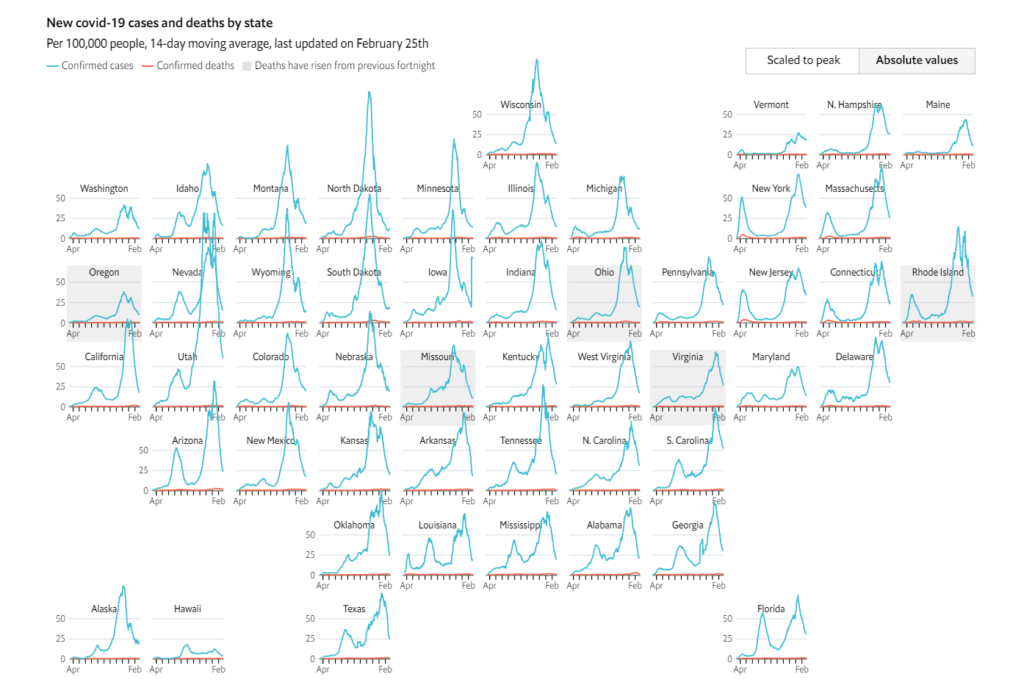
However, herd immunity will take months to achieve, and the sheer scale of infections in America dictates that covid-19 will not be under control for some time. In order to see where the pandemic is currently most severe across the nation, we have created an interactive map of covid-19 cases and deaths. It divides America into 500 areas. For each of these it shows cases and deaths per 100,000 people, so that infection and death rates in, say, New York City and its surrounds (population 40m) can be compared with those in Ironwood, Michigan (population 27,000).

Publication Date: 23 February 2021

Publication Site: The Economist

Tracking covid-19 excess deaths across countries

Link: https://www.economist.com/graphic-detail/coronavirus-excess-deaths-tracker

Graphic:

Excerpt:

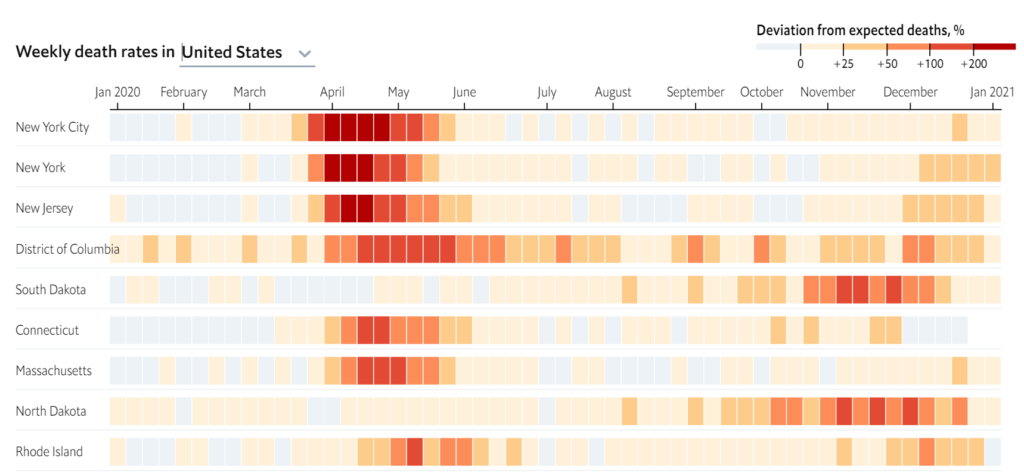
As covid-19 has spread around the world, people have become grimly familiar with the death tolls that their governments publish each day. Unfortunately, the total number of fatalities caused by the pandemic may be even higher, for several reasons. First, the official statistics in many countries exclude victims who did not test positive for coronavirus before dying—which can be a substantial majority in places with little capacity for testing. Second, hospitals and civil registries may not process death certificates for several days, or even weeks, which creates lags in the data. And third, the pandemic has made it harder for doctors to treat other conditions and discouraged people from going to hospital, which may have indirectly caused an increase in fatalities from diseases other than covid-19.

One way to account for these methodological problems is to use a simpler measure, known as “excess deaths”: take the number of people who die from any cause in a given region and period, and then compare it with a historical baseline from recent years. We have used statistical models to create our baselines, by predicting the number of deaths each region would normally have recorded in 2020.

Date Accessed: 25 February 2021

Date last updated: 23 February 2021

Publication Site: The Economist

Evidence from Britain shows covid-19 vaccines are very effective

Link: https://www.economist.com/graphic-detail/2021/02/22/evidence-from-britain-shows-covid-19-vaccines-are-very-effective

Graphic:

Excerpt:

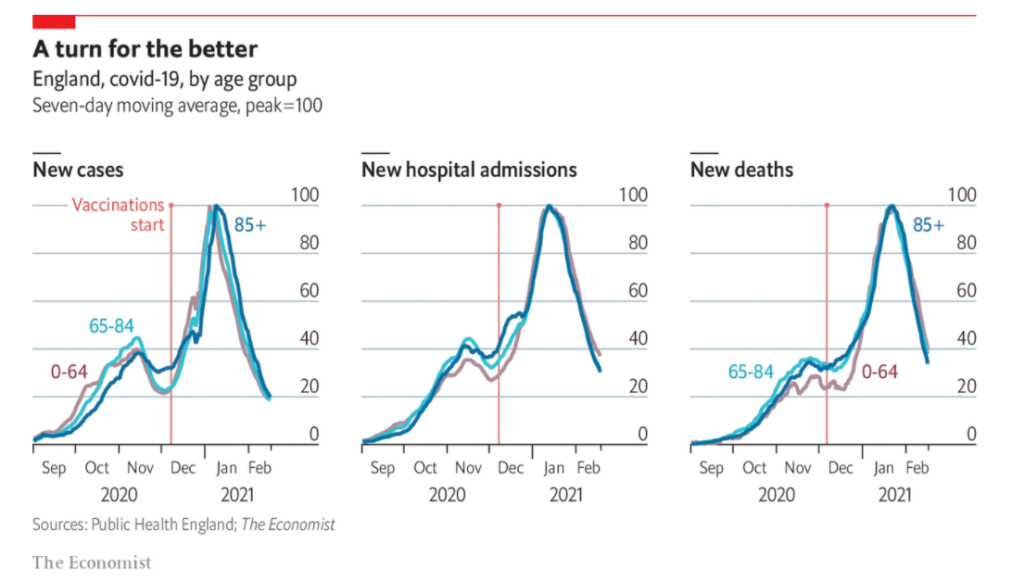
THE SECOND wave of the pandemic has been devastating in much of the world. Since September 1st covid-19 has claimed the lives of 1.6m people, compared with 850,000 in the preceding nine months. In America alone, the death toll passed 500,000 on February 22nd. What is more, new variants that may be more transmissible, more deadly or better at evading the body’s immune response are spreading.

At last, some optimism is budding. More than 200m doses of covid-19 vaccine have been administered across 92 countries. After a slow start, America’s programme is gathering speed: 16% of adults have received a first shot, and President Joe Biden is on target to meet his goal of 150m doses by his 100th day in office. The number of infections in the country is falling by half every 14 days.

Publication Date: 21 February 2021

Publication Site: The Economist

Fed Chairman Vows to Keep Supporting Economic Recovery

Link: https://www.thinkadvisor.com/2021/02/23/fed-chairman-vows-to-keep-supporting-economic-recovery/

Excerpt:

The Fed will continue $120 billion in monthly bond purchases and communicate any change.

Powell doesn’t expect any large and persistent increases in inflation; some pickup will be temporary.

Powell says getting the pandemic under control is needed for the economy to reopen.

Author(s): Bernice Napach

Publication Date: 23 February 2021

Publication Site: Think Advisor

New Nightingale Editorial Standards

Link: https://medium.com/nightingale/new-nightingale-editorial-standards-6cada1125d7d

Excerpt:

Always include a high-resolution image at the top of your story. This has the following benefits:

When people share your story on Facebook and Twitter, it will be more prominent in news feeds, making people more likely to click on it.

Our readers prefer images of data visualizations.

If you’re having a hard time, you can always look at the free-image services like Pixabay, Pexels, or Unsplash or discuss it with your editor.

Author(s): Jason Forrest

Publication Date: 22 February 2021

Publication Site: Nightingale at Medium

Excess mortality during the COVID-19 pandemic

Link: https://github.com/dkobak/excess-mortality

Graphic:

Excerpt:

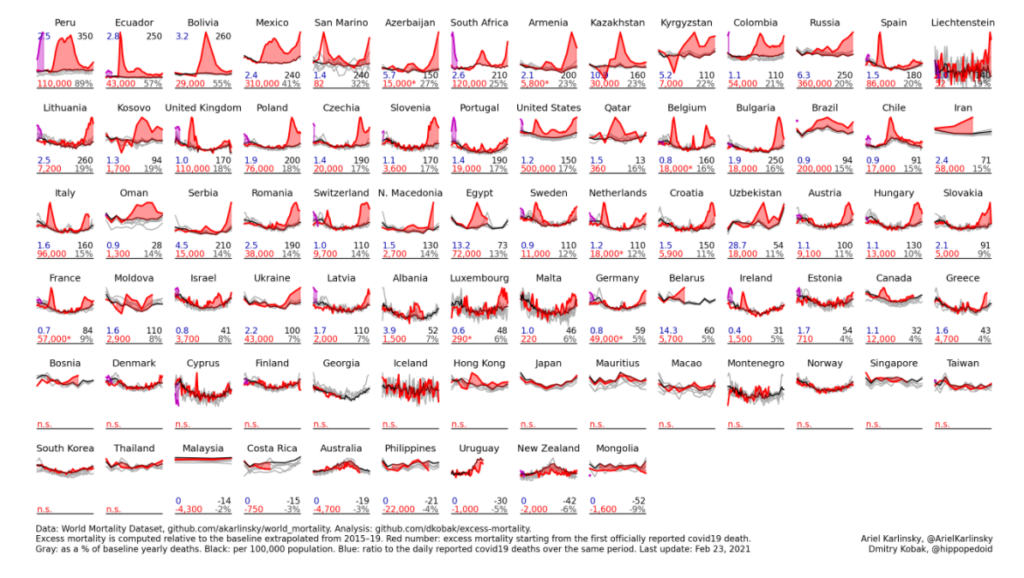
The data are sourced from the World Mortality Dataset. Excess mortality is computed relative to the baseline obtained using linear extrapolation of the 2015–19 trend. In the figure below, gray lines are 2015–19, black line is baseline for 2020, red line is 2020, purple line is 2021. Countries are sorted by the % increase over the baseline.

Red number: excess mortality starting from the first officially reported Covid-19 death.
Gray number: excess mortality as a % of the annual baseline deaths.
Black number: excess mortality per 100,000 population.
Blue number: ratio to the daily reported Covid-19 deaths over the same period (sourced from JHU).

Author(s): Dmitry Kobak

Date Accessed: 24 February 2021

Publication Site: github