HMT Review of Solvency II: Call for Evidence—IFoA Response

Link: https://www.actuaries.org.uk/system/files/field/document/HMT_SII_v7.pdf

Excerpt:

The current design of the SII risk margin is too interest-rate sensitive and too high, particularly in the current low-interest rate environment. We believe reform, and an overall reduction, in the risk margin is desirable and can be done whilst keeping an appropriate balance between policyholder protection and cost.


The Matching Adjustment (MA) is vitally important to UK insurers, UK pension schemes and individuals. Without it, annuity prices would increase, and it would simply not be affordable for many pension schemes to buy-out with an insurance company. The IFoA fully supports the continued inclusion of the MA; the MA has successfully helped reduced
procyclical investment behaviour, such as during the stressed conditions in early 2020. However, we believe that the MA framework needs to incorporate more pragmatic flexibility, without a lowering of regulatory standards.


We favour incentivisation of ‘green’ investment rather than overly penal disincentives for ‘brown’ asset classes, noting that sectors considered ‘brown’ must also be part of the solution to the challenges of climate change.

Author(s): Institute and Faculty of Actuaries

Publication Date: 19 February 2021

Publication Site: Institute and Faculty of Actuaries
Every State’s COVID Numbers in Context, February 2021

Link: https://polimath.substack.com/p/every-states-covid-numbers-in-context-7e1

Graphic:

Excerpt:

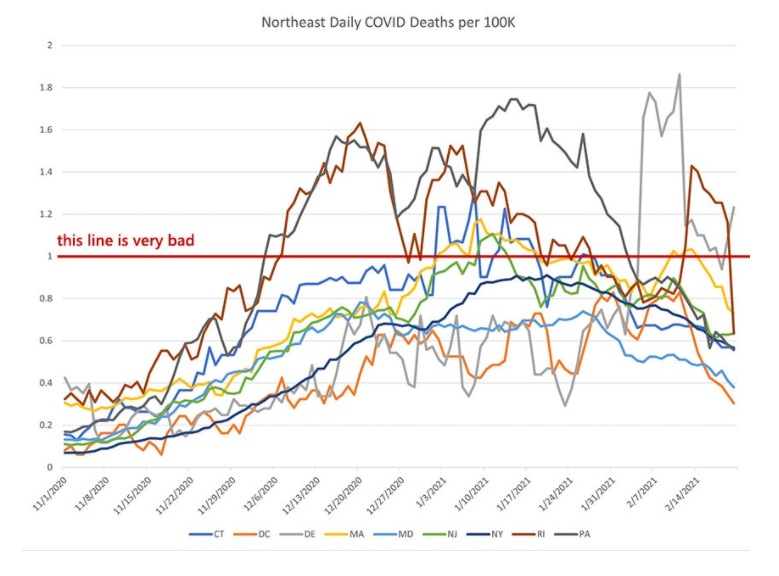
Comparing the northeast to the mountain states is a near-perfect microcosm of why I tend to think that this pandemic is largely running out on its own schedule with interventions making only a limited impact. We can see the northeast surging shortly after the mountain states and we can see that they are trailing behind on the case reductions.

Even so, we see the same pattern. Cases and deaths are past their peak and are sliding downward. Out hope is that cases can dip below the caution line within the next month or so (though I’m far past making any predictions on this).

Author(s): PoliMath

Publication Date: 23 February 2021

Publication Site: Marginally Compelling at Substack

State Employee Retirements at CalPERS Jump 15% in 2020

Link: https://www.ai-cio.com/news/state-employee-retirements-calpers-jump-15-2020/

Excerpt:

California state employee retirements jumped 15% last year, as employees dealing with pandemic-related stress chose to leave the workforce, a pension fund spokesperson with the California Public Employees’ Retirement System (CalPERS) confirmed. 

About 12,300 state workers in the state retirement system retired last year, up from roughly 10,700 the year prior, according to CalPERS data, which was first reported on by the Sacramento Bee. It’s a major spike from the prior two-year period, when state retirements fell 1.8% from 2018 to 2019. 

Overall, retirements in the entire CalPERS system—which includes state workers, as well as public agency employees and non-teaching school personnel—increased just 4% in 2020, data shows. The prior year, the number of retirements in the whole pension fund fell 1.4%. 

Author(s): Sarah Min

Publication Date: 23 February 2021

Publication Site: ai-CIO

Windfall Elimination Provision and Government Pension Offset Updated for 2021

Link: https://www.asppa-net.org/news/windfall-elimination-provision-and-government-pension-offset-updated-2021

Excerpt:

2021 Levels. For purposes of the WEP [windfall elimination provision], the amount of substantial earnings in covered employment or self-employment needed for a year of coverage (YOC) is adjusted annually by the growth in average earnings in the economy, provided a cost-of-living adjustment is payable. In 2021, the amount of substantial earnings in covered employment or self-employment needed for a YOC is $26,550.

For people with 20 or fewer YOCs who become eligible for benefits in 2021, the WEP reduces the first factor from 90% to 40%, resulting in a maximum reduction of $498 (90% of $996 minus 40% of $996). For each year of substantial earnings in covered employment or self-employment in excess of 20 years, the first factor increases by 5%. For example, the first factor is 45% for those with 21 YOCs. The WEP factor reaches 90% for those with 30 or more YOCs and at that point is phased out.

Author(s): JOHN IEKEL

Publication Date: 3 February 2021

Publication Site: ASPPA

Trader Cargill, pension fund TIAA linked to land grabs in Brazil’s Cerrado

Link: https://news.mongabay.com/2021/02/trader-cargill-pension-fund-tiaa-linked-to-land-grabs-in-brazils-cerrado/

Graphic:

Excerpt:

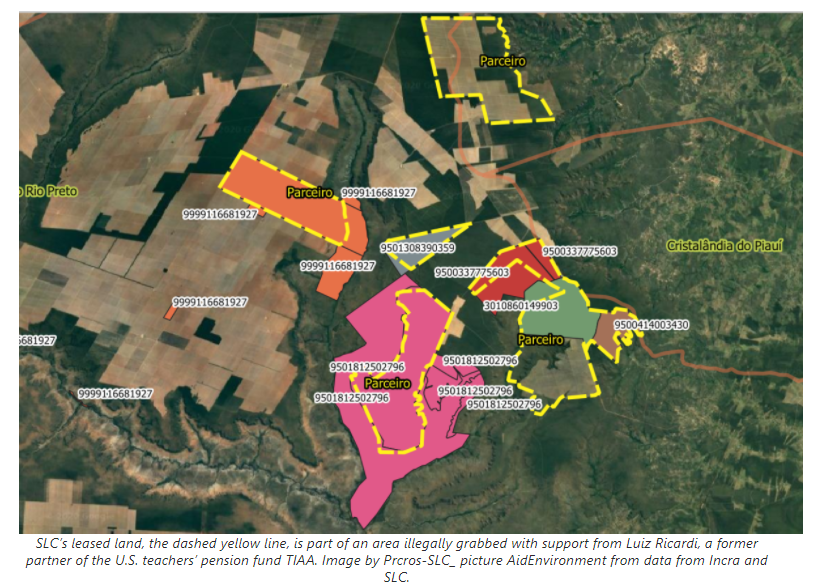
Global commodities giant Cargill continues to buy soybeans from a farm in Brazil that cultivates on illegally acquired and deforested land.

The Parceiro farm in Bahia state, owned by SLC Agrícola, has been implicated in a $200 million land-grabbing scheme being investigated by Brazilian authorities.

Also implicated in the case is the U.S. teachers’ pension fund TIAA, an investor in one of the parcels of illegally acquired land that effectively overlaps with SLC’s farm.

Cargill, which has a zero-deforestation commitment for its supply chain from the Cerrado, says it placed no restrictions on soybean purchases from SLC in 2020; it bought more than a quarter of the grower’s crop the previous year.

Author(s): Caio de Freitas Paes

Publication Date: 3 February 2021

Publication Site: Mongabay

N.C. treasurer announces move to make state pension plan less risky for taxpayers

Link: https://www.carolinacoastonline.com/regional/article_c65c2932-6633-11eb-8288-1f1410ad3f83.html

Excerpt:

In a move that will make government-employee pensions less risky for taxpayers, N.C. Treasurer Dale Folwell announced Tuesday, Feb. 2, that the assumed rate of return on the main state retirement plan will be lowered.

Folwell and the Retirement Systems Division said the assumed rate of return for investments in the North Carolina Retirement Systems Fund will be reduced from 7% to 6.5%. The move was unanimously approved by the boards representing teachers, state employees and local government employees on Jan. 28.

Lowering the rate requires greater contributions from state and local governments, but keeps debt from piling up in the long term.

Author(s): Johnny Kampis, Carolina Journal

Publication Date: 3 February 2021

Publication Site: Carolina Coast Online

Push for pension reform rocks teachers

Link: https://www.ptreyeslight.com/article/push-pension-reform-rocks-teachers

Excerpt:

Teachers are upset at the Marin County Board of Education for discussing pension reform in the middle of a pandemic without any feedback from labor unions. The county board considered a resolution last month that calls on state legislators to enact pension reform, proposing several possible solutions—including weakening pensions by reducing benefits and raising the retirement age. Teachers spoke out against the nonbinding resolution, which was tabled in response to their concerns.

…..

School districts and employees have no say in how much they pay. At Shoreline, about 10 percent of the general fund is paid to retirement funds. 

The required contribution from districts has steadily risen following the passage of A.B. 1469, which was intended to fully fund CalSTRS. When the bill passed in 2014, the state required districts to pay 8.88 percent of their payroll to the teachers’ retirement system. This year, they are required to pay 16.15 percent. Mandated CalPERS contributions have risen from 11.77 to 20.7 percent of payroll costs in the same timeframe, leaving less money within districts for direct education costs. 

The rising liability caught the eye of the Joint Legislative Advisory Committee, a countywide group of elected school board members and superintendents created to advocate on behalf of public education in Marin. Pension reform has been a priority for the committee since 2014, and it’s been the number-one goal since 2017. 

Author(s): Braden Cartwright

Publication Date: 3 February 2021

Publication Site: Point Reyes Light

Still primed for public life, ex-Pa. Treasurer Torsella reflects on pensions and bipartisanship

Excerpt:

Torsella also was at the center of a burgeoning bloc of hedge fund and private equity skeptics on state pension boards. He has publicly criticized Wall Street firms for charging too many fees for too little gain.

Torsella also co-authored a bipartisan legislative report that estimated Wall Street firms had taken $5.5 billion from the state over the past 30 years.

Pension officials have countered that private equity investments pay off, and provide a way for the fund to grow its assets hurt by bad policy, underinvestment, and losses from the 2008 crash.

Author(s): Stephen Caruso

Publication Date: 3 February 2021

Publication Site: Pennsylvania Capital-Star

Thomas Sowell: Common Sense in a Senseless World

Link: https://www.freetochoosenetwork.org/programs/thomas_sowell/

Video:

Description:

Thomas Sowell: Common Sense in a Senseless World traces Sowell’s journey from humble beginnings to the Hoover Institution, becoming one of our era’s most controversial economists, political philosophers, and prolific authors. Hosted by Jason Riley, a member of The Wall Street Journal editorial board, the one-hour program features insights from Sowell and interviews with his close friends and associates, revealing why the intensely private Thomas Sowell is considered by many to be “one of the greatest minds of the past half-century” and “the smartest person in the room.”

Date Accessed: 24 February 2021

Publication Site: Free to Choose Network

Jumping the COVID vaccination line: the next casualty of common sense – Wirepoints

Graphic:

Excerpt:

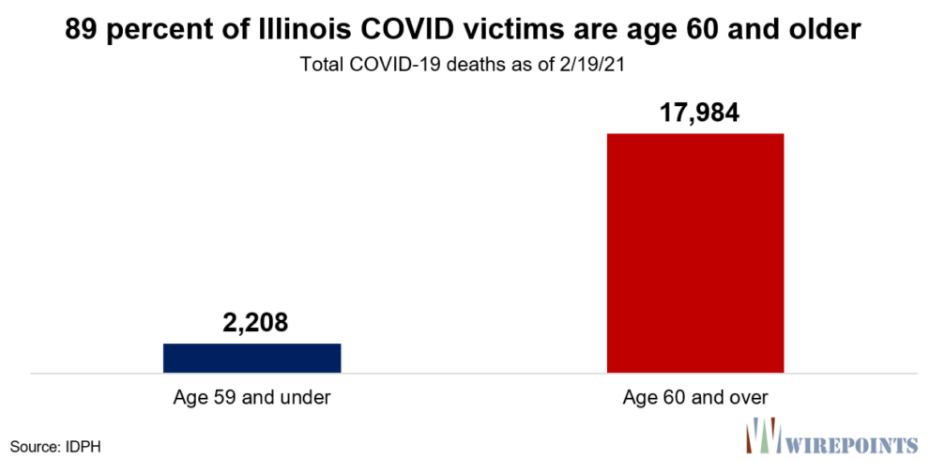
The state’s current vaccination category, 1B, includes the 1.9 millions over the age of 65, as well as the 1.3 million younger people who are first-responders or “essential workers” such as teachers, grocery store workers and transit workers. To date, about 150,000 Illinoisans aged 65 and over have been fully vaccinated, while nearly 390,000 residents aged 16-64 are already inoculated.

But groups both inside and outside that list have been demanding they take top priority. Everyone from politicians to teachers to bartenders to transit workers to librarians and more. That is patently absurd. There are a limited number of vaccines and if everybody is at the front of the line, then no one is. That’s why getting the elderly vaccinated has been so problematic.

…..

As long as we’re vaccinating the line jumpers who are younger than 60, we’re vaccinating the wrong people. Every needle in the arm of a younger Illinoisan – barring frontline health care workers – leaves an elderly Illinoisan at great risk.

Author(s): Ted Dabrowski and John Klingner

Publication Date: 22 February 2021

Publication Site: Wirepoints

What Wall Street’s ‘Short Squeeze’ Means for Investors and Regulators

Link: https://knowledge.wharton.upenn.edu/article/what-wall-streets-short-squeeze-means-for-investors-and-regulators/

Excerpt:

The consternation over the stock price surges at GameStop and AMC is rooted in their disconnect with their financial performance – both companies are losing money, made worse by the pandemic lockdowns.

The other shoe is yet to drop for those who bid up the share price of GameStop, according to Indarte. “I think we’re going to see more pain felt potentially by the retail investors that are in effect bidding up the price of GameStop,” she predicted. “It’s hard to justify the prices that we’ve been seeing for the company, based on the company’s fundamentals.” In the latest quarter, GameStop reported a 30% fall in revenues to $1 billion and a loss of $18.8 million. Similarly, AMC has also shuttered most of its theaters, and recently secured $917 million in financing to stave off bankruptcy.

In addition to the soundness of its fundamentals, a company’s stock price can also be driven by investor sentiment, “but there is large heterogeneity between different companies for the importance of both,” according to Binsbergen. Much of the price discovery depends on the liquidity and the total market capitalization of the stock, he noted. Small and illiquid stocks are more susceptible to non-fundamental price movements than larger stocks, he explained.

Author(s): Jules H. van Binsbergen, Sasha Indarte

Publication Date: 29 January 2021

Publication Site: Knowledge @ Wharton

States push ahead on private-sector initiatives

Link: https://www.pionline.com/retirement-plans/states-push-ahead-private-sector-initiatives

Excerpt:

To date, 12 states and Seattle have enacted retirement savings programs for private-sector workers. They include OregonSaves with more than 90,000 funded accounts and $92 million in assets, the Illinois Secure Choice retirement savings program with $52.6 million and 82,852 funded accounts, and the $38 million CalSavers Retirement Savings Program that as of February had enrolled 274,024 participants, with another enrollment phase coming up.

The predominant model is an auto IRA, in which employer participation is required if no plan is already offered. Other options are a voluntary payroll deduction Roth IRA, a multiple employer plan, and a service provider marketplace, or a hybrid.

Author(s): Hazel Bradford

Publication Date: 22 February 2021

Publication Site: Pensions & Investments