The $1.9 trillion Biden stimulus plan is moving forward — here are the biggest parts of it

Link: https://www.marketwatch.com/story/the-biden-stimulus-plan-moved-forward-today-here-are-the-biggest-parts-of-it-11614032251

Excerpt:

The House Budget Committee approved on Monday a $1.92 trillion bill to carry out President Joe Biden’s coronavirus relief plan, the first step toward likely House passage by the end of the week.

The vote was 19-16. Texas Democrat Rep. Lloyd Doggett voted with Republicans in opposition to the bill but a spokeswoman for him later said he had cast his vote in error and supported the legislation.

…..

Aid to state, local and tribal governments: This would provide money for states and local governments, as well as tribal governments, to offset tax-collection losses and increased spending resulting from the coronavirus pandemic. Price tag: $350 billion.

….

Multiemployer pension plan aid: The Pension Benefit Guaranty Program would be able to give grants to underfunded pension plans guaranteed by the PBGC. The PBGC revolving fund to help pay full benefits when pensions fall short is set to be exhausted in 2027 under current law. Price tag: $81.5 billion.

Author(s): Jonathan Nicholson

Publication Date: 23 February 2021

Publication Site: MarketWatch
CalPERS seen weighing proposal on rule changes for hiring, firing of CIO

Link: https://www.pionline.com/pension-funds/calpers-seen-weighing-proposal-rule-changes-hiring-firing-cio

Excerpt:

The CalPERS board is looking at a change in the way it will decide who replaces Yu ‘Ben’ Meng as CIO of the fund.

CalPERS board is expected to weigh a move that would modify a recent governance change calling for the full board in conjunction with the CEO to hire, evaluate and terminate the pension fund’s CIO.

Author(s): ARLEEN JACOBIUS

Publication Date: 23 February 2021

Publication Site: Pensions & Investments

Solvency II Review: Call for Evidence

Link: https://www.gov.uk/government/publications/solvency-ii-review-call-for-evidence

Excerpt:

Solvency II is the regime that governs the prudential regulation of insurance firms in the UK. This call for evidence is the first stage of the review of Solvency II.

The review is underpinned by three objectives:

to spur a vibrant, innovative, and internationally competitive insurance sector

to protect policyholders and ensure the safety and soundness of firms

to support insurance firms to provide long-term capital to support growth, including investment in infrastructure, venture capital and growth equity, and other long-term productive assets, as well as investment consistent with the government’s climate change objectives.

The government seeks views on how to tailor the prudential regulatory regime to support the unique features of the insurance sector and regulatory approach in the UK.

Author(s): Her Majesty’s Treasury

Date Accessed: 24 February 2021

Publication Site: Gov.UK

Annual Statistical Supplement, Social Security

Link: https://www.ssa.gov/policy/docs/statcomps/supplement/2020/index.html

Preface:

The Supplement is a major resource for data on programs administered by the Social Security Administration—the Old-Age, Survivors, and Disability Insurance program, known collectively as Social Security, and the Supplemental Security Income program. The Supplement also includes program summaries and legislative histories that help users of the data understand these programs. Please note that additional disability tables and statistics can be found in the SSI Annual Statistical Report and the Annual Statistical Report on the Social Security Disability Insurance Program.

The Supplement has been published annually since 1940. Decisions affecting the future of Social Security are facilitated by the availability of relevant data over a long period. The data provide a base for research, policy analysis, and proposals for changing the programs. In addition to meeting the Social Security Administration’s information needs, the Supplement strengthens the agency’s ability to respond to requests for program data from congressional committees, government agencies at all levels, and the research community.

The Supplement is prepared by Social Security Administration staff from various components throughout the agency. I would like to express my thanks to them for their contributions.

Katherine N. Bent
Acting Associate Commissioner for Research, Evaluation, and Statistics
February 2021

Date Accessed: 24 February 2021

Publication Site: Social Security Administration

Matching adjustment becomes a battleground in UK’s Solvency II consultation

Link: https://www.insuranceerm.com/analysis/matching-adjustment-becomes-a-battleground-in-uks-solvency-ii-consultation.html

Excerpt:

Solvency II sets strict requirements over what kinds of liabilities and assets are eligible for the MA [matching adjustment], and the governance of them. In the UK’s Solvency II consultation, respondents have argued a looser regime would be good for insurers – and good for the country.

…..

Many of these suggestions have been previously floated in industry circles, some since even before Solvency II came into effect in 2016. But there are a growing number of experts calling for a much more dramatic rethink of the MA – and whether it should even exist.

Dean Buckner, a former regulator at the Bank of England who worked on the MA, and Kevin Dowd, professor of finance and economics at Durham University, have been at the forefront of arguing the MA creates “fake capital” and puts annuity payments at risk.

In their submission to the consultation, they write: “The MA allows firms to recognise some anticipated risky future profits as if they were certain, thereby allowing them to be distributed before being realised. If the risky future profits are not realised – bear in mind that they are called ‘risky’ for a reason – then the capital created by MA will vanish, and policyholders will be at risk.”

Author(s): Christopher Cundy

Publication Date: 23 February 2021

Publication Site: Insurance ERM

An Ancient Greek Approach to Risk and the Lessons It Can Offer the Modern World

Link: https://theconversation.com/an-ancient-greek-approach-to-risk-and-the-lessons-it-can-offer-the-modern-world-154139

Excerpt:

While the earliest generations lived life free of worries, according to Hesiod, life in the current iron generation is shaped by risk, which leads to pain and sorrow.

Throughout the poem, Hesiod develops an idea of risk and its management that was common in ancient Greece: People can and should take steps to prepare for risk, but it is ultimately inescapable.

As Hesiod says, “summer won’t last forever, build granaries,” but for people of the current generation, “there is neither a stop to toil and sorrow by day, nor to death by night.”

Author(s): Joshua P. Nudell

Publication Date: 22 February 2021

Publication Site: The Conversation

Investments post double-digit gains

Excerpt:

Feb. 24, 2021 – The Ohio Public Employees Retirement System posted double-digit investment returns in 2020, topping our assumed return rate in both the Defined Benefit and Health Care funds.

The OPERS Defined Benefit Fund returned 12.02 percent last year, compared to the target return of 7.2 percent. The Health Care Fund increased by 10.96 percent, compared to the target return of 6.0 percent.

Four asset classes led the strong absolute returns: U.S. Equities, Non-U.S. Equities, Private Equity and Treasury Inflation Protected Securities, commonly referred to as TIPS. Other bonds also had a strong year, as core fixed income securities returned more than 9 percent, and U.S. Treasuries topped 8 percent for the year.

Author(s): Michael Pramik

Publication Date: 24 February 2021

Publication Site: Ohio Public Employees Retirement System

Forget Bitcoin or Tesla. Muni Bonds Are the King of Costly.

Link: https://www.bloomberg.com/opinion/articles/2021-02-22/forget-bitcoin-or-tesla-muni-bonds-are-the-king-of-costly

Graphic:

Excerpt:

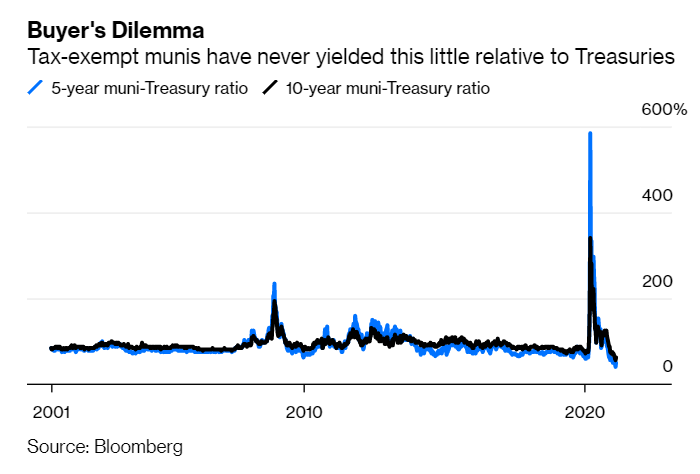
A flood of money pouring in? Check: Muni bond funds added about $2 billion in the week ended Feb. 17, according to Refinitiv Lipper US Fund Flows data, building upon a $2.6 billion inflow in the prior period that was the fourth-largest on record. Scarce supply? You bet: Some analysts estimate that states and cities in 2021 will bring to market the smallest amount of tax-exempt bonds in 21 years. Fiscal stimulus supporting its case? Indeed: The prospect of $350 billion in aid to state and local governments should help stave off any widespread credit stress.

Perhaps most remarkably, though, muni investors appear to have fully embraced the “HODL” mentality of the crypto crowd. In typical times, February’s sharp selloff in U.S. Treasuries, which has sent the benchmark 10-year yield up almost 30 basis points to 1.35% (for a monthly loss of almost 2%), would have reverberated by now across the market for state and local bonds. Instead, tax-exempt yields have been borderline immovable; they only finally started to budge toward the end of last week. 

By that time, municipal bonds became arguably the most expensive asset class anywhere. As Bloomberg News’s Danielle Moran noted, yields had fallen so low on top-rated tax-free debt that even after accounting for the exemption from federal taxes, it still made more sense for investors to purchase Treasuries instead. It’s certainly fair to argue that Bitcoin isn’t worth more than $50,000, or that shares of Tesla Inc. shouldn’t be trading at more than 1,000 times earnings. But it’s at least possible to make the case that they should. It’s not every day that a corner of the bond market rallies to such an extent that it’s objectively a bad deal. 

Author(s): Brian Chappatta

Publication Date: 22 February 2021

Publication Site: Bloomberg

FirstEnergy Corp. to publicly disclose more political spending under deal with New York pension fund

Link: https://www.cleveland.com/open/2021/02/firstenergy-corp-to-publicly-disclose-more-political-spending-under-deal-with-new-york-pension-fund.html

Excerpt:

COLUMBUS, Ohio—FirstEnergy Corp. has agreed to regularly open its books to the public about its political spending, under an agreement the scandal-ridden utility has reached with a New York State public pension fund.

Under the deal with the New York State Common Retirement Fund, FirstEnergy has agreed to post comprehensive reports on its website twice per year through May 2024 detailing all its spending on any candidates, political parties, and ballot measures in any state. The agreement was released Monday by New York State Comptroller Thomas P. DiNapoli, the pension’s trustee.

Author(s): Jeremy Pelzer

Publication Date: 22 February 2021

Publication Site: cleveland.com

ConEd earmarks $480 million for pension plan contributions

Link: https://www.pionline.com/pension-funds/coned-earmarks-480-million-pension-plan-contributions

Excerpt:

Consolidated Edison Inc., New York, expects to make contributions of $480 million to its pension plans in 2021, according to the company’s 10-K statement filed Feb. 18 with the Securities and Exchange Commission.

Most of the contribution — $441 million — will go to the utility holding company’s subsidiary Consolidated Edison Co. of New York (CECONY) Inc.’s pension plan. The company has only U.S. pension plans.

Last year, the total contribution was $332 million, of which $301 million was provided to CECONY’s plan.

Author(s): ROBERT STEYER

Publication Date: 22 February 2021

Publication Site: Pensions & Investments

Tony Evers’ budget takes nearly $2 billion chunk out of state’s improving financial situation

Link: https://madison.com/wsj/news/local/govt-and-politics/tony-evers-budget-takes-nearly-2-billion-chunk-out-of-states-improving-financial-situation/article_8afbb2a3-a23e-5708-ac8f-cba55bf50081.html

Excerpt:

Gov. Tony Evers’ biennial budget proposal fulfills many Democratic priorities with big spending increases, but Republicans have raised concern that the $91 billion proposal would almost entirely drain the state’s coffers — by close to $2 billion — and leave Wisconsin in a more precarious financial position down the road.

The state is projected to have a nearly $2 billion surplus in its general fund by the end of the year, but Evers’ projected budget, which includes $1.6 billion in new tax revenue from marijuana, big manufacturers and the wealthy, still reduces that to around $143 million by mid-2023.

“It’s not necessarily inappropriate to draw down a big chunk of your reserves when you’re facing a once-in-100-years pandemic,” Wisconsin Policy Forum research director Jason Stein said. “You don’t have the reserves just to put them on a wall and admire them, but at the same time … you have to think about what’s going to be sustainable for the state budget because some of these challenges are not just going to evaporate either.”

Author(s): Mitchell Schmidt | Wisconsin State Journal , Riley Vetterkind | Wisconsin State Journal

Publication Date: 21 February 2021

Publication Site: Wisconsin State Journal

WEAK ACCOUNTING STANDARDS ENABLE ILLINOIS BUDGET DEFICITS

Link: https://www.illinoispolicy.org/weak-accounting-standards-enable-illinois-budget-deficits/

Graphic:

Excerpt:

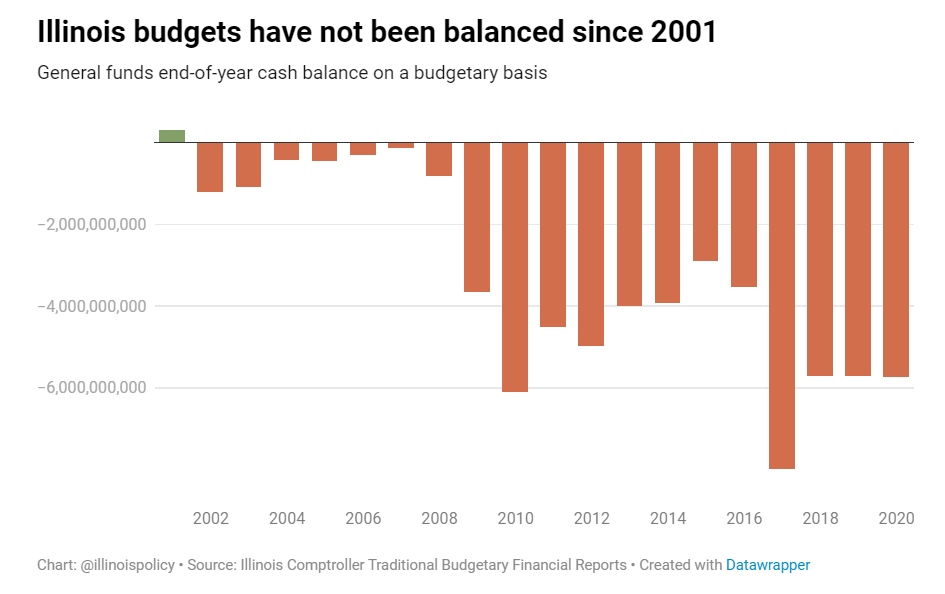
Bad accounting has helped Illinois politicians avoid balancing the budget for 20 years, despite a constitutional requirement to pass a balanced budget each year. Government accounting standards that fail to offer transparency and accuracy in financial reporting have also contributed to the state’s $260 billion pension crisis, the primary reason Illinois has the lowest credit rating any state has ever received.

The Governmental Accounting Standards Board has proposed changes it calls “improvements” to the accounting standards for governments. However, watchdog groups such as Truth in Accounting have criticized the proposed changes and urged the adoption of more stringent standards that would require governments to balance their budgets the way most businesses are required to do. Illinois has grown accustomed to using lax accounting methods to hide its budget deficits, racking up debt year after year. The state’s taxpayers would benefit from tougher standards that impose fiscal discipline.

Author(s): Justin Carlson

Publication Date: 19 February 2021

Publication Site: Illinois Policy Institute