COVID-19 outcomes among people with intellectual and developmental disability living in residential group homes in New York State

Link: https://www.sciencedirect.com/science/article/abs/pii/S193665742030100X?via=ihub&modtag=djemBestOfTheWeb

Excerpt:

People with IDD living in residential group homes were at greater risk of severe COVID-19 outcomes: case rates – 7,841 per 100,000 for people with IDD compared to 1,910 for New York State; case-fatality – 15.0% for people with IDD compared to 7.9% for New York State; and mortality rate – 1,175 per 100,000 for people with IDD compared to 151 per 100,000 for New York State. Differences in cases and mortality rate were confirmed across regions of the state, but case-fatality rate was only higher for people with IDD in and around the New York City region.

Author(s): Scott D. Landes, Margaret A. Turk, Margaret K. Formica, Katherine E. McDonald, J. Dalton Stevens

Publication Date: October 2020

Publication Site: Disability and Health Journal

Despite Starkly Different COVID-19 Policies, the U.S. and the U.K. Saw Similar Drops in Cases Around the Same Time

Excerpt:

Despite the stark difference in policy, both countries saw remarkably similar COVID-19 trends this winter. According to Worldometer’s numbers, the seven-day average of new cases peaked in the U.K. on January 9; it peaked in the U.S. two days later. That number then fell sharply in both countries. As of yesterday, it was down 81 percent in the U.K. and 73 percent in the U.S.

Daily deaths are also falling in both countries. As of yesterday, the seven-day average in the U.K. was down 61 percent from the peak on January 23. In the U.S., it was down 43 percent from the peak on January 26. Given the dramatic drop in daily new cases that began more than a month ago, daily deaths should continue to fall.

…..

The same story of starkly different policies and similar outcomes emerges from a comparison of Texas and California, the two most populous states. While California Gov. Gavin Newsom ordered a new lockdown on December 3, Texas Gov. Greg Abbott did not impose new restrictions, and the state remained largely open. Yet since mid-January, the two states have seen almost the same drop in the seven-day average of newly reported cases, which has fallen by 85 percent in California and 81 percent in Texas.

Author(s): JACOB SULLUM

Publication Date: 22 February 2021

Publication Site: Reason

Does Private Equity Investment in Healthcare Benefit Patients? Evidence from Nursing Homes

Link: https://www.nber.org/papers/w28474

Abstract:

The past two decades have seen a rapid increase in Private Equity (PE) investment in healthcare, a sector in which intensive government subsidy and market frictions could lead high-powered for-profit incentives to be misaligned with the social goal of affordable, quality care. This paper studies the effects of PE ownership on patient welfare at nursing homes. With administrative patient-level data, we use a within-facility differences-in-differences design to address non-random targeting of facilities. We use an instrumental variables strategy to control for the selection of patients into nursing homes. Our estimates show that PE ownership increases the short-term mortality of Medicare patients by 10%, implying 20,150 lives lost due to PE ownership over our twelve-year sample period. This is accompanied by declines in other measures of patient well-being, such as lower mobility, while taxpayer spending per patient episode increases by 11%. We observe operational changes that help to explain these effects, including declines in nursing staff and compliance with standards. Finally, we document a systematic shift in operating costs post-acquisition toward non-patient care items such as monitoring fees, interest, and lease payments.

Author(s): Atul Gupta, Sabrina T. Howell, Constantine Yannelis & Abhinav Gupta

Publication Date: February 2021

Publication Site: NBER

How Wall Street Kills Grandma

Link: https://www.dailyposter.com/p/how-wall-street-kills-grandma

Excerpt:

The study from University of Pennsylvania, University of Chicago and New York University researchers evaluated data from 15,000 nursing homes across the United States, alongside Medicare patient data, to assess the impacts of private equity ownership on patient outcomes. In all, the researchers found that the deaths accounted for “about 160,000 lost life-years.”

Private equity firms typically take over existing corporations with borrowed or investor money and then impose cost-cutting measures to maximize revenues — often in preparation for selling off the newly stripped down firms at a profit. In the health care sector, private equity buyouts have been associated with lower staffing levels, more frequent citations for health and safety violations, shortages of supplies like ventilators that are crucial for COVID patients, and other failings tied to the constant imperative to cut costs.

In all, 70 percent of nursing homes currently operate as for-profit businesses, far more than other healthcare facilities. Only about one quarter of hospitals, for example, are for profit.

Author(s): Julia Rock, David Sirota

Publication Date: 22 February 2021

Publication Site: The Daily Poster

Mortality with Meep: Digging into CDC report on mortality in the first half of 2020

Link: https://marypatcampbell.substack.com/p/mortality-with-meep-digging-into

Graphic:

Excerpt:

It is better to provide death rates by age ranges for year-to-year comparisons.

When you calculate a period life expectancy, you’re incorporating the mortality rates for all the ages above the current age, and it doesn’t really capture how specific age ranges were affected. I can use these life expectancies to make estimates about the death rates, but I’m not going to – I’m trying to keep the calculations simple so that other people can follow my spreadsheets and check what I’m doing.

With age-adjusted death rates, you can capture overall mortality levels, but again, you don’t know which age ranges were affected the most.

I believe period life expectancy is used for these types of reports because people are more comfortable thinking about number of years to live, or age at death, than they are thinking about rates.

Author(s): Mary Pat Campbell

Publication Date: 22 February 2021

Publication Site: STUMP

The smallest population increase in 15 years

Link: https://www.scb.se/hitta-statistik/statistik-efter-amne/befolkning/befolkningens-sammansattning/befolkningsstatistik/pong/statistiknyhet/befolkningsstatistik-helaret-2020/

Graphic:

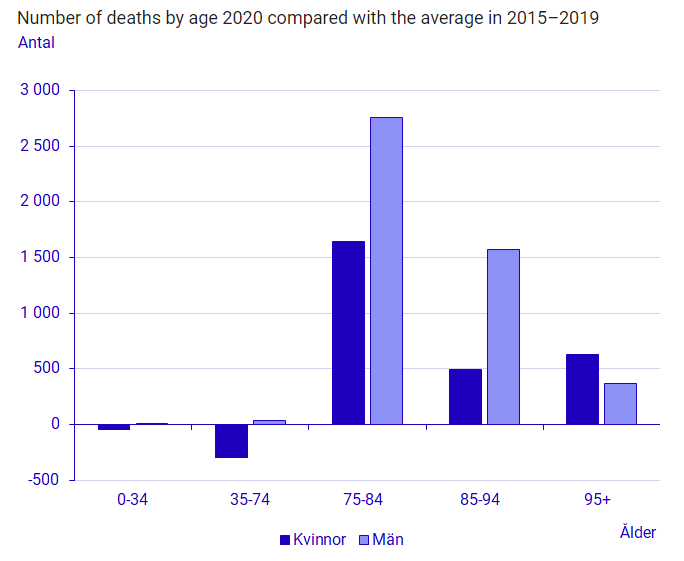
[kvinnor = women, man = men]

Excerpt: [via Google Translate]

Last year, it was especially in older ages that the number of deaths was more than in the immediately preceding years. The increasing number of deaths also affected men to a greater extent than women. The excess mortality rate last year was greatest among men older than 75 years, in the age group 75–84 years 20.6 per cent died more than during the comparison period. Among younger women 0-34 years, there was no excess mortality, -8.9 percent fewer died compared with the comparison period. For women, just like men, the differences were greatest in the oldest age groups; in the group aged 75–84, 14.7 per cent more deaths were noted than the average over the past five years.

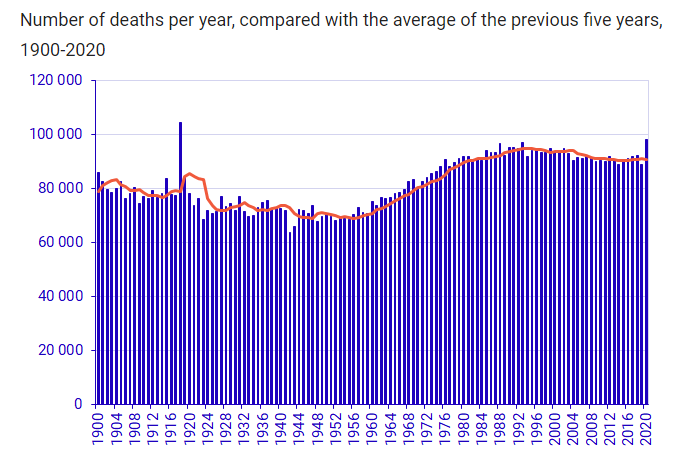
It is not easy to put the number of dead in a longer historical context. Not least because the demographic composition and population of the country has changed. The development of the number of deaths over time is affected partly by the medical development and partly by the development of various diseases and lifestyles. The number of deaths during different periods is also affected by how many are at the ages when most people die.

Publication Date: 22 February 2021

Publication Site: Statistics Sweden

A leaked report shows Pfizer’s vaccine is conquering covid-19 in its largest real-world test

Link: https://www.technologyreview.com/2021/02/19/1019264/a-leaked-report-pfizers-vaccine-conquering-covid-19-in-its-largest-real-world-test/

Excerpt:

A leaked scientific report jointly prepared by Israel’s health ministry and Pfizer claims that the company’s covid-19 vaccine is stopping nine out of 10 infections and the country could approach herd immunity by next month.

The study, based on the health records of hundreds of thousands of Israelis, finds that the vaccine may sharply curtail transmission of the coronavirus. “High vaccine uptake can meaningfully stem the pandemic and offers hope for eventual control of the pandemic as vaccination programs ramp up across the rest of the world,” according to the authors.

The nationwide study was described by the Israeli news website Ynet on Thursday, and a copy was obtained by MIT Technology Review.

Author(s): Joshua Mitnick, Antonio Regalado

Publication Date: 19 February 2021

Publication Site: MIT Technology Review

Covid vaccines: Boris Johnson pledges surplus to poorer countries at G7

Link: https://www.bbc.com/news/uk-politics-56117120

Excerpt:

Boris Johnson is pledging to donate most of the UK’s surplus vaccine supply to poorer countries in a speech to a virtual G7 meeting on Friday.

He urged rich countries to back a 100-day target for the developing new vaccines for future emerging diseases.

The UK has ordered more than 400 million doses of various vaccines, so many will be left over once all adults are vaccinated.

Publication Date: 20 February 2021

Publication Site: BBC News

Dogecoin Has a Top Dog Worth $2.1 Billion

Link: https://www.wsj.com/articles/dogecoin-has-a-top-dog-worth-2-1-billion-11613559022?mc_cid=4b04f7e31f&mc_eid=983bcf5922

Excerpt:

The dogecoin market has a pack leader.

Records show that a person, or entity, owns about 28% of all of the cryptocurrency in circulation—a stake worth about $2.1 billion at current prices. The holder’s identity isn’t known, which is common in the opaque world of digital currencies.

It is hard to tell what to make of this giant position in what has long been a small and niche corner of the cryptocurrency world.

Dogecoin was created in 2013 as a satirical homage to bitcoin. Its developers were riffing off the meme of a Shiba Inu dog with bad spelling habits. It wasn’t designed to be used as a form of payment, or as anything except a joke. At the start of 2021, a dogecoin was worth about half a cent, even as bitcoin prices had surged to nearly $30,000.

Author(s): Caitlin Ostroff

Publication Date: 17 February 2021

Publication Site: Wall Street Journal

U.S. insurers brace for hefty claims from Texas storm once thaw sets in

Link: https://www.reuters.com/article/usa-weather-texas-insurance/u-s-insurers-brace-for-hefty-claims-from-texas-storm-once-thaw-sets-in-idUSL1N2KO3AX

Excerpt:

U.S. property insurers are bracing for claims for damage from collapsing roofs, bursting pipes and lost business as Texas takes stock of its losses from a winter storm that has crippled its electrical grid.

Insurers’ losses could stretch into billions of dollars, said Moody’s analyst Jasper Cooper.

Insurers in Texas, the second-largest property insurance market among U.S. states, are used to grappling with historic storms, such as Hurricane Harvey in 2017.

But this winter storm is unique because of its grip across the state. It crippled the electric grid and left hundreds of thousands of homes without power for four days.

Author(s): Suzanne Barlyn

Publication Date: 18 February 2021

Publication Site: Reuters

What happened to coronavirus, flu ‘twin-demic’? Experts weigh in

Link: https://www.foxnews.com/health/how-flu-remained-low-amid-coronavirus-experts

Excerpt:

With coronavirus cases soaring in late summer, experts warned about the potential for a so-called “twin-demic,” which they said would’ve seen hospital systems overwhelmed by both COVID-19 and the influx of flu patients, but the surge never came. In fact, the Centers for Disease Control and Prevention (CDC), is reporting that flu activity in the U.S. “remains lower than usual for this time of year,” which is typically the peak of illnesses.

Since Oct. 1, 2020, or the start of flu season, there have been 165-laboratory confirmed flu-related hospitalizations in the U.S. According to the CDC, not only is this below average for this point in the season, it’s the lowest rate seen since data collection began in 2005.

So why did the influenza virus take a backseat to coronavirus? Experts say it’s a mix of factors, but mitigation measures put in place to stop the spread of COVID-19 likely played a big part.

Author(s): Alexandria Hein

Publication Date: 19 February 2021

Publication Site: Fox News