Trucking Failures Surged Last Year Under Pandemic

Link: https://www.wsj.com/articles/trucking-failures-surged-last-year-under-pandemic-11612827527

Excerpt:

U.S. trucking-company failures nearly tripled in 2020 from the previous year as fallout from the pandemic deepened pressure on smaller operators while well-capitalized bigger truckers held on and found stronger financial footing as the economy reopened.

Some 3,140 fleets shut down last year, a 185% jump from 2019, according to transportation industry data firm Broughton Capital LLC. Roughly half of the 2020 failures came in the second quarter, when freight volumes plummeted amid widespread shutdowns aimed at limiting the spread of Covid-19.

Author(s): Jennifer Smith

Publication Date: 8 February 2021

Publication Site: Wall Street Journal

New York Lawmakers Float Crackdown on Hedge Funds’ Sovereign-Debt Tactics

Link: https://www.wsj.com/articles/new-york-lawmakers-float-crackdown-on-hedge-funds-sovereign-debt-tactics-11612780201

Excerpt:

Some New York lawmakers are planning legislation designed to blunt hedge funds’ ability to resist sovereign-debt restructurings, while easing financial settlements for government borrowers in distress.

New York state Sen. Gustavo Rivera and Assemblywoman Maritza Davila, both Democrats, plan to introduce legislation as soon as this week to allow a supermajority of a nation’s creditors to amend or restructure its debt contracts and bind any dissenters that could otherwise hold out.

Many sovereign bonds in Latin America, Africa, and other emerging markets contain collective-action clauses that require all creditors to honor agreements that a majority of them make with the borrower. But others lack such mechanisms, leaving no ready way for settlements made with majority support to become binding on all members of a creditor class.

…..

A risk of the legislation is that investors would sue to challenge it because it could retroactively change certain contracts already in place. Changing contract rights can be justified under certain circumstances, if doing so advances a compelling state interest.

Author(s): Alexander Gladstone

Publication Date: 9 February 2021

Publication Site: Wall Street Journal

Report: Riverside County’s pension liabilities high, but gap gradually closing

Link: https://www.desertsun.com/story/news/politics/2021/02/09/report-riverside-countys-pension-liabilities-high-but-gap-gradually-closing/4457794001/

Excerpt:

According to the report, the county’s retirement apparatus is now 71% funded, compared to 70% in January 2020.

Although the unfunded pension gap increased from $3.5 billion to $3.6 billion in that time, the total market value of the county’s assets also grew, from $8.1 billion to $8.8 billion, according to PARC.

….

If investment growth remains positive, and the county’s financial condition does not suffer from additional financial shocks like the one stemming from coronavirus, PARC estimated that the 80% funded status could be attained by 2027.

Author(s): City News Service

Publication Date: 9 February 2021

Publication Site: Desert Sun

How Pandemic-Driven Revenue Shortfalls Could Affect State Pension Contributions

Link: https://www.pewtrusts.org/en/research-and-analysis/articles/2021/01/13/how-pandemic-driven-revenue-shortfalls-could-affect-state-pension-contributions

Excerpt:

As states respond to the Covid-19 pandemic, many also face severe revenue shortfalls because of the economic downturn. These gaps between resources and planned spending pose immediate challenges for policymakers, who must balance budgets while addressing increased demand for public health and other essential services. Some states have already tried to cut costs by reducing or delaying contributions to public pension plans, and others may consider doing so if federal aid to states does not materialize.

The pandemic’s effect on state budgets has been significant. Fiscal year 2020 marked the first time that state general fund revenues declined since the Great Recession, with preliminary projections issued since March showing that states expected fiscal 2021 revenues to fall below initial estimates by about 10%, on average. More recent estimates indicate that state revenue shortfalls could total more than $300 billion cumulatively over fiscal years 2020-22.

Author(s): David Draine & Stephanie Connolly

Publication Date: 13 January 2021

Publication Site: Pew Trusts

Twitter thread on Robinhood halting GME trading

Link: https://threadreaderapp.com/thread/1354952686165225478.html

Excerpt:

Robinhood (RH) is a broker. They don’t execute stock orders themselves. They sign up customers, route their orders to executing brokers, and keep track of who owns what. RH is also its own clearing broker, so they directly settle and custody their clients’ securities. 

Yes, RH is paid by Citadel to handle executing some of its order flow. This isn’t as nefarious as it sounds – Citadel Equity Securities is paying to execute retail orders because they aren’t pernicious (like having 500x the size behind them). 

…..

RH offered to open up stock market investing more broadly. They succeeded, clearly. But the regulations didn’t change – there are still pro-Wall St, pro-incumbent rules and capital requirements. It’s one of the most highly regulated industries in our nation. 

So @AOC is right to ask how it can be that Robinhood stopped its clients from buying certain securities. And what she’ll find is that the reason is that Dodd-Frank requires brokers like RH to post collateral to cover their clients’ trading risk pre-settlement. 

Author(s): Silent Cal

Publication Date: 28 January 2021

Publication Site: Twitter

Corte Madera moves to refinance pension obligation

Excerpt:

The town of Corte Madera is moving toward refinancing its $21.4 million pension liability to help manage its budget more effectively while still coping with a loss of revenue from the pandemic.

“We’re not out of the woods yet,” Mayor Eli Beckman said. “We are doing quite well relative to our worst fears and what we are seeing other municipalities get hit with. Corte Madera has been lucky.”

The town’s annual payments to the California Public Employees’ Retirement System, known as CalPERS, have ballooned from $733,000 in 2015 to $1.37 million this year, according to a Nov. 17 staff report. The town projects the annual payments will grow to $2.1 million by 2025 and $2.26 million by 2031.

Author(s): LORENZO MOROTTI

Publication Date: 20 January 2021

Publication Site: Marin Independent Journal

Editorial: Marin pension changes are painful but necessary

Excerpt:

The combination of reality and responsible caution is getting expensive for Marin public agencies that provide their workers with generous pensions.

The member agencies in the Marin County Employees’ Retirement Association are getting the latest dose and the association’s board voted to reduce its annual assumption rate on investment returns to 6.75%. It is a quarter of one percent reduction, but one that will cost agencies such as the county and the city of San Rafael thousands of dollars every year.

….

It recognizes a combination of expected returns on its stock market and real estate investments and that the number of pensioners is not only growing, but they are living longer and drawing more from the fund.

Living longer may be great news for the retirees, but it is an increased cost for MCERA.

Author(s): MARIN IJ EDITORIAL BOARD

Publication Date: 28 January 2021

Publication Site: Marin Independent Journal

The Covid Spend-O-Rama’s Multiemployer Pension Bailouts: Some Disappointed First Impressions

Link: https://www.forbes.com/sites/ebauer/2021/02/09/the-covid-spend-o-ramas-multiemployer-pension-bailouts–some-first-impressions/?sh=5fa34dbb2e62

Excerpt:

Which brings us to yesterday’s proposal. It is named the “Butch Lewis Emergency Pension Plan Relief Act of 2021” but it is not the “Butch Lewis Act” and it is not the “Emergency Pension Plan Relief Act of 2021.”

There are some commonalities, to be sure. The new bill maintains the provision which allows plans to use the “zone” status from prior to the pandemic to avoid designation as endangered, critical, or critical and declining. It allows plans to stretch their “funding improvement and rehabilitation period” from 10 to 15, or from 15 to 20 year, depending on the plan’s particulars. It permits plans to amortize asset losses over 30 years to reduce their required contributions — plus, added in the new version, the option to also defer recognizing “other losses related to the virus SARS-CoV-2” such as reductions in employment or increases in retirements.

But there’s another change that’s substantial. In the prior, HEROES Act version, the drafters maintained the concept of the “partition,” shifting liabilities for a portion of an at-risk pension to the PBGC and funneling extra funds there to be able to make those payments; to be sure, that version had planned to increase the maximum benefit substantially in order to protect retirees from benefit cuts, but the structure remained somewhat similar. The new proposal simply sends cash to eligible ailing multiemployer plans directly.

….

A straightforward read of this, then, is that every penny of pension benefits due to be paid to present or future retirees, for the next 30 years, would be paid by the federal government.

Author(s): Elizabeth Bauer

Publication Date: 9 February 2021

Publication Site: Forbes
Multiemployer Plan Bailout Caps Benefit Plan Limits

Link: https://www.asppa.org/news/multiemployer-plan-bailout-caps-benefit-plan-limits

Graphic:

Excerpt:

Legislation before the House Ways & Means Committee plans to help pay for a multiemployer plan bailout by utilizing a budget “gimmick” that would freeze retirement plan contribution limits—though not for collectively bargained plans. 

More specifically, the Butch Lewis Emergency Pension Plan Relief Act of 2021, included as subtitle H of a nine-part package that the committee plans to mark up this week, would impose a cost-of-living freeze on:

the Code Section 415(c) annual contribution limit for defined contribution plans; 

the Section 415(b)(1)(A) annual defined benefit limit; and 

the Section 401(a)(17) annual compensation limit. 

This appears to be designed to fill a budget hole in the 10-year scoring window—and as such would freeze these limits starting in calendar year 2030.[1] Ironically, it’s scored to lose money in the years leading up to the effective date, apparently anticipating that individuals will be inclined to increase contributions before the limits are imposed. 

Author(s): TED GODBOUT AND NEVIN E. ADAMS

Publication Date: 9 February 2021

Publication Site: ASPPA

Israel provides first signs of mass vaccination driving down virus cases

Link: https://www.ft.com/content/0cdc8563-1e6d-4089-bedb-b0f675c0d683

Graphic:

Excerpt:

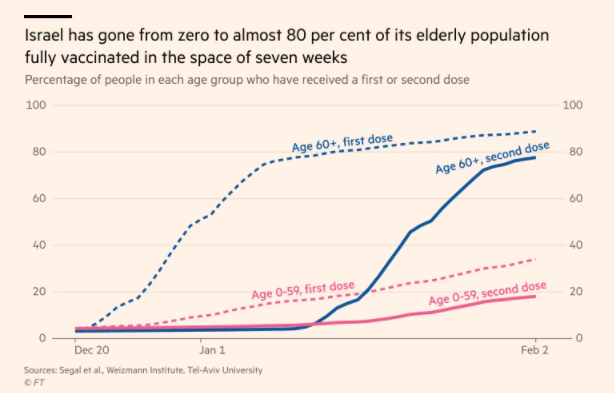
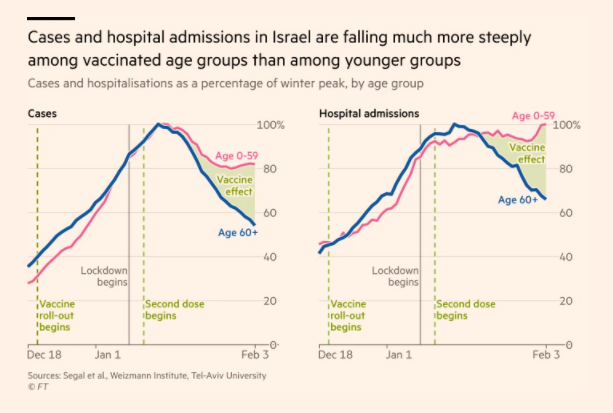
Cases and hospital admissions in Israel are falling steeply among vaccinated age groups in the first clear sign worldwide that Covid-19 jabs are preventing illness following a mass inoculation campaign.

Daily case rates among people aged 60 and above have fallen by 46 per cent relative to their mid-January peak, compared with a much smaller decline of 18 per cent among under-60s, according to analysis by a team from the Weizmann Institute of Science near Tel Aviv.

Author(s): John Burn-Murdoch in London and Mehul Srivastava

Publication Date: 5 February 2021

Publication Site: Financial Times

Congressional COVID relief package could help Texas bolster pension funds for teachers, state workers

Link: https://www.dallasnews.com/news/politics/2021/02/08/congressional-covid-relief-package-could-help-texas-bolster-pension-funds-for-teachers-state-workers/

Excerpt:

 With President Joe Biden and a Democratic-controlled Congress moving ahead on a coronavirus relief package, Texas budget writers are beginning to look at how they might use federal funds for one-time “investments,” such as bolstering pension funds for retired teachers and state workers.

….

That’s only one way state coffers could be altered now that the federal government is led by Democrats. Unlike Republicans who controlled the U.S. Senate during former President Donald Trump’s administration, the Democrats and Biden want to send money to aid state and local governments. Of a $1.9 trillion package, some $350 billion would go to states and localities.

….

“Those investments may be made in our retirement funds or one-time plugs or capital investments,” Kolkhorst said. She referred to lawmakers’ ongoing efforts to make the Teacher Retirement System and the Employees Retirement System more actuarially sound, and to deteriorating buildings used as state offices and at state mental hospital campuses.

Author(s): Robert T. Garrett

Publication Date: 8 February 2021

Publication Site: Dallas Morning News