The Cycle Plot

Link: https://policyviz.com/2021/02/09/the-cycle-plot/

Graphic:

Excerpt:

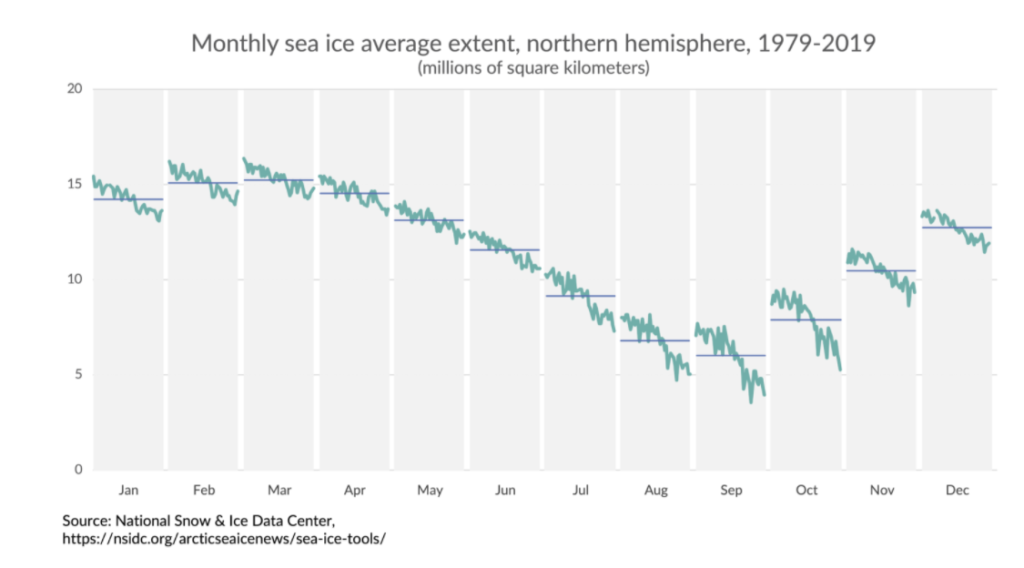
Two primary things came out of last week’s video from Kennedy Elliott about the cycle plot. First, Naomi Robbins shared the original paper where the cycle plot was introduced, which I hadn’t seen before. In William S. Cleveland & Irma J. Terpenning’s Graphical Methods for Seasonal Adjustment (1982) paper, they focus on the importance of seasonal adjustments in various data series and how graphs and charts should be a routine part of the process of seasonally adjusting data.

Spreadsheet link: https://policyviz.com/wp-content/uploads/2021/02/SeaIceIndex_to_share.xlsx

Publication Date: 9 February 2021

Publication Site: PolicyViz

DATA VISUALIZATION CATALOGS

Link: https://policyviz.com/wp-content/uploads/2021/02/DataCatalogs.pdf

Excerpt:

This is a list of data visualization catalogs and collections. It is inspired by the lists
published by Yuri Engelhardt and others. It is provided for your use and reference.
• 6 Ways to Visualize Graphs | https://www.twosixlabs.com/6-ways-visualizegraphs
• 9 Ways to Visualize Proportions | http://flowingdata.com/2009/11/25/9-waysto-visualize-proportions-a-guide/
• 45 Ways to Communicate Two Quantities |
https://www.scribblelive.com/blog/2012/07/27/45-ways-to-communicatetwo-quantities/

Accessed: 10 February 2021

Publication Site: PolicyViz

Negative Interest Rates Are Coming, but There Is No Chance That They Will Work

Link: https://www.nakedcapitalism.com/2021/02/negative-interest-rates-are-coming-but-there-is-no-chance-that-they-will-work.html

Graphic:

Excerpt:

As The Guardian and many other newspapers reported yesterday, the Bank of England yesterday announced that it was preparing the ground for negative official interest rates within six months.

As the Bank has suggested, this does not mean that there will be negative rates. But unless they allow for the possibility if that now they will, as they admit, restrict their policy options. In that case this announcement has to be seen as creating the possibility of negative nominal interest rates.

….

Sixth, it is an unfortunate fact that this will not work. As I have already noted, in practice we already have real negative interest rates. There is nothing new then about this policy. And since existing negative rates have not stopped people saving, making such rates official will have little macro impact. After a crisis people are cautious. They are willing to pay the price of a government guarantee. And if that is a negative interest rate, so be it. I suggest that will continue to be true for several years based on past trends.

My suggestion is, then, that the Bank can try this policy but it will be a vain attempt to stimulate the economy that will not succeed. Much more radical thinking is required to achieve that. I will address that in another post, soon. I will link it when it is up.

Author(s): Yves Smith, Richard Murphy

Publication Date: 6 February 2021

Publication Site: naked capitalism
As Pandemic Continues, More in U.S. and Europe Feel Major Impact on Their Lives

Graphic:

Excerpt:

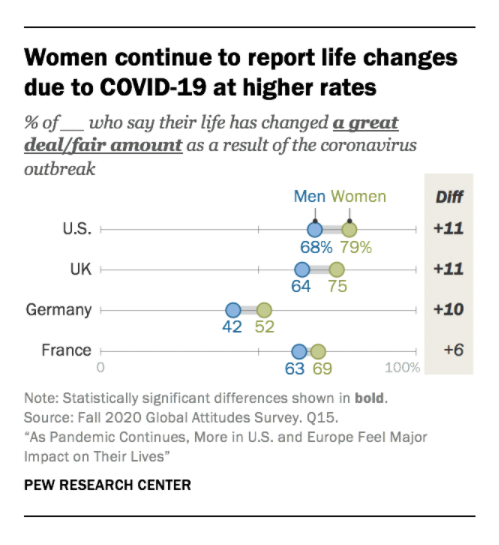
The novel coronavirus continues to pose weighty challenges for people around the world. Significant shares of the public in the United States, France, Germany and the United Kingdom say their lives have changed because of the outbreak, according to a new Pew Research Center survey conducted as vaccines were first being approved for conditional use in the UK and U.S. and  restrictions tightened in parts of Europe. And the shares who feel this way have grown notably since summer, when the Center reported already-high levels of impact in people’s lives. 

At the same time, as coronavirus case counts soar in each of these four nations, publics are largely split on whether their country has done a good job handling the outbreak. Ideology plays a role in people’s assessments of their national coronavirus response, but this rings especially true in the U.S. and UK, where those on the political left are more critical. Those who feel better about their nation’s economic situation are more likely to give positive reviews of how the virus has been handled thus far. 

Author(s): KAT DEVLIN AND NICHOLAS KENT

Publication Date: 3 February 2021

Publication Site: Pew Research Center

COVID-19 Severity Prediction

Link: https://covidseverity.com//

Graphic:

Excerpt:

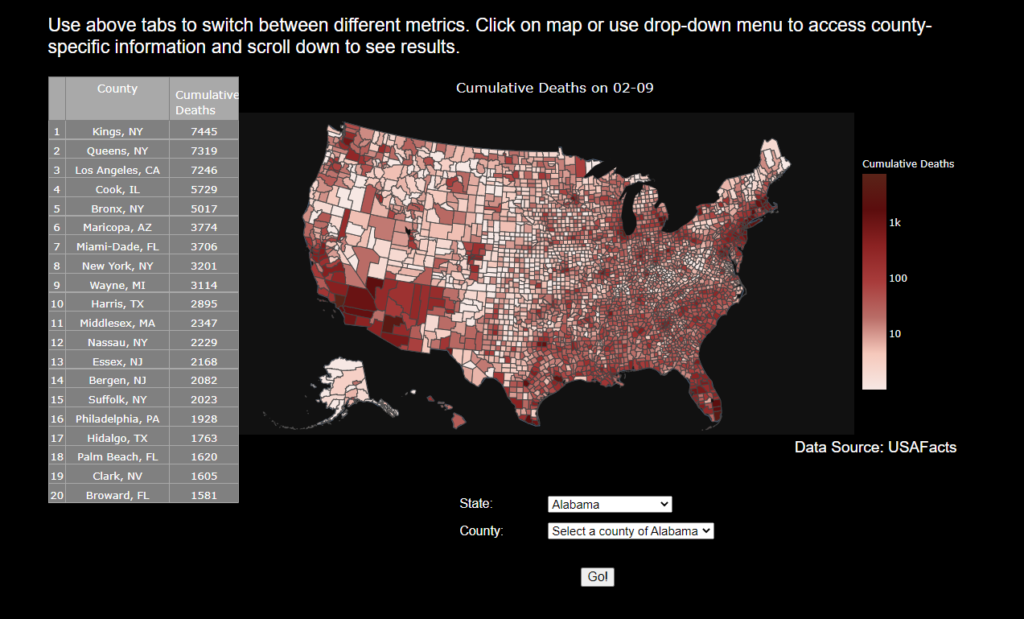
The Yu Group at UC Berkeley Statistics / EECS / CCB is working to help forecast the severity of the epidemic for individual counties and hospitals in the US. We develop interpretable models (updated daily) and curate data to predict the trajectory of COVID-19-related deaths. This website provides access to those predictions, in the form of interactive visualizations. We are collaborating with Response4Life to blunt the effect of COVID-19 through the production and appropriate distribution of PPE, medical equipment, and medical personnel to healthcare facilities across the United States.

For hospital level prediction, please go to our hospitalization prediction page where one can upload data for a specific hospital and download prediction results for the given hospital. The uploaded data will only be temporarily used for prediction and will not be collected.GITHUB

Author(s): Yu Group, UC Berkeley Statistics / EECS / CCB

Accessed Date: 10 February 2021

New Study Finds Pandemic-Spurred Technologies Lowered Barriers to Exit in High-Cost States

Link: https://myemail.constantcontact.com/Press-Release–New-Study-Finds-Pandemic-Spurred-Technologies-Lowered-Barriers-to-Exit-in-High-Cost-States.html?soid=1107718355130&aid=MZYC-NYVCD4

Excerpt:

Both employers and households will find it easier to leave major job centers as technologies made commonplace by the COVID-19 pandemic have led to a rethinking of the geography of work, according to a new study published by Pioneer Institute. 

“The pandemic has changed the calculus on whether telecommuting is worth it, for both employers and workers,” said Andrew Mikula, author of “Barriers to Exit Lowered in High-Cost States as Pandemic-Related Technologies Changed Outlook.” 

The study draws on survey data projecting that a third of workers could be permanent telecommuters by the end of 2021 and discusses implications of these trends for transportation, municipal finance, and wealth migration. While worst-case scenarios could bring a level of disinvestment in places like New York City not seen since the 1970s, even a mid-range scenario suggests a significant relocation of jobs and potentially wealth.

Author(s): Pioneer Institute

Publication Date: 10 February 2021

Publication Site: Constant Contact

House panel to weigh multiemployer pension reform bill

Link: https://www.pionline.com/legislation/house-panel-weigh-multiemployer-pension-reform-bill

Excerpt:

Legislation to help struggling multiemployer pension funds is to be considered this week by a key House panel as part of a COVID-19 relief measure.

The House Ways and Means Committee is expected to start marking up a package of pandemic relief measures Wednesday, including one aimed at stabilizing pensions for more than 1 million participants in multiemployer plans approaching insolvency.

The pension section of the proposed Emergency Pension Plan Relief Act of 2021 is cited as the “Butch Lewis 4 Emergency Pension Plan Relief Act of 2021.”

It is based on a previously proposed multiemployer pension relief bill named for retiree Butch Lewis that called for a federal loan program for struggling plans and more resources for the Pension Benefit Guaranty Corp. to help troubled plans through partitions.

Author(s): Hazel Bradford

Publication Date: 9 February 2021

Publication Site: Pensions & Investments

Illinois Gov. JB Pritzker’s Budget Plan Won’t Push For An Income Tax Hike For Next Year

Link: https://www.wbez.org/stories/illinois-gov-pritzkers-budget-plan-holds-the-line-on-income-taxes-for-next-year/fd2e0e14-bf3d-49c0-a4e8-5d9de7395b34

Excerpt:

Illinois Gov. JB Pritzker’s 2022 state budget proposal won’t include an income tax hike, but it will seek the elimination of $900 million in business tax credits and aims to hold spending at current levels, the governor’s office said Tuesday.

The Democratic governor will present his budget outline on Feb. 17. It’s Pritzker’s first spending plan since the November defeat of his constitutional amendment to impose a graduated income tax.

The outline he will present to lawmakers for the state fiscal year that begins July 1 includes a $3 billion deficit – less than the $5.5 billion originally forecast.

Author(s): Dave McKinney, Tony Arnold

Publication Date: 9 February 2021

Publication Site: WBEZ

Lamont leans heavily on federal aid to keep taxes flat in CT

Excerpt:

Gov. Ned Lamont proposed a two-year, $46 billion budget Wednesday that relies on federal funding and state reserves to close a major deficit without significant tax hikes while bolstering aid for municipalities and school districts.

But the package also leaves Connecticut with several budget challenges to be resolved in the not-so-distant future.

The package would channel more than $400 million in emergency federal relief  to low-performing school districts. But it also would suspend plans to bolster regular state-funded aid for municipal schools by $90 million in the next two-year budget cycle.

Author(s): Keith Phaneuf

Publication Date: 10 February 2021

Publication Site: CT Mirror

To What Extent Does Your State Rely on Individual Income Taxes?

Graphic:

Excerpt:

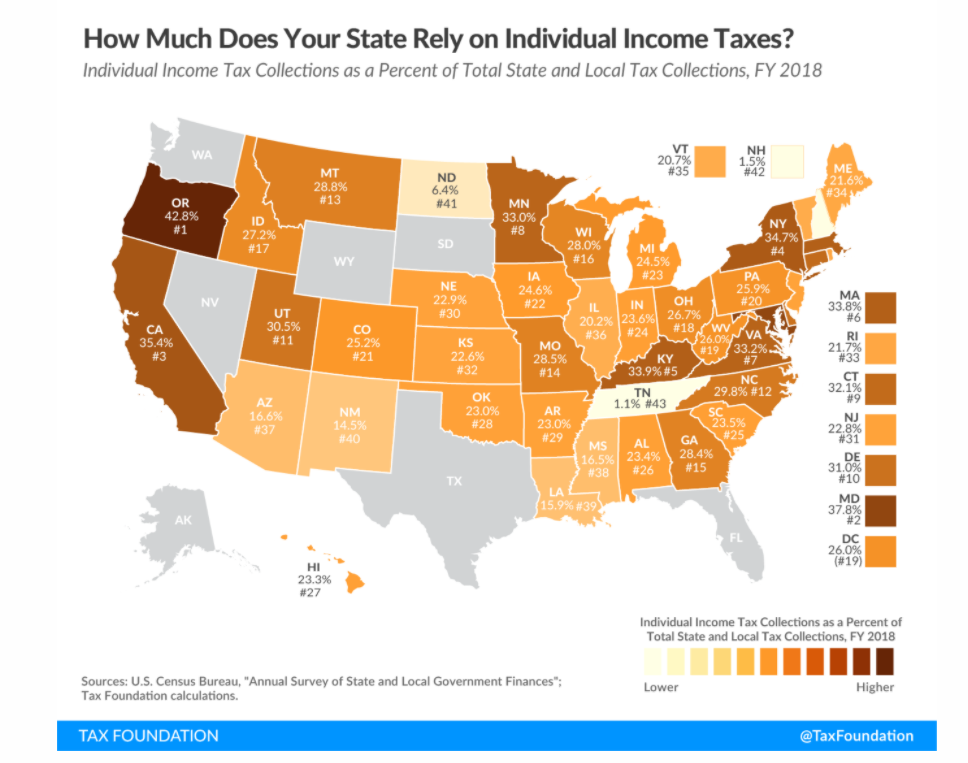
Sources of state revenue have come under closer scrutiny in light of the impact of the coronavirus pandemic, as different tax types have differing volatility and economic impact—although even beyond these unique circumstances, it is important for policymakers to understand the trade-offs associated with different sources of tax revenue. This week’s map looks at what percentage of each state’s state and local tax collections is attributable to the individual income tax.

State and localities rely heavily on the individual income tax, which accounted for 24.2 percent of total U.S. state and local tax collections in fiscal year 2018, the latest year for which data are available. The individual income tax ranks just above the general sales tax (23.3 percent) and behind property taxes (31.1 percent), taking its place as the second largest source of state and local revenue.

Author(s): Janelle Cammenga

Publication Date: 10 February 2021

Publication Site: Tax Foundation