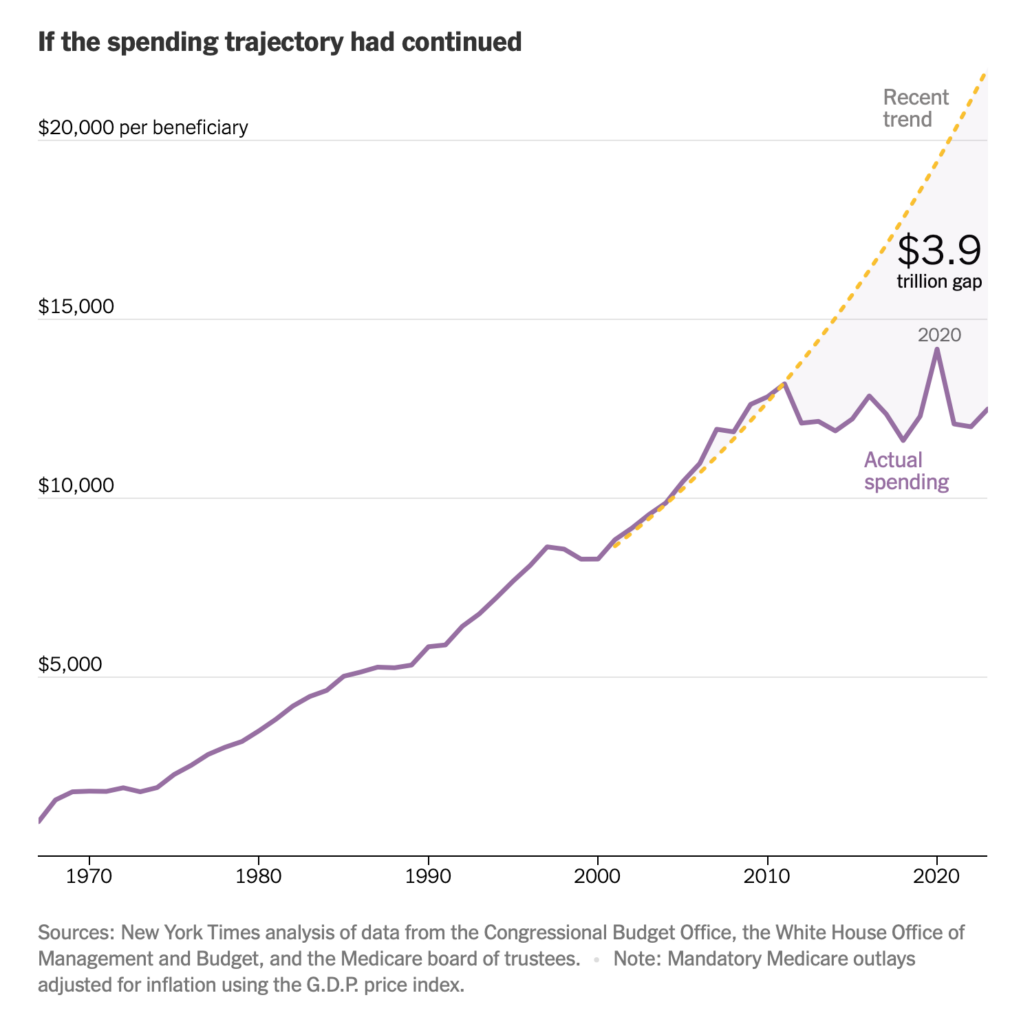
A Huge Threat to the U.S. Budget Has Receded. And No One Is Sure Why

Link: https://www.nytimes.com/interactive/2023/09/05/upshot/medicare-budget-threat-receded.html?smid=url-share

Graphic:

Excerpt:

For decades, runaway Medicare spending was the story of the federal budget.

Now, flat Medicare spending might be a bigger one.

Something strange has been happening in this giant federal program. Instead of growing and growing, as it always had before, spending per Medicare beneficiary has nearly leveled off over more than a decade.

The trend can be a little hard to see because, as baby boomers have aged, the number of people using Medicare has grown. But it has had enormous consequences for federal spending. Budget news often sounds apocalyptic, but the Medicare trend has been unexpectedly good for federal spending, saving taxpayers a huge amount relative to projections.

….

Some of the reductions are easy to explain. Congress changed Medicare policy. The biggest such shift came with the Affordable Care Act in 2010, which reduced Medicare‘s payments to hospitals and to health insurers that offered private Medicare Advantage plans. Congress also cut Medicare payments as part of a budget deal in 2011.

But most of the savings can’t be attributed to any obvious policy shift. In a recent letter to the Senate Budget Committee, economists at the Congressional Budget Office described the huge reductions in its Medicare forecasts between 2010 and 2020. Most of those reductions came from a category the budget office calls “technical adjustments,” which it uses to describe changes to public health and the practice of medicine itself.

Older Americans appear to be having fewer heart attacks and strokes, the likely result of effective cholesterol and blood pressure medicines that became cheap and widely used in recent years, according to research from Professor Cutler and colleagues. And drug makers and surgeons haven’t developed as many new blockbuster treatments recently — there has been no new Prozac or angioplasty to drive up spending. (Medicare is currently barred by statute from covering the new class of expensive anti-obesity drugs.)

….

Medicare may even wind up saving money because of Covid-19 — because the older Americans who died from the disease tended to have other illnesses that would have been expensive to treat if they had survived, according to an analysis from the Medicare actuary.

Author(s): Sanger-Katz, Margot; Parlapiano, Alicia

Publication Date: 5 Sept 2023

Publication Site: NY Times
Unhealthy Longevity in the United States

Link: https://www.soa.org/resources/research-reports/2023/unhealthy-longevity-us/

PDF: https://www.soa.org/4a525c/globalassets/assets/files/resources/research-report/2023/unhealthy-longevity-us.pdf

Graphic:

Excerpt:

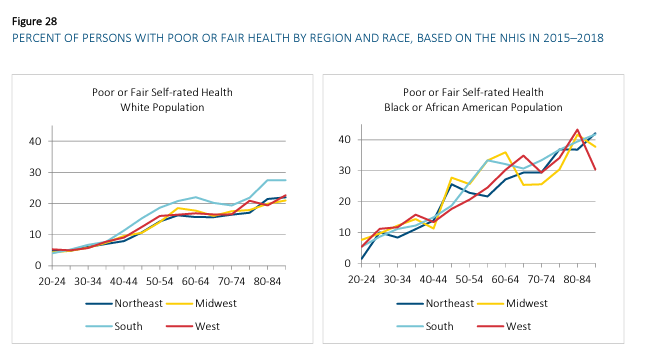
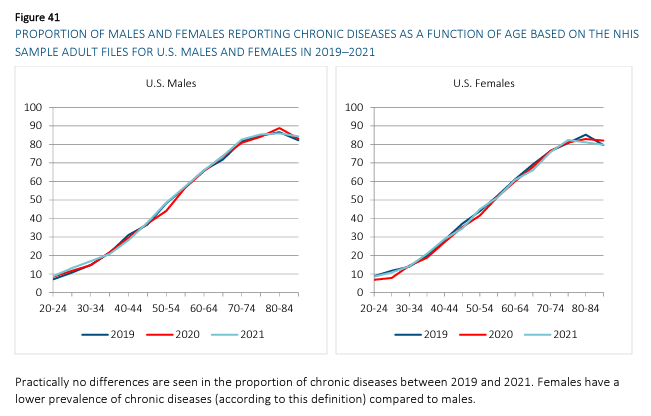
The SOA Research Institute’s Mortality and Longevity Strategic Research Program is pleased to make available a research report that quantifies differences in mortality and disease prevalence by health status. Additionally, period life tables by health status, sex, and age are available in Appendix D.

Author(s):

Natalia S. Gavrilova, Ph.D.
Leonid A. Gavrilov, Ph.D.

NORC at the University of Chicago

Publication Date: August 2023

Publication Site: Society of Actuaries

Fatality Inspection Data – Work-related fatalities for cases inspected by Federal or State OSHA

Link: https://www.osha.gov/fatalities

Archive data: https://www.osha.gov/fatalities/reports/archive

Excerpt:

This page provides data on work-related fatalities that occurred under Federal OSHA and State Plan jurisdiction for cases that have been closed or citations issued on or after January 1, 2017.

Employers must report worker fatalities to OSHA within eight hours. OSHA investigates all work-related fatalities in all covered workplaces. The agency has up to six months to complete an investigation and determine whether citations will be issued.

The table below can be modified or searched by inserting additional information in the boxes above each column.

COVID-19-related fatalities are provided in the “COVID-19” tab below, and are not included in the CY 2017-22 list.

Publication Date: accessed 5 Sep 2023

Publication Site: OSHA, Department of Labor

State legislators: Oregon treasury’s investment choices create risk to us all

Link: https://www.portlandtribune.com/opinion/state-legislators-oregon-treasury-s-investment-choices-create-risk-to-us-all/article_65cae490-406b-11ee-a841-a3bbfbc99a7f.html

Excerpt:

The Oregon Public Employee Retirement System (PERS) pension fund has been in the national spotlight recently because of risks from private investments hidden from the public. What risks? Risk to public employees’ retirement, risk to taxpayers who have to pick up the shortfall, risk to workers as private equity asset managers rake in huge profits at Oregonians’ expense, risk to all Oregonians as private equity undermines our communities, and risk to the climate as private equity firms are uniquely exposed to fossil fuel companies.

A recent article in the business section of The New York Times, “The Risks Hidden in Public Pension Funds,” focuses on the Oregon treasury’s unusually large private investments in PERS. The treasury has long hailed its private equity investments for producing high rates of return, overlooking warning signs that the managers report earnings that turn out to be overstated. The Times reported, “they aren’t taking account of the true risks embedded in private equity. Oregon’s pension fund is over 40% more volatile than its own reported statistics show.”

…..

Divest Oregon’s 2022 report, “Oregon Treasury’s Private Investment Transparency Problem,” documents that more than 50% of PERS is in private investments, with various labels (“private equity,” “alternatives,” “opportunity,” even real estate).

These private funds are heavily invested in coal, oil and gas. The treasury increased its investments in fossil fuels in private investments from 2021 to 2022 (the most recent data released by the state) and continues to invest billions in the fossil fuel industry in 2023, for example in the private investment firm GNP. While Divest Oregon applauds Treasurer Tobias Read in his work to create a “decarbonization plan” for PERS, the treasurer must respond to calls to stop new private investments that fund the climate crisis.

Author(s): State Sen. Jeff Golden and state Reps. Khanh Pham and Mark Gamba

Publication Date: 29 Aug 2023

Publication Site: Portland Tribune

Public Pensions: Double-Check Those ‘Shadow Banker’ Investments

Link:https://www.governing.com/finance/public-pensions-double-check-those-shadow-banker-investments

Excerpt:

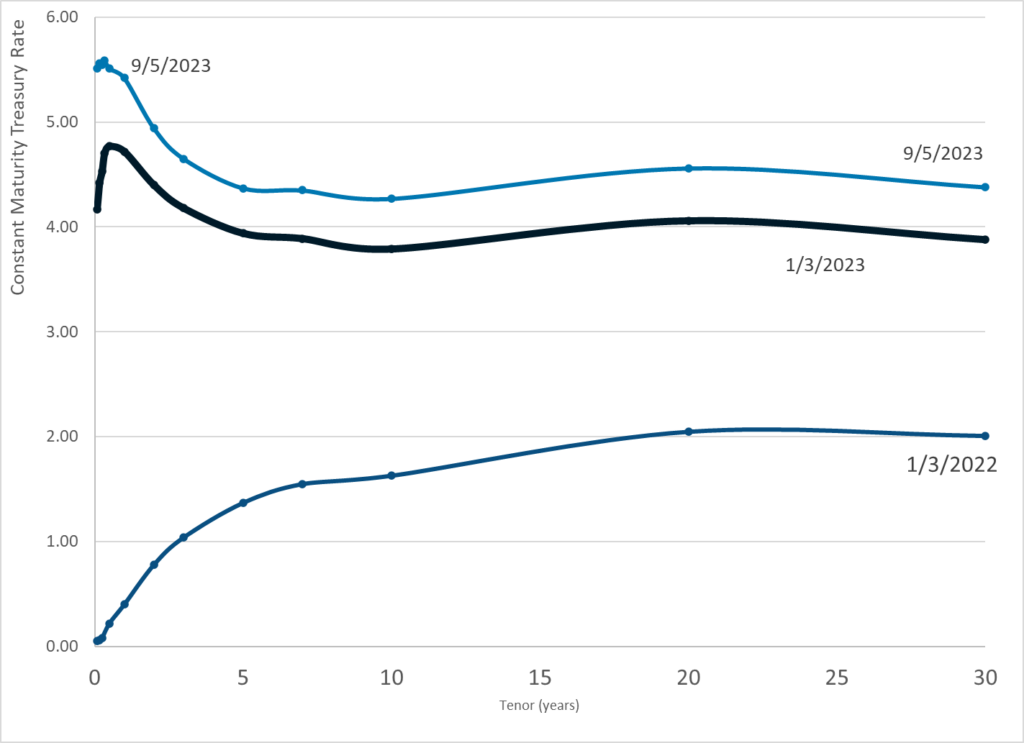
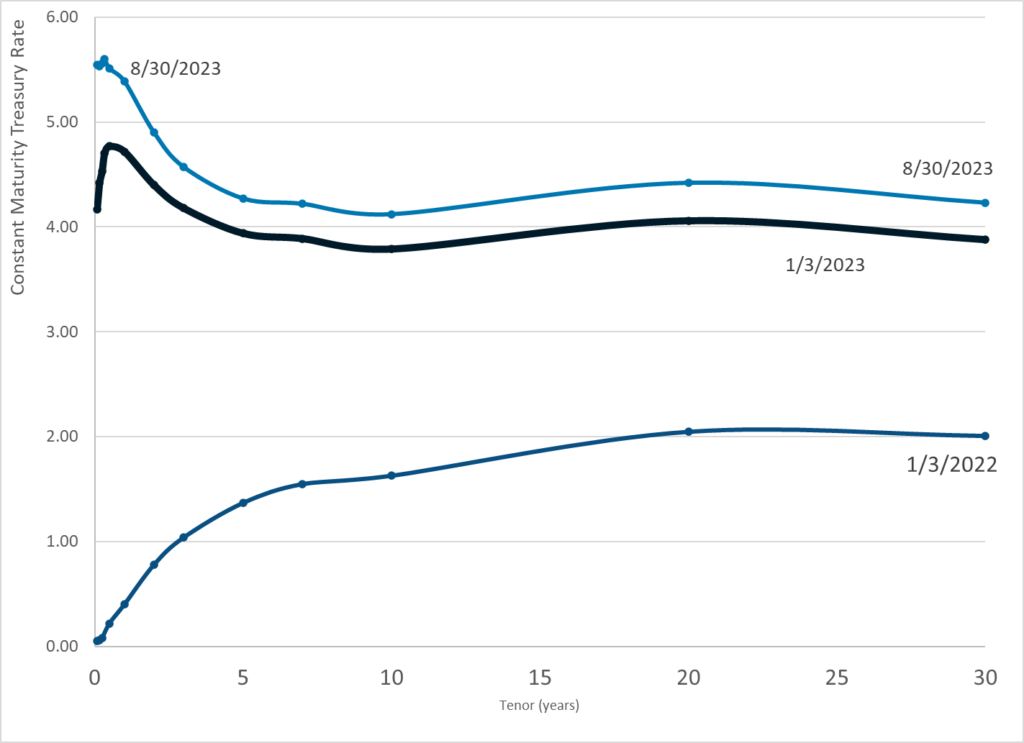
For almost a decade leading up to 2021, bond yields were suppressed by low inflation and central bank stimulus. To make up for scanty interest rates on their bond investments, many public pension funds followed the lead of their consultants and shifted some of their portfolios into private credit funds. These “shadow bankers” have taken market share from traditional lenders, seeking higher interest rates by lending to non-prime borrowers.

Even during the pandemic, this strategy worked pretty well, but now skeptics are warning that a tipping point may be coming if double-digit borrowing costs trigger defaults. It’s time for pension trustees and staff to double-check what’s under the hood.

For the most part, the worst that many will find is some headline risk with private lending funds that underwrite the riskiest loans in this industry. Even for the weakest of those, however, the problem will not likely be as severe as the underwater mortgages that got sliced, diced and rolled up into worthless paper going into the global financial crisis of 2008. And until and unless the economy actually enters a full-blown recession, many of the underwater players will still have time to work out their positions.

The point here is not to sound a false alarm or besmirch the private credit industry. Rather, it’s highlighting what could eventually become soft spots in some pension portfolios in time to avoid doubling down into higher risks and to encourage pre-emptive staff work to demonstrate and document vigilant portfolio oversight.

Author(s):Girard Miller

Publication Date: 8 Aug 2023

Publication Site: Governing