The estimated number of suicide deaths in the United States rose to nearly 50,000 in 2022, according to provisional data released on Thursday from the Centers for Disease Control and Prevention. The total would be an increase of approximately 2.6 percent since 2021.
The C.D.C. estimates the overall number of deaths to be 49,449 but has not yet calculated the suicide rates for 2022. Given that the U.S. population grew by about 0.4 percent in 2022, a 2.6 percent increase in deaths indicates that suicide rates are continuing to rise, although not universally among all groups.
Suicide deaths have fluctuated somewhat over the years and declined in 2019 and 2020. But the overall suicide rate, or the number of suicides per 100,000 people, has increased by about 35 percent over the last two decades. People 65 and older had the highest increase in the number of deaths by suicide in 2022 among the various age groups.
Back on July 18, the Equable Institute released the 2023 version of its annual State of Pensions report, which means that, yes, it’s time for another check-in on these infamously-poorly-funded pension plans. Among the wealth of tables is a list of the best and worst-funded of the 58 local pension plans studied, and, yes, you guessed it, the bottom five spots are Chicago plans, with the bottom three at levels far below all others:
Municipal employees, 21% funded,
Chicago police, 21.8% funded, and
Chicago fire, 18.8% funded.
Combined with the Chicago Laborers’ pension fund, with a 41% funded status, the pensions for which the city bears a direct responsibility have a total pension debt on a market value of assets basis of $35 billion. (This data is from the actual reports*, released in May, which doesn’t match the Equable report precisely.) Spot fifth-worst is taken up by the Chicago Teachers, at 42.4% funded, and the first non-Chicago system in their list, Dallas Police & Fire at 45.2%, is twice as well funded, percentage-point-wise, as the Terrible Trio.
…..
What’s more, Ralph Martire and his Center for Tax and Budget Accountability continue to promote what he calls “reamortization” as a solution to the problem, both through an April Chicago Sun Times commentary and through the release of a report, “Understanding – and Resolving Illinois’ Pension Funding Challenges” (which is an update of a prior proposal). This proposal, which is directed at Illinois pensions but is clearly meant based on other comments to be an all-purpose fix, sounds innocuous, as merely a sort of “refinancing” as one might with a mortgage, but it’s really much more as he proposes to
Reduce the funded status target from 90% to 80%, based on the claim that the GAO deems this funded status to be the right target for a “healthy” plan (whether he deliberately misleads or not, he is wrong here, the National Association of State Retirement Administrators or NASRA clearly explained more than a decade ago that 100% funding is always the right target and the only significance of an 80% level is that private sector pension law requires plans funded less than 80% to take immediate corrective action rather than have a long-term funding schedule, and the American Academy of Actuaries more explicitly calls this a “myth”);
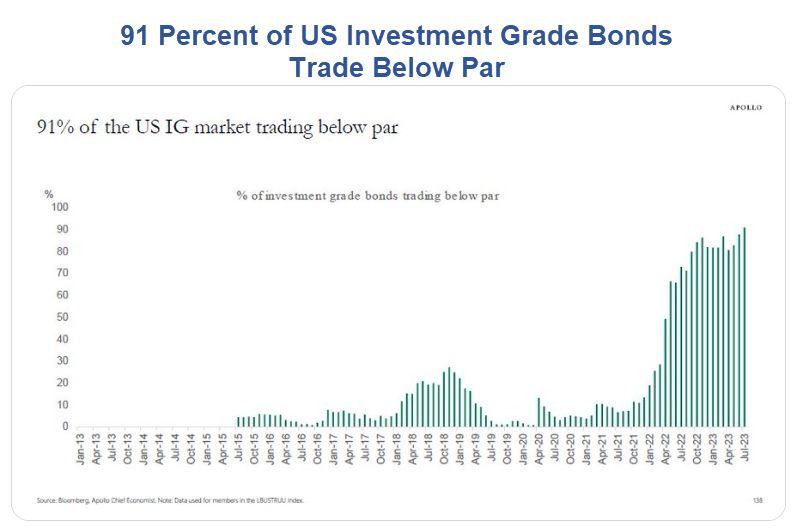
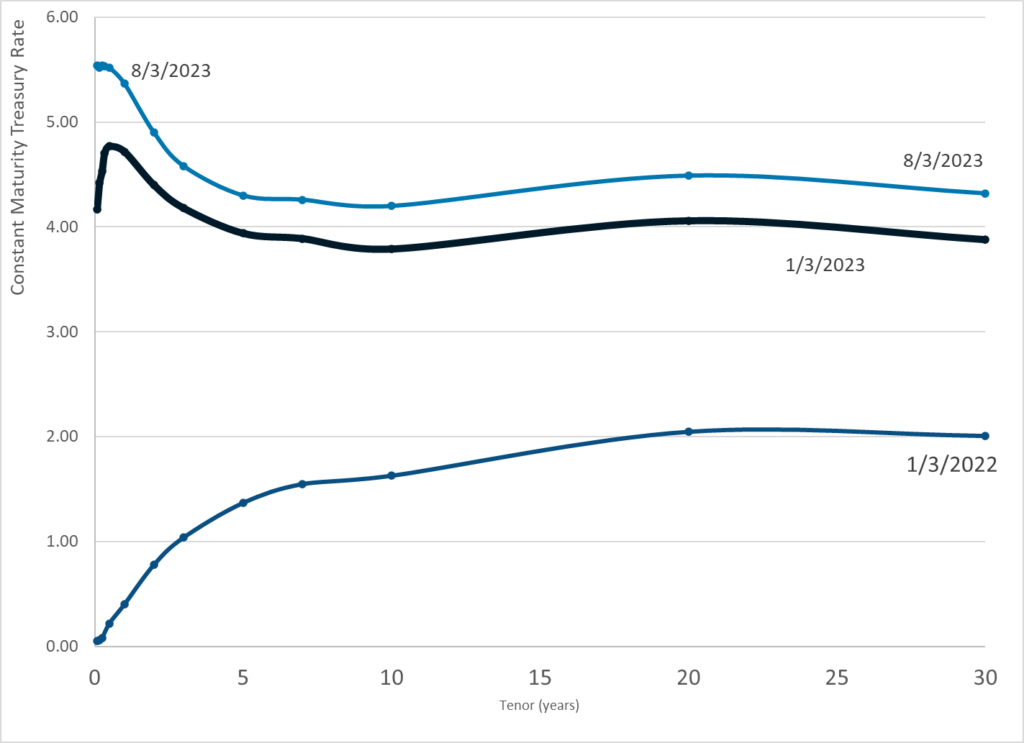
Issue large sums of Pension Obligation Bonds, which were questionable already when they first began promoting this but are now a terrible idea with our current high bond rates, all the more so for a low-credit-rating city such as Chicago; and
Move contributions from last day of the fiscal year to the first day, which he argues would be a gain of a year’s investment return while forgetting that it requires the city to have this money on Day 1 and forgo the other uses it would have.
However, a second tab in the spreadsheet contained multiple entries in relation to more than 10,000 individuals. For each individual, there are 32 pieces of data meaning that in total, there are about 345,000 pieces of data in the file.
The spreadsheet, which has been seen by the Belfast Telegraph after we were alerted to it by a relative of a serving officer, includes each officer’s service number, their status, their gender, their contract type, their last name and initials, details of how much of the week they work, and their rank.
It also includes the location where they are based (but not their home address), their duty type (from chief constable to detective, intelligence officer and so on), details of their unit (such as the anti-corruption unit or the vetting department), their branch and department, and other technical information about their employment.
There are 10,799 entries in the database. There are 9,276 police officers and police staff. It is not clear if the additional entries relate to other employees or former employees.
The data has been removed from the internet.
There are details of staff who are suspended, on career breaks, or partly retired.
It reveals members of the organised crime unit, telecom liaison officers, intelligence officers stationed at ports and airports, PSNI pilots in its air support unit, officers in the surveillance unit and – of acute sensitivity – almost 40 PSNI staff based at MI5’s headquarters in Holywood.
There are a tiny number of individuals whose unit is given as “secret”. But although that does not disclose precisely what they do, it marks them out as operating in an acutely sensitive area – and then gives their name.
Franklin, who was a printer, among his other roles, was known for marking his early paper money with images of intricately veined leaves that were nearly impossible for counterfeiters to copy, using a variety of fonts, some available only to him, and intentionally lacing the text with misspellings.
But scientists say Franklin took things a step further to stave off fraudsters. Other distinguishing characteristics of Franklin’s money—the new research revealed through advanced atomic-level imaging methods—were more subtle. He used a unique black ink. His paper glimmered. Blue threads decorated the surface, and finer fibers were woven throughout.
Researchers detailed the innovations in a paper published Monday in the journal Proceedings of the National Academy of Sciences. The findings describe previously unknown methods Franklin developed to safeguard printed money notes against counterfeiting.
Everyone knows, or at least should know, that the “Big 3” rating agencies that rate about 98 percent of all debt all issue trash ratings. Here’s the background on how that happened.
Rating agencies used to get paid by investors on the basis of how well they did at estimating the likelihood of default. The better your ratings, the more sought out your opinions.
In the mid 1970s, the SEC created nationally recognized statistical ratings organizations (NRSROs). Following that idiotic regulation, the rating agencies got paid on the basis of how much debt they rated, not how accurate their ratings were. Fees come from corporations issuing debt, not investors seeking true default risk.
The more stuff you rate AAA, the more business you get from companies who want their debt rated. The new model is ass backward, and why ratings are trash. A genuine fiasco happened with ratings during the Great Financial Crisis with tons of garbage rated AAA went to zero.
There should not be NRSROs. The SEC made matters much worse, except of course for the Big 3 who have a a captured, mandated audience, coupled with massive conflicts of interest.
Question Was political party affiliation a risk factor associated with excess mortality during the COVID-19 pandemic in Florida and Ohio?
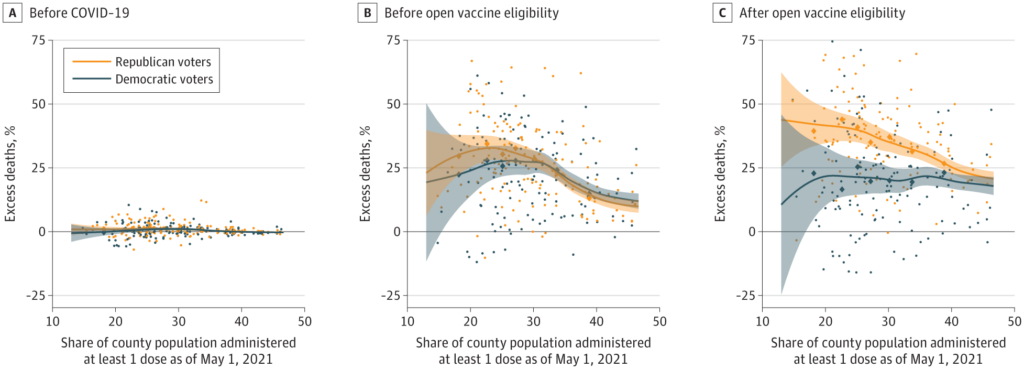
Findings In this cohort study evaluating 538 159 deaths in individuals aged 25 years and older in Florida and Ohio between March 2020 and December 2021, excess mortality was significantly higher for Republican voters than Democratic voters after COVID-19 vaccines were available to all adults, but not before. These differences were concentrated in counties with lower vaccination rates, and primarily noted in voters residing in Ohio.
Meaning The differences in excess mortality by political party affiliation after COVID-19 vaccines were available to all adults suggest that differences in vaccination attitudes and reported uptake between Republican and Democratic voters may have been a factor in the severity and trajectory of the pandemic in the US.
Abstract
Importance There is evidence that Republican-leaning counties have had higher COVID-19 death rates than Democratic-leaning counties and similar evidence of an association between political party affiliation and attitudes regarding COVID-19 vaccination; further data on these rates may be useful.
Objective To assess political party affiliation and mortality rates for individuals during the initial 22 months of the COVID-19 pandemic.
Design, Setting, and Participants A cross-sectional comparison of excess mortality between registered Republican and Democratic voters between March 2020 and December 2021 adjusted for age and state of voter registration was conducted. Voter and mortality data from Florida and Ohio in 2017 linked to mortality records for January 1, 2018, to December 31, 2021, were used in data analysis.
Exposures Political party affiliation.
Main Outcomes and Measures Excess weekly deaths during the COVID-19 pandemic adjusted for age, county, party affiliation, and seasonality.
Results Between January 1, 2018, and December 31, 2021, there were 538 159 individuals in Ohio and Florida who died at age 25 years or older in the study sample. The median age at death was 78 years (IQR, 71-89 years). Overall, the excess death rate for Republican voters was 2.8 percentage points, or 15%, higher than the excess death rate for Democratic voters (95% prediction interval [PI], 1.6-3.7 percentage points). After May 1, 2021, when vaccines were available to all adults, the excess death rate gap between Republican and Democratic voters widened from −0.9 percentage point (95% PI, −2.5 to 0.3 percentage points) to 7.7 percentage points (95% PI, 6.0-9.3 percentage points) in the adjusted analysis; the excess death rate among Republican voters was 43% higher than the excess death rate among Democratic voters. The gap in excess death rates between Republican and Democratic voters was larger in counties with lower vaccination rates and was primarily noted in voters residing in Ohio.
Conclusions and Relevance In this cross-sectional study, an association was observed between political party affiliation and excess deaths in Ohio and Florida after COVID-19 vaccines were available to all adults. These findings suggest that differences in vaccination attitudes and reported uptake between Republican and Democratic voters may have been factors in the severity and trajectory of the pandemic in the US.
Author(s): Jacob Wallace, PhD1; Paul Goldsmith-Pinkham, PhD2; Jason L. Schwartz, PhD1