Social Media Is Fueling Enthusiasm for New Weight Loss Drugs. Are Regulators Watching?

Link: https://kffhealthnews.org/news/article/social-media-is-fueling-enthusiasm-for-new-weight-loss-drugs-are-regulators-watching/

Excerpt:

Competition to claim a market that could be worth $100 billion a year for drugmakers alone has triggered a wave of advertising that has provoked the concern of regulators and doctors worldwide. But their tools for curbing the ads that go too far are limited — especially when it comes to social media. Regulatory systems are most interested in pharma’s claims, not necessarily those of doctors or their enthused patients.

Few drugs of this type are approved by the FDA for weight loss — they include Novo Nordisk’s Wegovy. But after shortages made that treatment harder to get, patients turned to other pharmaceuticals — like Novo Nordisk’s Ozempic and Eli Lilly’s Mounjaro — that are approved only for Type 2 diabetes. Those are often used off-label — though you wouldn’t hear that from many of their online boosters.

The drugs have shown promising clinical results, Jaisinghani and her peers emphasize. Patients can lose as much as 15% of their body weight. Novo Nordisk is sponsoring research to examine whether Wegovy causes reductions in the rate of heart attacks for patients with obesity.

The medications, though, come at a high price. Wegovy runs patients paying cash at least $1,305 a month in the Washington, D.C., area, according to a GoodRx search in late March. Insurers only sometimes cover the cost. And patients typically regain much of their lost weight after they stop taking it.

Author(s):Darius Tahir and Hannah Norman

Publication Date: 18 Apr 2023

Publication Site: KFF Health News
NGO Study IDs Vanguard, BlackRock as Big Climate-Change Villains

Link: https://www.ai-cio.com/news/ngo-study-ids-vanguard-blackrock-big-climate-change-villains/

Excerpt:

Guess who the largest investors in climate-harming energy companies are? That would be major asset managers, with BlackRock and Vanguard Group the biggest offenders. So says an environmentalists’ report, “Investing in Climate Chaos.”

The report, spearheaded by Urgewald, a German environmental group, and conducted “in partnership” with more than 20 other nongovernmental organizations, comes down hard on two financial service stalwarts in particular: Vanguard, the mutual fund powerhouse, and BlackRock, the world’s largest asset manager.

Beyond those two, half of the stakes in fossil fuel companies identified in the report are held by just 23 investors. What’s more,18 of them are U.S.-based, the advocacy group stated, basing the report on data collected in January.

….

BlackRock has positions in oil and gas companies that account for two-thirds of the world’s yearly hydrocarbon production, per Urgewald. Its single largest energy holding is also Exxon, which is the firm’s ninth biggest equity position overall. . Although the asset manager has a policy against investing in any business that gets at least one-quarter of its revenue from coal, the report charged that BlackRock exempts power companies that use coal. “As a result, BlackRock remains the world’s largest investor in coal developers,” it said.

….

In the past, BlackRock has responded to critics on the right and the left by saying that, while it supports ESG, is not about to “dictate how clients should invest.” In a statement, it declared that “transition to a low carbon is in the interest of realizing the best long-term financial results for our clients.” 

Vanguard, also under GOP attack, has made much the same argument. It did raise environmentalists’ ire last year when it quit the investment-industry initiative on combating climate change, saying it wanted to “speak independently on matters of importance to our investors.” Some contended that Vanguard was just knuckling under to politicians’ pressure.

Author(s): Larry Light

Publication Date: 25 Apr 2023

Publication Site: ai-CIO

How an Auditor Shortage Could Hurt Local Governments

Link: https://www.route-fifty.com/finance/2023/04/how-auditor-shortage-could-hurt-local-governments/385337/

Excerpt:

It’s no surprise to anyone at this point that local governments are struggling to find workers. But finance departments are especially hard-hit when it comes to brain drain. A National Association of State Treasurers study found that 60% of public finance workers are over 45 while less than 20% are younger than 35.

The private sector is facing similar issues. According to the American Institute of Certified Public Accountants (AICPA), the accounting profession has an acute shortage of workers as the population of graduates with accounting degrees has declined over the years. 

….

ACFRs, unlike quarterly or other interim reports, are the official account of a government’s finances for the previous year and show how those numbers compare with previous years. It takes some time for finance departments to gather the year-end data, but getting those numbers audited is the last and generally the most time-consuming step before publishing the annual financial report. In some cases, like in Indiana and Ohio, the audit is conducted or signed off by the state auditor’s office. In other instances, localities hire a firm to audit their financial statements.

According to new data published by the University of Illinois Chicago and Merritt Research Services, the last decade has seen a 13% increase in the median amount of time for local government audits to be completed. That means most governments are posting their ACFRs at least three weeks later in the year compared with a decade ago. Nearly half of the increase has occurred over the last two years. The research focuses on the median—rather than the average—because some governments are extreme outliers and take a year and a half or even more than two years to file their annual report. 

Author(s): Liz Farmer

Publication Date: 18 Apr 2023

Publication Site: Route Fifty

Heat exposure deaths inspire proposed air conditioning requirements in Illinois

Link:https://www.thecentersquare.com/illinois/article_6616e81a-e074-11ed-8a30-8b0b8fc31490.html

Excerpt:

 Two bills in the Illinois legislature this session will require air conditioning, or at least a common room with air conditioning, in buildings housing seniors.

Last May, when a heat wave sent temperatures in Illinois soaring into the high 90s, three older women living in state-subsidized housing died of heat exposure in the Rogers Park neighborhood of Chicago. The three seniors, Delores McNeely, 76, Gwendolyn Osborne, 72, and Janice Reed, 68, were constituents of state Sen. Mike Simmons, D-Chicago. Two separate bills now aim to prevent these types of deaths,

Simmons sponsored a proposal that would require all state-funded affordable housing to have air conditioning. The bill passed the state Senate in March.

….

In March, the National Low Income Housing Coalition and Housing Action Illinois found that Illinois is lacking 300,000 affordable housing units for the 443,746 poorest households in the state. For every 100 extremely low-income renters, there are only 34 affordable and available units, the report found.

The report defines “very low income” in the Chicago area as households that earn less than $31,250 a year for a family of four, and $22,000 a year for a single person. Many seniors on Social Security live on half of that, Palmer said.

Author(s): Zeta Cross

Publication Date: 22 Apr 2023

Publication Site: The Center Square

Wall Street Boosts States’ Credit Scores as Recession Worries Cloud Outlook

Link: https://www.bloomberg.com/news/articles/2023-04-19/wall-street-boosts-states-credit-scores-as-recession-woes-cloud-outlook

Graphic:

Excerpt:

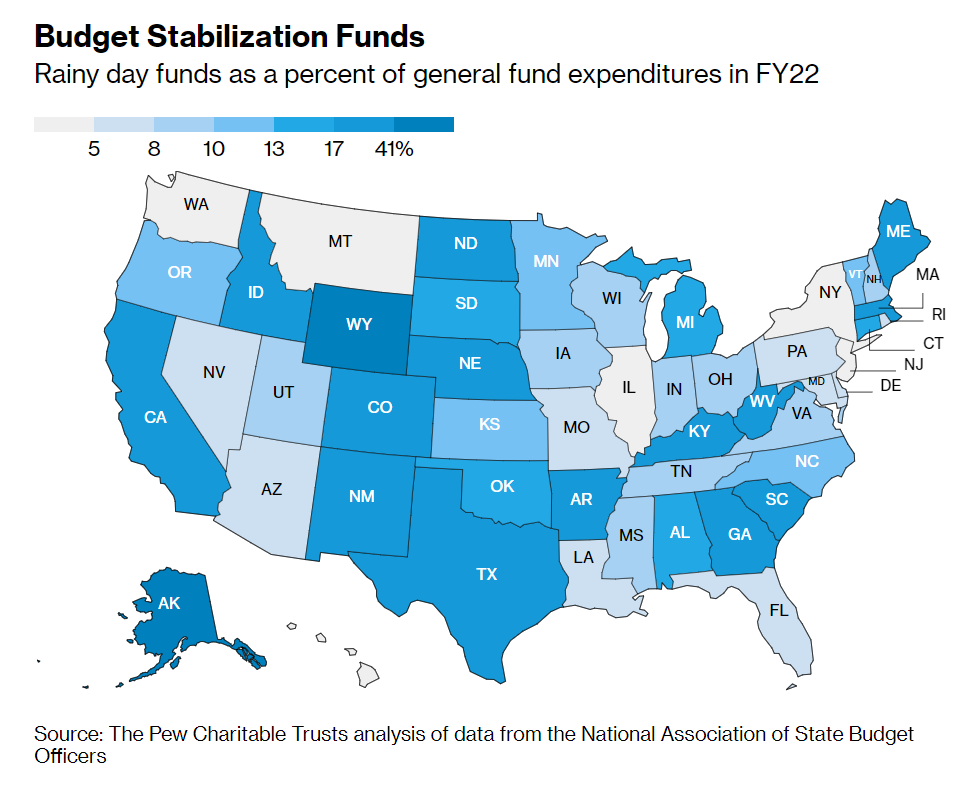
Illinois, Massachusetts and New Jersey this year have garnered higher credit scores from rating companies, including brighter outlooks for the states as well. The upgrades also helped shrink bond yield spreads in the primary and secondary municipal markets, signaling investor perception of state debt is improving.

The better state ratings are due in part to the positive effect of federal pandemic aid, which some states used for one-time expenses while others set cash aside for the future. State treasuries also saw an influx of tax revenue from residents — bolstered by US stimulus money sent to individuals — who spent on services at home at the height of the pandemic, and on travel after Covid lockdowns were eased. 

Still, a slowdown in the US economy this year is causing concern that states can no longer expect a cash haul. The likelihood that the economy in the next 12 months will slide into a recession is greater now than a month earlier, according to a March 20-27 Bloomberg survey of 48 economists.

The poll, conducted after several bank closures roiled financial markets, put the odds of a contraction at 65%, up from 60% in February, amid interest-rate hikes by the Federal Reserve and growing risks of tighter credit conditions. 

Author(s): Skylar Woodhouse

Publication Date: 19 Apr 2023

Publication Site: Bloomberg

Federal Financial Watchdog Aims to Expand Its Reach

Link: https://www.thinkadvisor.com/2023/04/24/federal-financial-watchdog-aims-to-expand-its-reach/

Excerpt:

The Financial Stability Oversight Council — the federal agency in charge of keeping the U.S. financial system upright — wants to change a 2019 document that limits how it tries to keep problems at life insurers, money market funds, cryptocurrency firms and other nonbank financial companies from destroying the economy.

FSOC announced Friday that it’s proposing a new version of the document that would free it from the 2019 restrictions.

….

FSOC started a fight with life insurers and their regulators by designating companies such as MetLife and Prudential Financial as “systemically important financial institutions,” or companies needing extra oversight.

Life insurers argued that the SIFI designation process was unclear, arbitrary and unfair.

MetLife sued FSOC over its SIFI designation. A federal appeals court threw out MetLife’s designation in 2018.

FSOC withdrew the last designation of a nonbank company — Prudential Financial — in October 2018.

…..

FSOC says it needs more flexibility to address potential risks as early and as quickly as possible, and that comparing the potential benefits of focusing attention on a nonbank company to the potential impact on the company is not useful.

“This is in part because it is not feasible to estimate with any certainty the likelihood, magnitude or timing of a future financial crisis,” FSOC said. FSOC argued that, if it does prevent a financial crisis, it would save the country trillions of dollars.

FSOC noted that it consults with state regulators and federal regulatory agencies regularly, and that its own members are made up mostly of state and federal agency heads.

“The council expects that most potential risks to financial stability will continue to be addressed by existing regulators rather than by use of the council’s nonbank financial company designation authority,” FSOC said.

Author(s): Allison Bell

Publication Date: 24 Apr 2023

Publication Site: Think Advisor

Nevada Bill Marks Third Try at Establishing State-Sponsored Retirement Plan

Link: https://www.ai-cio.com/news/nevada-bill-marks-third-try-at-establishing-state-sponsored-retirement-plan/

Excerpt:

Nevada State Senator Dallas Harris is hoping the third time is the charm and has introduced a bill to create a state-supported retirement plan after two previous attempts by the legislature died on the vine.

The bill, SB305, would create the Nevada Employee Savings Trust, which would be directed by a board of trustees with the power to establish a retirement savings program and automatically enroll private employees who do not have a retirement savings plan available via their workplace. To be enrolled, an employee would need to be at least 18 years old, have worked at the same place for 120 days and have wages that are allocable to the state, although employees would be allowed to opt out.

….

The current bill stipulates that the board is required to establish one or more investment funds and that the underlying investments of each fund must be diversified “so as to minimize the risk of large losses under any circumstances.” The board also may, at any time, add, replace or remove any investment fund.

 The underlying investments may include shares of mutual funds, exchange-traded funds, publicly traded equity and fixed-income securities, as well as other investments available for investment. However, the investment funds would be prohibited from investing in any bond, debt instrument or other security issued by the state of Nevada.

Author(s): Michael Katz

Publication Date: 24 Apr 2023

Publication Site: ai-CIO

The economic impact of the opioid epidemic

Link: https://www.brookings.edu/blog/usc-brookings-schaeffer-on-health-policy/2023/04/17/the-economic-impact-of-the-opioid-epidemic/

Graphic:

Excerpt:

While the opioid epidemic has had significant impacts across the labor market, its effects have been particularly pronounced in specific occupations and industries. A CDC analysis of mortality data from 21 states concluded that unintentional and undetermined overdose deaths accounted for a disproportionate share of all deaths in the following six occupational groups: construction, extraction (e.g., mining), food preparation and serving, health care practitioners, health care support, and personal care and service. These fatalities are particularly concentrated in construction and extraction: an analysis by the Massachusetts Department of Public Health found that individuals employed in construction and extraction accounted for over 24% of all overdose deaths in the state’s working population.

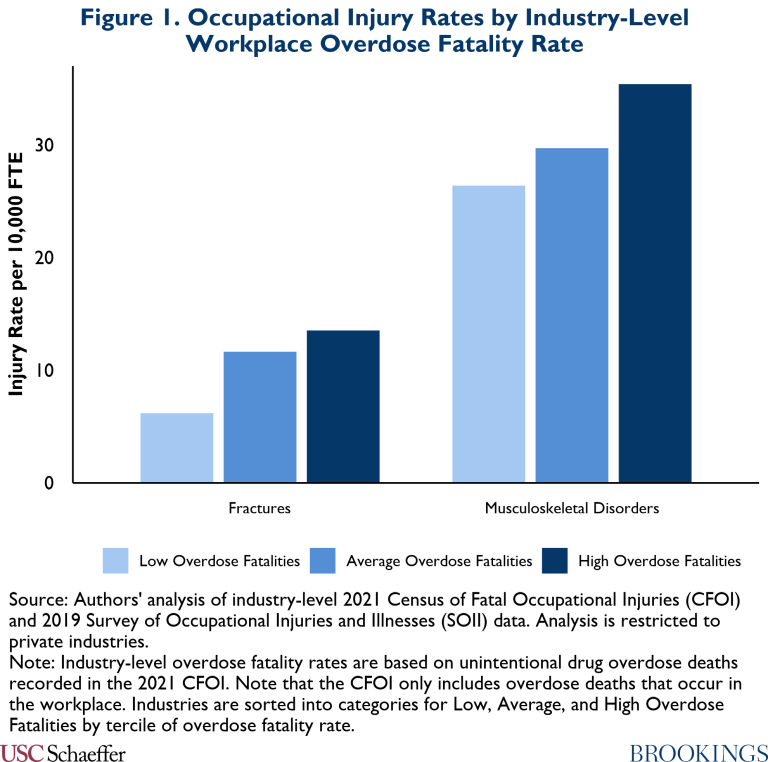
Notably, the jobs with the highest rates of opioid overdose fatalities generally have high occupational injury rates and low access to paid sick leave. Figure 1 demonstrates that the industries with the highest rates of overdose fatalities in the workplace have elevated occupational injury rates for fractures and musculoskeletal disorders, both of which are significant risk factors for long-term opioid use.

Author(s): Julia Paris, Caitlin Rowley, and Richard G. Frank

Publication Date: 17 April 2023

Publication Site: Brookings

Recent SEC Proposals to Come Under Scrutiny of Financial Services Committee

Link: https://www.ai-cio.com/news/sec-recent-proposals-to-come-under-scrutiny-of-financial-services-committee/

Excerpt:

The House Committee on Financial Services will hold an oversight hearing on the Securities and Exchange Commission next Wednesday and Chairman Gary Gensler is expected to testify. The SEC’s proposed budget and their recent proposals, especially the climate disclosure proposal will all likely be discussed.

The SEC requested $2.436 billion for 2024, an increase of $265 million from this year primarily to hire new staff. The new hires are proportionally concentrated in the Divisions of Risk Analysis and Investment Management, whose staffs would increase by more than 5% each. The largest aggregate staffing increase would be to the Division of Enforcement, from its current 1,505 positions to 1,558.

…..

Womack also suggested that the SEC’s proposal on climate disclosure, which would require entities registered with the SEC to disclose their carbon emissions, was not within the SEC’s legal authority, a concern shared by several other Republican members of the committee.

The climate disclosure proposal has been a sensitive issue for agricultural interests. Representative Ashley Hinson, R-Iowa, emphasized the potential impact of this rule on farmers at the hearing. She said that this proposal would be bad for farmers in her state who would have to collect and disclose their emissions data to issue securities and to work with larger businesses who must collect emissions data from their value chain.

Representative Michael Cloud, R-Texas, shared this sentiment during the hearing and said that any issuer subject to Scope 3 disclosure would compel farms in their supply chain to collect this data, a tedious process, which might reduce farmer’s access to credit if they do not comply.

Author(s): Paul Mulholland

Publication Date: 12 April 2023

Publication Site: ai-CIO

In Communities Where Civic Health Is Poor, Lives Are Shorter

Link: https://www.governing.com/now/in-communities-where-civic-health-is-poor-lives-are-shorter

Graphic:

Excerpt:

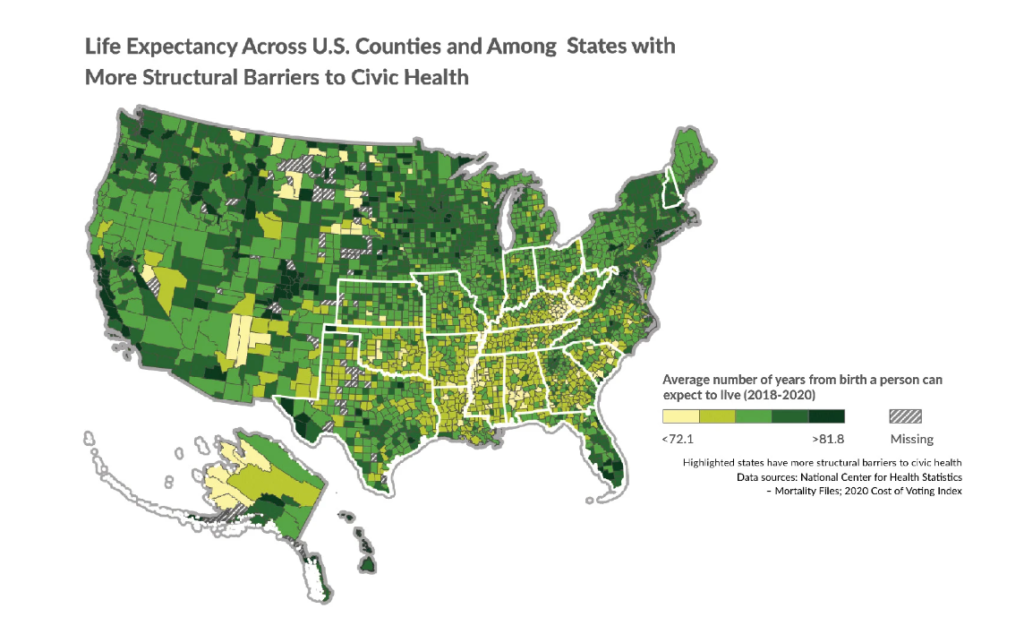
Neglected civic infrastructure — schools, parks, community centers, libraries and other public spaces that help foster a sense of belonging — coupled with barriers to participation in civic life aren’t just manifestations of poor governance. According to the 2023 County Health Rankings & Roadmaps (CHR&R) from the University of Wisconsin Population Health Institute (UWPHI), they have health consequences.

The rankings, published since 2010, were developed to provide insight and guidance for improving health equity. The new report focuses on relationships between the state of civic infrastructure, community engagement and well-being.

“There is a connection between our civic health and thriving people and places,” says Sheri Johnson, the director of UWHPI.

The pandemic made the chronic stress faced by those without access to broadband connections, safe public spaces or other civic resources more visible than ever. Public health researcher Arline Geronimus has been at the forefront of research demonstrating that the stresses of poverty and discrimination actually cause cellular-level damage, overloading the hormonal systems that help us survive dangerous situations.

Author(s): Carl Smith

Publication Date: 4 April 2023

Publication Site: Governing

Social Security Surplus Will Run Out in 10 Years, Report Estimates

Link: https://www.thewealthadvisor.com/article/social-security-surplus-will-run-out-10-years-report-estimates

Excerpt:

Social Security’s reserves are projected to run out in 2033, according to a new report, at which point the entitlement program’s trust fund will be able to pay out just 77% of benefits to seniors.

That estimate is a year earlier than what was stated in the 2022 report for the Old-Age and Survivors Insurance (OASI) Trust Fund, according to the annual report released Friday from the trustees of the program. The revision reflects a 3% reduction in labor productivity and gross domestic product.

One bright spot: A projection for a key trust fund for Medicare is better. It’s expected to exhaust its reserves by 2031, three years later than reported last year, after new data forecast lower health-care spending.

Author(s): Janna Herron, Yahoo Finance

Publication Date: 31 March 2023

Publication Site: Wealth Advisor