Analysis: Money before climate; market downturn spurs ESG fund exodus

Link: https://www.reuters.com/business/cop/money-before-climate-market-downturn-spurs-esg-fund-exodus-2022-11-11/

Graphic:

Excerpt:

Funds adhering to environmental, social, and corporate governance (ESG) principles have been hit by unprecedented outflows in the market downturn, as investors prioritize capital preservation over goals such as tackling climate change.

ESG, a classification applied to fund assets currently worth an estimated $6.5 trillion, is being tested by a drop in market values fuelled by concerns that central banks hiking interest rates to fight rampant inflation will trigger an economic recession.

Investors souring on ESG funds could pose a challenge to governments seeking to enlist them in the fight against climate change. Policymakers at the COP27 climate talks in Egypt are trying this week to secure more financing from the private sector to help lower carbon emissions.

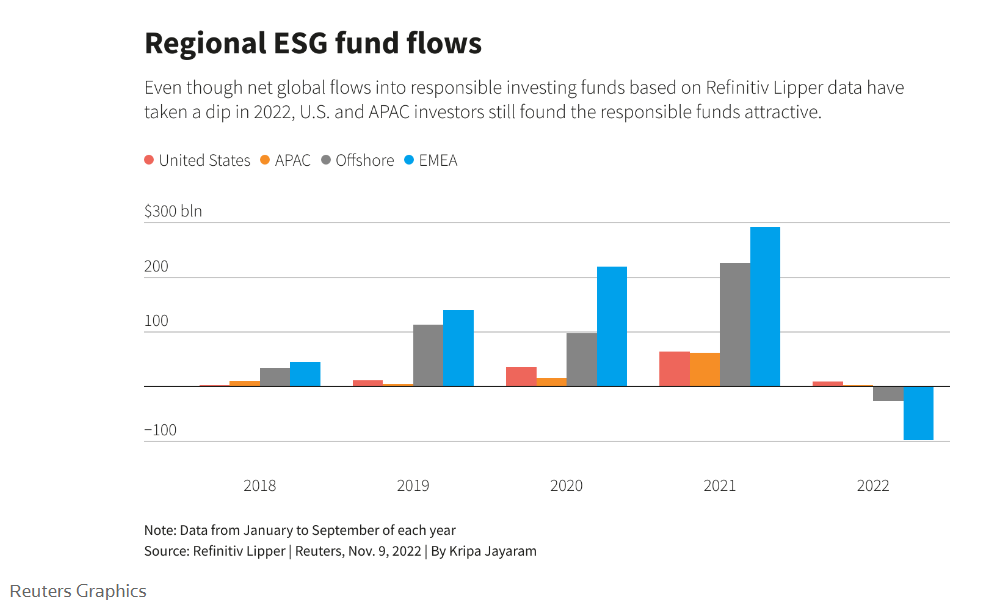
Data from research service Refinitiv Lipper shows that funds of equities, debt and other asset types dedicated to responsible investing posted net outflows globally of $108 billion this year to the end of September, the first time investors withdrew money from them over such a long period since Refinitiv started tracking them in late 2017.

Author(s): Isla Bennie, Ross Kerber

Publication Date: 11 Nov 2022

Publication Site: Reuters
Chicago Teachers’ Pension Fund to Reorientate Portfolio to Fully Offset Fossil Fuel Investments

Link: https://www.ai-cio.com/news/chicago-teachers-pension-fund-to-reorientate-portfolio-to-fully-offset-fossil-fuel-investments/

Excerpt:

The Chicago Teachers’ Pension Fund trustees in October voted to engage with fossil fuel companies to encourage them towards clean renewable energy sources and investing in viable clean and renewable energy sources to offset the fund’s fossil fuel investments. The fund plans to achieve this goal by the end of 2027.

In a statement shared to Chief Investment Officer, the fund’s CIO Fernando Vinzons wrote, “the fund will approach divestiture from a multi-pronged approach, engaging with current companies to encourage them toward a path of clean renewable energy sources, while working toward the longer-term goal of divesting from publicly traded fossil fuel holdings and investing. Divestment does not attract consensus among institutional investors. Many public pension funds are engaging with companies that produce fossil fuels, some are divesting those companies, and some, as the case with state funds from the state of such as Louisiana, are allocating away from managers perceived to be harming the domestic energy sector by endorsing programs like the Net Zero campaign.

According to a press release from the Chicago Teachers’ pension fund, Carlton W. Lenoir, Sr., executive director at CTPF, commented on the vote saying, “as fiduciaries, our trustees must invest consistent with our mission to protect and enhance the present and future economic well-being of members, pensioners, and beneficiaries, and we are confident that this action fulfills that responsibility.”

Author(s): Dusty Hagedorn

Publication Date: 7 Nov 2022

Publication Site: ai-CIO

Republicans ride ESG backlash to state financial offices

Link: https://rollcall.com/2022/11/17/republicans-ride-esg-backlash-to-state-financial-offices/

Excerpt:

Republicans picked up state financial officer positions during the midterm elections amid a campaign against environmental, social and governance investing.

Five positions — in Kansas, Iowa, Missouri, Nevada and Wisconsin — flipped from Democratic to Republican in races for state auditor, controller or treasurer. Of the 50 directly elected positions, Republicans won 29 and Democrats won 19, according to an analysis from Ballotpedia. Two races remain uncalled.

A handful of Republicans’ campaigns for state financial officers focused on ESG, echoing sentiments from GOP officials at statehouses across the country and in Congress who say ESG investing is harming capital markets and domestic energy production and reject the case made by Democrats, major investors and other proponents.

At stake is a suite of legislation and rules that would curb ESG as a material consideration, along with other financial factors, for investors. The proposals include policies for states’ pension funds to divest hundreds of millions of dollars from financial institutions that incorporate ESG — and especially climate — in their investment decisions.

Author(s): Ellen Meyers

Publication Date: 17 Nov 2022

Publication Site: Roll Call

The 2-10 Yield Curve Inversion Recession Signal is the Strongest in Over 40 Years

Link: https://mishtalk.com/economics/the-2-10-yield-curve-inversion-recession-signal-is-the-strongest-in-over-40-years

Graphic:

Excerpt:

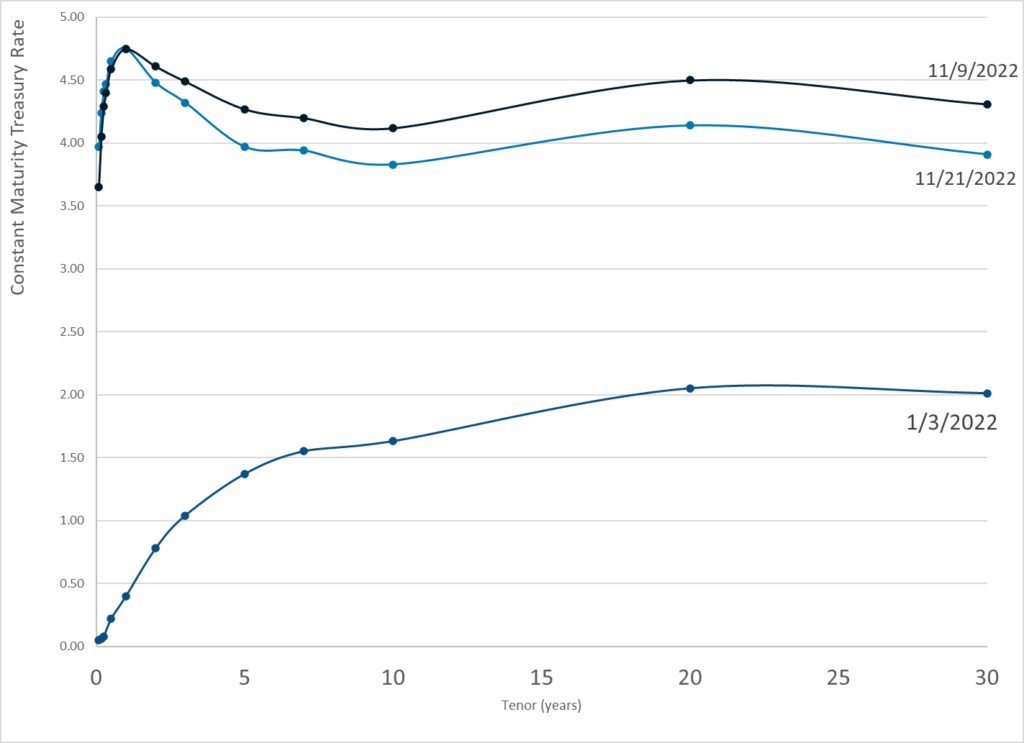
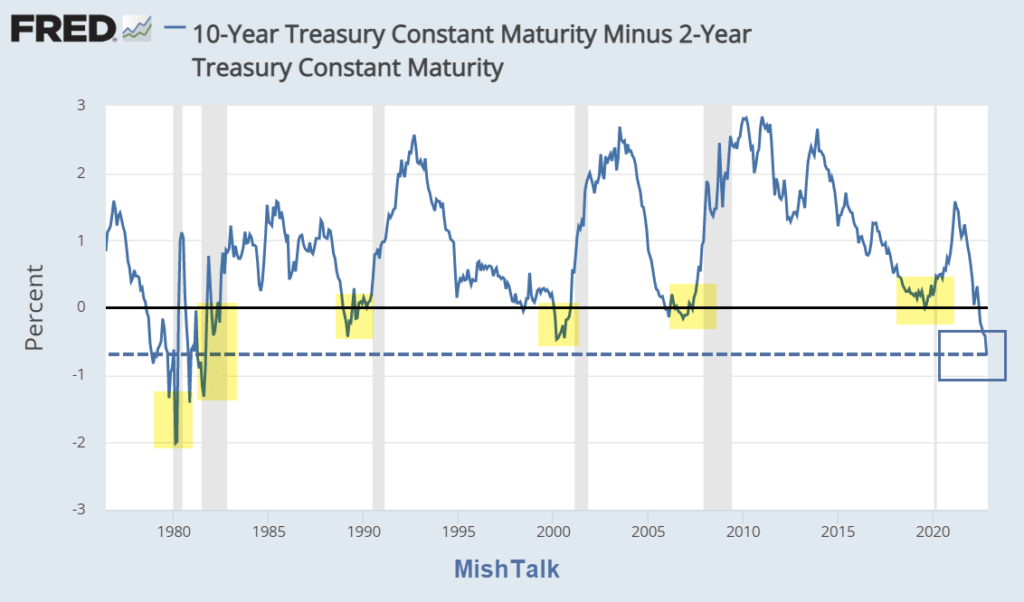
The 10-year to 2-year inversion is 71 basis points, the steepest since October 1981 (see chart)

Never before have we seen such strong inversions except right before or in recessions.

It will not be different this time. A recession is on the way, assuming it’s not already started.

Author(s): Mike Shedlock

Publication Date: 22 Nov 2022

Publication Site: Mish Talk

Adjustments in City’s pension plan may take six or more years

Link: https://richmondfreepress.com/news/2022/nov/10/adjustments-citys-pension-plan-may-take-six-or-mor/

Excerpt:

City Hall’s 4,200 retirees likely may wait years before seeing another cost-of-living adjustment in their pensions.

In a report to City Council on Monday, Leo Griffin, director of the Richmond Retirement System, projected that 2029 may be the earliest that cost-of-living adjustments are considered for enrollees in the defined benefit pension plan. The defined benefit plan provides a guaranteed pension that depends on the salary earned.

Mr. Griffin’s report suggested the city would be better off waiting until 2033 to consider pension improvements. That is when the system is projected to be fully funded and the city’s yearly

contribution for the pension plan is projected to plummet 81 percent from around $55 million a year to $10 million a year.

Mr. Griffin’s projections assume that the system achieves an average annual 7 percent return on investments.

If that level of return is received, his report indicates that the system would cross the 80 percent threshold of funding in six years – the funding threshold the retirement system has set before any cost-of-living adjustment could be considered.

Author(s): Jeremy M. Lazarus

Publication Date: 10 Nov 2022

Publication Site: Richmond Free Press

Europe faces ‘cancer epidemic’ after estimated 1m cases missed during Covid

Link: https://www.theguardian.com/society/2022/nov/15/europe-faces-cancer-epidemic-after-estimated-1m-cases-missed-during-covid

Excerpt:

Experts have warned that Europe faces a “cancer epidemic” unless urgent action is taken to boost treatment and research, after an estimated 1m diagnoses were missed during the pandemic.

The impact of Covid-19 and the focus on it has exposed “weaknesses” in cancer health systems and in the cancer research landscape across the continent, which, if not addressed as a matter of urgency, will set back cancer outcomes by almost a decade, leading healthcare and scientific experts say.

A report, European Groundshot – Addressing Europe’s Cancer Research Challenges: a Lancet Oncology Commission, brought together a wide range of patient, scientific, and healthcare experts with detailed knowledge of cancer across Europe.

One unintended consequence of the pandemic was the adverse effects that the rapid repurposing of health services and national lockdowns, and their continuing legacy, have had on cancer services, on cancer research, and on patients with cancer, the experts said.

“To emphasise the scale of this problem, we estimate that about 1m cancer diagnoses might have been missed across Europe during the Covid-19 pandemic,” they wrote in The Lancet Oncology. “There is emerging evidence that a higher proportion of patients are diagnosed with later cancer stages compared with pre-pandemic rates as a result of substantial delays in cancer diagnosis and treatment. This cancer stage shift will continue to stress European cancer systems for years to come.

Author(s): Andrew Gregory

Publication Date: 15 Nov 2022

Publication Site: The Guardian UK

Backlash Against ESG Investment Of Taxpayer Money Grows, But Illinois And Chicago Carry On – Wirepoints

Link: https://wirepoints.org/backlash-against-esg-investment-of-taxpayer-money-grows-but-illinois-and-chicago-carry-on-wirepoints/

Excerpt:

But those scorned sectors have been the better investments this year, and tech companies have been hammered. Only 31% of actively managed ESG equity funds beat their benchmarks in the first half of 2022, compared to 41% of conventional funds, according to Refinitiv Lipper, as Reuters recently reported. So far this year, 19 of the 20 best-performing companies in the S&P 500 are either fossil-fuel producers or otherwise connected with fossil fuels.

Consequently, ESG funds “have been hit by unprecedented outflows in the market downturn, as investors prioritize capital preservation over goals such as tackling climate change,” wrote Reuters.

Predictably, the issue has become political since state and local officials invest trillions of dollars owned by taxpayers. Republican candidates generally oppose ESG investment of public funds, and five positions — in Kansas, Iowa, Missouri, Nevada and Wisconsin — flipped from Democratic to Republican in recent races for state auditor, controller or treasurer. Of the 50 directly elected positions, Republicans won 29 and Democrats won 19, according to a recent Roll Call report.

Illinois Treasurer Michael Frerichs, however, is among the Democratic officials not backing off on ESG. “We are in it for the long term” is the title of an open letter he recently signed along with 13 other Democratic state financial officers criticizing efforts to stop ESG use of taxpayer money. The letter is astonishingly hypocritical. It says those who want to ban ESG investment of public money are “blacklisting financial firms that don’t agree with their political views.” That, of course, is precisely what ESG does.

Author(s): Mark Glennon

Publication Date:19 Nov 2022

Publication Site: Wirepoints

Maternal Mortality Rates in the United States, 2020

Link: https://stacks.cdc.gov/view/cdc/113967

Graphic:

Excerpt:

This report updates a previous one that showed maternal mortality rates for 2018 and 2019 (2).
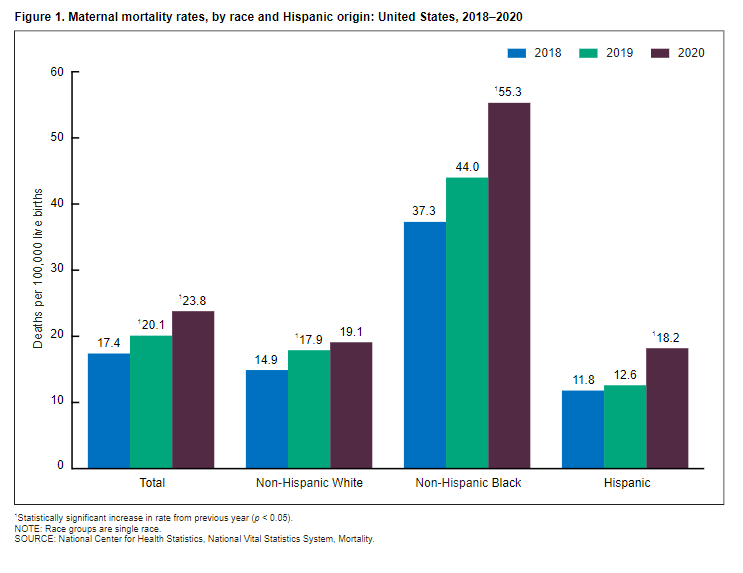
In 2020, 861 women were identified as having died of maternal causes in the United States,
compared with 754 in 2019 (3). The maternal mortality rate for 2020 was 23.8 deaths per
100,000 live births compared with a rate of 20.1 in 2019 (Table).
In 2020, the maternal mortality rate for non-Hispanic Black women was 55.3 deaths per 100,000
live births, 2.9 times the rate for non-Hispanic White women (19.1) (Figure 1 and Table). Rates
for non-Hispanic Black women were significantly higher than rates for non-Hispanic White and
Hispanic women. The increases from 2019 to 2020 for non-Hispanic Black and Hispanic women
were significant. The observed increase from 2019 to 2020 for non-Hispanic White women was
not significant.

Author(s): Donna L. Hoyert

Publication Date: 23 Feb 2022

Publication Site: CDC Stacks

DOI: https://dx.doi.org/10.15620/cdc:113967

A Woke Panic on Maternal Mortality

Link: https://www.city-journal.org/a-woke-panic-on-black-maternal-mortality

Excerpt:

The Centers for Disease Control and Prevention has created the public concern about black maternal mortality. In February, the CDC released data showing that the maternal mortality rate for black women is 2.9 times higher than the rate for white women. It’s a worrisome statistic, yet the CDC’s own data, as well as a study from the CDC Foundation, provide crucial (and generally unreported) context.

To be clear, even a single death of a pregnant woman is one too many. But the overwhelming majority of women survive motherhood: in 2020, according to the CDC, 861 women in the United States died related to pregnancy, out of a total of about 3.6 million births—a rate of 0.02 percent. Just over 350 were white, while just under 300 were black. Scientifically speaking, it’s hard to draw society-wide conclusions from such a small sample. It’s even harder when you recognize that the CDC statistics include deaths that occurred up to a year after delivery, as well as those caused by underlying and preexisting medical conditions that pregnancy may have aggravated. And the CDC admits that the systems for identifying mortality rates are prone to error.

….

The panel found that less than about a third of the preventable deaths, across all races, were attributable to individual providers. It did not cite racial bias as the reason. Yet the academic and media narrative leads to the assumption that black mothers are dying because doctors and nurses are racist. This leads to a corresponding claim that black mothers would die less often if they saw black doctors, which some call “racial concordance.” These are strange assertions, since Hispanic maternal mortality is lower than the rate for whites, which wouldn’t be true if medical professionals were racist. Yet these claims are still being used to justify discriminatory and dangerous policies across health care.

Author(s): Stanley Goldfarb, Benita Cotton-Orr

Publication Date: 18 Nov 2022

Publication Site:

Impact of COVID-19 on Defined Benefit Pension Plan Funding

Link: https://www.theactuarymagazine.org/impact-of-covid-19-on-defined-benefit-pension-plan-funding/

Graphic:

Excerpt:

Higher interest rates already have translated into higher discount rates for solvency and accounting valuations, which means good news (lower liabilities) for DB pension plans. The sensitivity of a pension plan’s liabilities to the discount rate used to determine their value depends on the demographics of the plan members, the type of valuation and level of discount rates being used. Generally, the “duration” for most pension plan liabilities (defined here as the percentage decrease in liabilities for a 1% increase in discount rates) will range from 10 to 25.

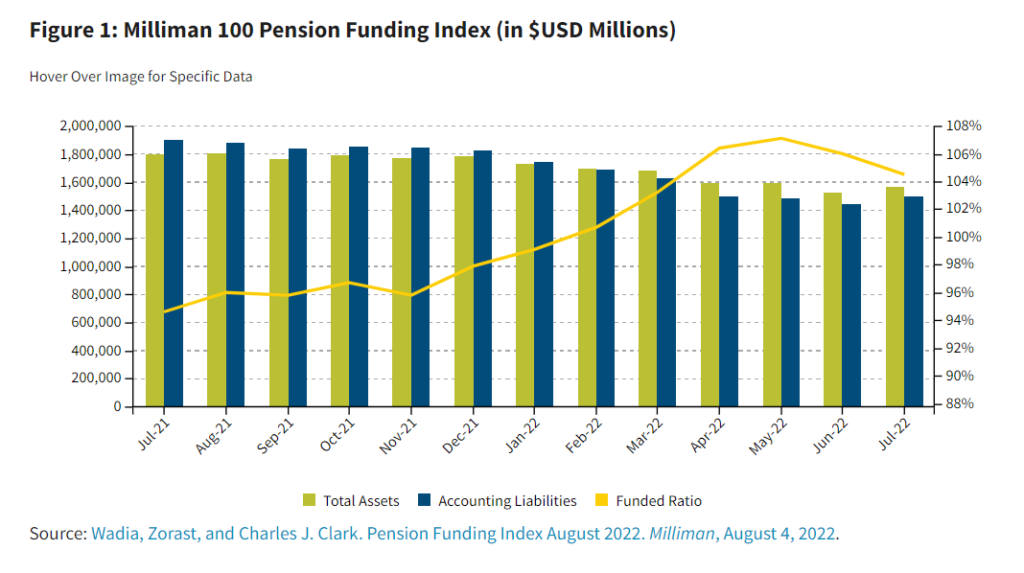
In the United States, the average accounting funded ratio increased from 94.6% in July 2021 to 104.5% in July 2022, according to the Milliman 100 Pension Funding Index, despite significant decreases in plan assets during that time. This is because the average accounting discount rate (typically based on long-term, high-quality bond yields) increased from 2.59% to 4.25% during that same period, driving down accounting liabilities at a faster pace than asset losses. Figure 1 demonstrates this effect in more detail.

Author(s): John Melinte

Publication Date: November 2022

Publication Site: The Actuary at SOA