Ontario Teachers Pension Could Lose $95 Million on FTX Investment

Link: https://www.ai-cio.com/news/ontario-teachers-pension-could-lose-95-million-on-ftx-investment/

Excerpt:

Canada’s Ontario Teachers Pension Plan could lose as much as $95 million that it had invested in now bankrupt cryptocurrency exchange FTX.

In October of last year, the C$242.5 billion ($182.9 billion) pension fund announced that it had participated along with 68 other investors in a $420 million funding round for FTX Trading Ltd., which is the owner and operator of FTX.COM. The investment was made through OTPP’s C$8.2 billion Teachers’ Venture Growth platform.

The pension fund says TVG, which was established in 2019 to invest in emerging technology companies raising late-stage venture and growth capital, seeks out innovative companies “that are using technology to shape a better future.”

Although the pension fund didn’t say how much of the $420 million it accounted for at the time of the announcement, it recently disclosed that it invested a total of $75 million during that round of funding in both FTX International and its U.S. entity FTX.US. It also revealed that it made a follow-on investment of $20 million in FTX .US three months later in January.

Author(s): Michael Katz

Publication Date: 11 Nov 2022

Publication Site: ai-CIO

Covid’s Drag on the Workforce Proves Persistent. ‘It Sets Us Back.’

Link: https://www.wsj.com/articles/covid-workforce-absenteeism-productivity-economy-labor-11667831493

Graphic:

Excerpt:

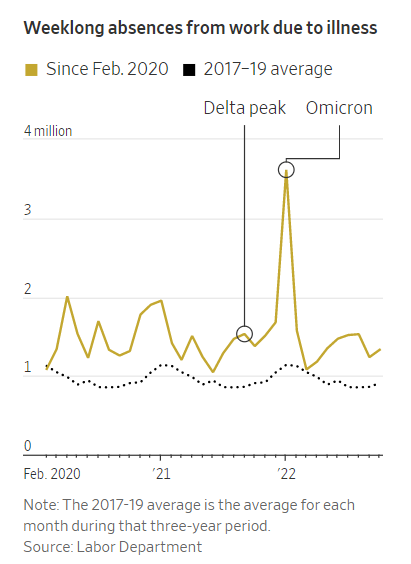
Two-and-a-half years after Covid-19 emerged, reported infections are way down, pandemic restrictions are practically gone and life in many respects is approaching normal. The labor force, however, is not.

Researchers say the virus is having a persistent effect, keeping millions out of work and reducing the productivity and hours of millions more, disrupting business operations and raising costs.

In the average month this year, nearly 630,000 more workers missed at least a week of work because of illness than in the years before the pandemic, according to Labor Department data. That is a reduction in workers equal to about 0.4 percent of the labor force, a significant amount in a tight labor market. That share is up about 0.1 percentage point from the same period last year, the data show.

….

Another half a million workers have dropped out of the labor force due to lingering effects from previous Covid infections, according to research by economists Gopi Shah Goda of Stanford University and Evan J. Soltas at the Massachusetts Institute of Technology. In a Census Bureau survey in October, 1.1 million people said they hadn’t worked the week before because they were concerned about contracting or spreading the virus.

The resulting labor shortages are contributing to upward pressure on wages and inflation, one reason the Fed delivered its fourth consecutive 0.75 percentage point interest rate increase last Wednesday. On Friday, the Labor Department reported brisk job growth in October, but health-related absences remained elevated and the labor force contracted slightly.

Author(s): Gwynn Guilford and Lauren Weber

Publication Date: 7 Nov 2022

Publication Site: WSJ

Upgrade will help Chicago navigate a thornier bond market

Link: https://fixedincome.fidelity.com/ftgw/fi/FINewsArticle?id=202210251432SM______BNDBUYER_00000184-0fdf-d34d-a3d7-5fff818a0000_110.1&utm_source=Wirepoints+Newsletter&utm_campaign=845146e7cd-RSS_EMAIL_CAMPAIGN&utm_medium=email&utm_term=0_895ee9abf9-845146e7cd-30506353#new_tab

Excerpt:

Last week’s Fitch Ratings upgrade of Chicago offers dual benefits for Mayor Lori Lightfoot’s administration as it pursues passage of a proposed 2023 budget and preps a general obligation issue.

Fitch’s Friday upgrade to BBB from BBB-minus, the city’s first from Fitch in 12 years, and the potential for more good rating news could help sell the City Council on supplemental pension contributions and other pieces of the budget plan viewed favorably by analysts.

The Fitch action and an overall rosier view of the city’s fiscal condition should also broaden the investor appeal of an upcoming $757 million general obligation issue in a more fickle and tumultuous market than prevailed in the city’s last GO offering in late 2021.

Author(s): Yvette Shields

Publication Date: 25 Oct 2022

Publication Site: Fidelity Fixed Income

The EU’s Windfall Profits Tax: How “Tax Fairness” Got in the Way of Energy Security

Link: https://taxfoundation.org/windfall-profits-tax-eu-energy-security/

Excerpt:

On 30 September, the Council of the European Union agreed to impose an EU-wide windfall profits tax on fossil fuel companies to fund relief for households and businesses facing high energy prices (due primarily to Putin’s war on Ukraine).

Given the dire economic environment for families and the urgency to transition away from Russian energy, extracting profits from fossil fuel companies to transfer to needy households sounds like killing two birds with one stone. It might even sound fair in a year when oil companies are making record profits because of higher energy prices. 

Unfortunately, it’s not sound policy. If history is any indicator, it will only make these goals harder to achieve.

The tax (or “Solidarity Contribution” in EU-speak) is calculated on taxable profits starting in 2022 and/or 2023, depending on national tax rules, that are above a 20 percent increase of the average yearly taxable profits since 2018. The EU anticipates the policy will raise about €140 billion.

Author(s): Sean Bray

Publication Date: 4 Oct 2022

Publication Site: Tax Foundation

People Will Pay for Illiquidity

Link: https://www.bloomberg.com/opinion/articles/2022-11-01/people-will-pay-for-illiquidity

Excerpt:

Adding liquidity is, conventionally, desirable. It reduces risk: If you can sell a thing easily, that makes it less risky to buy it, so you are more likely to commit capital to the thing. It increases demand: If only a few rich people can buy a thing with great difficulty, it will probably have a lower price than if everyone can buy a share of it easily. It improves transparency and makes prices more efficient. Also, financial innovation tends to be done by banks and other financial intermediaries, and their goal is pretty much to do more intermediation. More liquidity means more trading, which means more profits for banks.

Another, funnier sort of financial innovation is about subtracting liquidity. If you can buy and sell something whenever you want at a clearly observable market price, that is efficient, sure, but it can also be annoying.

….

Or we have talked about a fun post from Cliff Asness titled “ The Illiquidity Discount,” in which he argues that private equity is essentially in the business of selling illiquidity. If you are a big institution and you buy stocks in public companies, the stocks might go down, and you will be sad for various reasons. You might be tempted to sell at the wrong time. You will have to report your results to your stakeholders, and if the stocks went down those results will be bad and you will get yelled at or fired. Whereas if you put your money in a private equity fund, it will buy whole public companies and take them private, and then you won’t know what the stock price is and won’t be able to sell. The private equity fund will send you periodic reports about the values of your investments, but those values won’t necessarily move that much with public-market stock prices: The fund will base its valuations on its estimates of long-term cash flows, and those will not change from day to day. By being illiquid, the private equity fund can look less volatile. Getting similar returns with less volatility is good; getting similar returns and feeling like you have less volatility also might be good.[4] Asness writes:

If people get that PE is truly volatile but you just don’t see it, what’s all the excitement about? Well, big time multi-year illiquidity and its oft-accompanying pricing opacity may actually be a feature not a bug! Liquid, accurately priced investments let you know precisely how volatile they are and they smack you in the face with it. What if many investors actually realize that this accurate and timely information will make them worse investors as they’ll use that liquidity to panic and redeem at the worst times? What if illiquid, very infrequently and inaccurately priced investments made them better investors as essentially it allows them to ignore such investments given low measured volatility and very modest paper drawdowns? “Ignore” in this case equals “stick with through harrowing times when you might sell if you had to face up to the full losses.” What if investors are simply smart enough to know that they can take on a lot more risk (true long-term risk) if it’s simply not shoved in their face every day (or multi-year period!)? 

One objection to this sort of financial product — illiquidity provision — is that it does not generate a lot of transactions. If you work at a bank and you think of a product that will cause customers to trade bonds or houses or diamonds more often, then it is pretty easy to figure out how to make money from that product. 

Author(s): Matt Levine

Publication Date: 1 Nov 2022

Publication Site: Bloomberg
2023 Tax Brackets

Link: https://taxfoundation.org/2023-tax-brackets/

Graphic:

Excerpt:

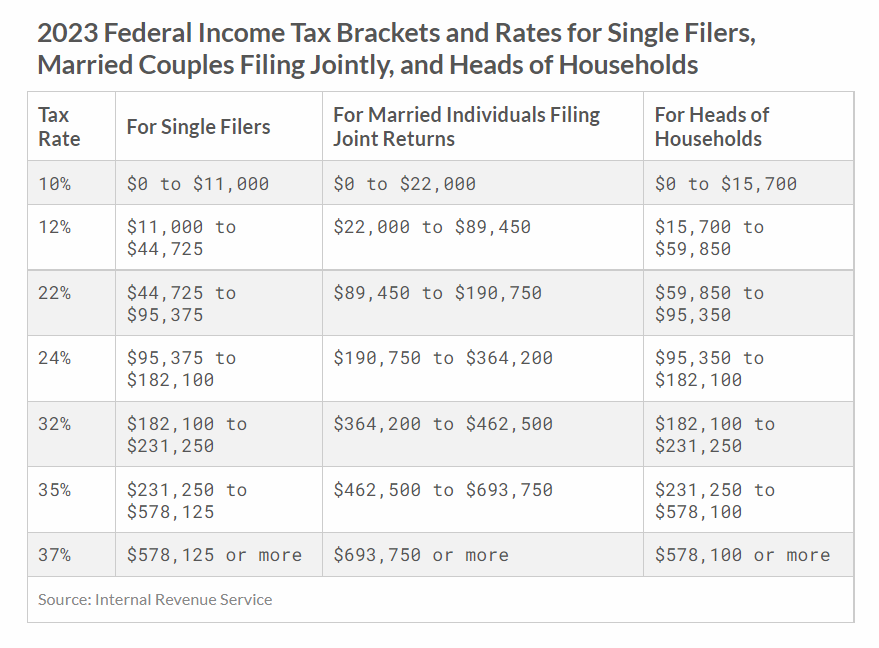
On a yearly basis the Internal Revenue Service (IRS) adjusts more than 60 tax provisions for inflation to prevent what is called “bracket creep.” Bracket creep occurs when people are pushed into higher income tax brackets or have reduced value from credits and deductions due to inflation, instead of any increase in real income.

The IRS used to use the Consumer Price Index (CPI) as a measure of inflation prior to 2018. However, with the Tax Cuts and Jobs Act of 2017 (TCJA), the IRS now uses the Chained Consumer Price Index (C-CPI) to adjust income thresholds, deduction amounts, and credit values accordingly.

The new inflation adjustments are for tax year 2023, for which taxpayers will file tax returns in early 2024. Note that the Tax Foundation is a 501(c)(3) educational nonprofit and cannot answer specific questions about your tax situation or assist in the tax filing process.

Author(s): Alex Durante

Publication Date: 18 Oct 2022

Publication Site: Tax Foundation

Social Security Politics

Link: https://marypatcampbell.substack.com/p/social-security-politics#details

Graphic:

Excerpt:

2022 OASDI Trustees Report, plus spreadsheets, etc. https://www.ssa.gov/OACT/TR/2022/

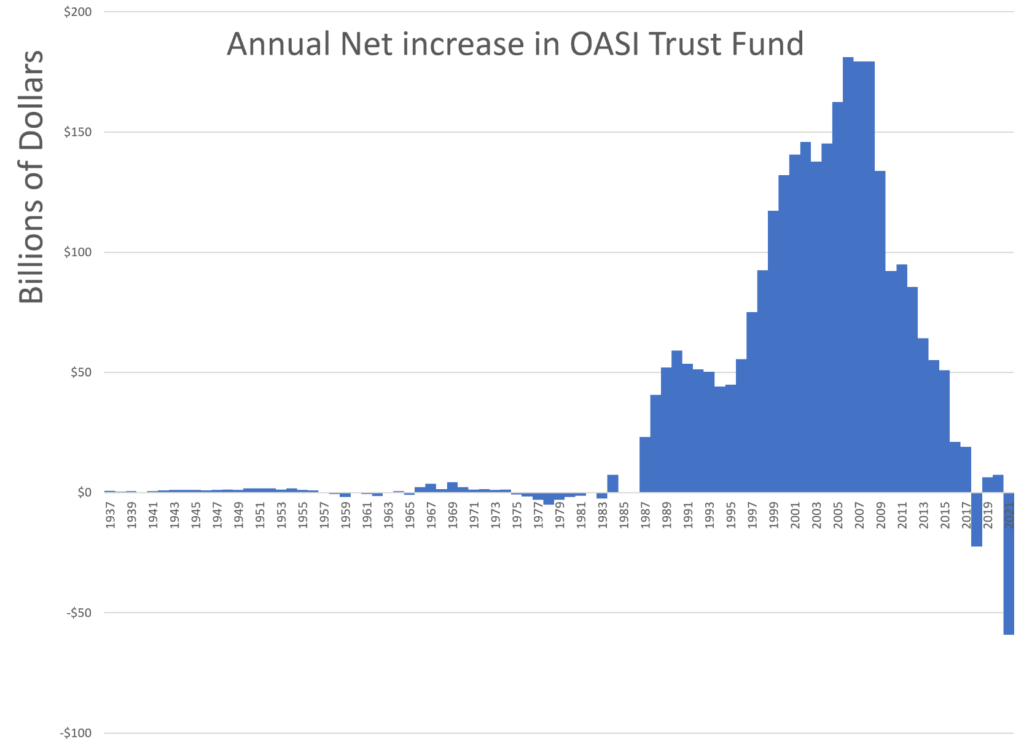
I am graphing the net change in the OASI (that’s the old age benefit part) Trust Fund, year-over-year.

I think you can easily see all those glorious years the Boomer payroll taxes were being stuffed into the Trust Fund… but really flowing right out into current spending for other goodies.

And you can see when that reversed and is now negative, and will continue to be negative until the Trust Fund is exhausted, in the early 2030s.

Author(s): Mary Pat Campbell

Publication Date: 7 Nov 2022

Publication Site: STUMP at substack

Candidates discuss Illinois’ unfunded pension debt

Link: https://www.thecentersquare.com/illinois/gubernatorial-candidates-discuss-plans-to-shore-up-illinois-unfunded-pension-debt/article_d4ee1dcc-5acc-11ed-ba1f-5f5508ee672f.html

Excerpt:

Candidates for Illinois governor are taking different approaches on how they’d tackle the state’s unfunded pension liabilities.

Illinois has among the most unfunded public sector employee pension liability. State numbers indicate around $151 billion unfunded, but some place like the American Legislative Exchange Council place the debt at $533 billion.

State Sen. Darren Bailey, who’s running against incumbent Democratic Gov. J.B. Pritzker, said he’ll use reduced state spending to pay down pensions.

“We’ll find the fat in the budget and we’ll begin to apply that to get this pension situation under control, but first and foremost, I will be sitting at the table with pensioners,” Bailey, R-Xenia, told The Center Square. “I fear that the pension debt may be that large looming problem that will sneak up on Illinois if we continue to ignore it as J.B. Pritzker has.”

Pritzker touts on his campaign website “fully funding pension contributions” as a way to reduce state pension liabilities, “going above and beyond with payments and expanding the employee pension buyout program.”

Pritzker’s campaign did not return requests for an interview.

Author(s): Greg Bishop

Publication Date: 2 Nov 2022

Publication Site: The Center Square

2022 Employer Health Benefits Survey

Link: https://www.kff.org/health-costs/report/2022-employer-health-benefits-survey/

Graphic:

Excerpt:

This 24th annual survey of employers provides a detailed look at trends in employer-sponsored health coverage, including premiums, employee contributions, cost-sharing provisions, offer rates, wellness programs, and employer practices. The 2022 survey included 2,188 interviews with non-federal public and private firms.

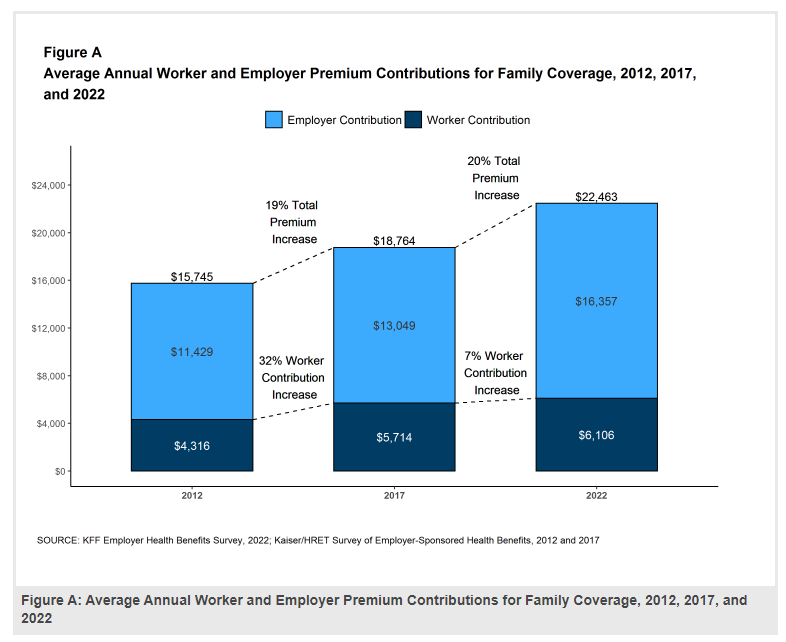
Annual premiums for employer-sponsored family health coverage reached $22,463 this year, with workers on average paying $6,106 toward the cost of their coverage. The average deductible among covered workers in a plan with a general annual deductible is $1,763 for single coverage. Workers at smaller firms contribute on average contribute nearly $2,000 more toward the cost of family coverage than workers at smaller firms. They also face general annual deductibles that are $1,000 higher on average. This year’s report also looks at employers’ experiences and views about mental health and substance use services, telemedicine, and wellness programs.

Publication Date: 27 Oct 2022

Publication Site: Kaiser Family Foundation