Why Do Vaccinated People Represent Most COVID-19 Deaths Right Now?

Link: https://www.kff.org/policy-watch/why-do-vaccinated-people-represent-most-covid-19-deaths-right-now/

Graphic:
Excerpt:

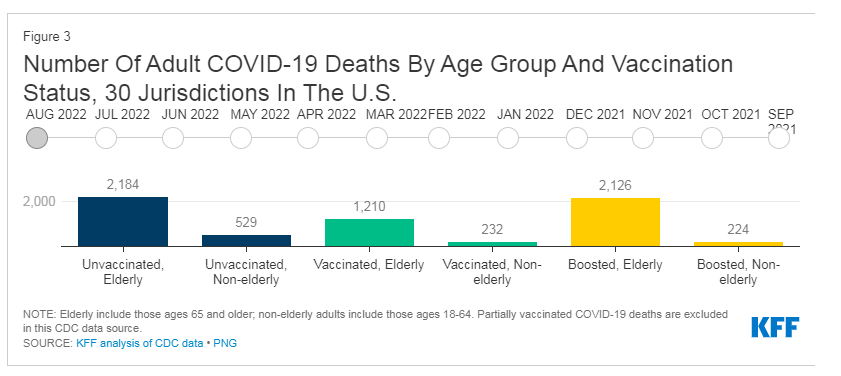
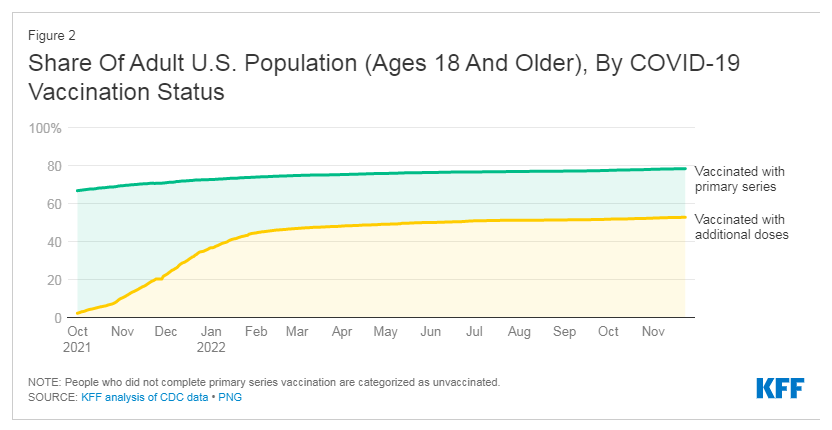
The waning protection from vaccines is why CDC recommends recent booster shots, and why it’s especially important for people at higher risk to stay up-to-date on boosters. Per current recommendations, most adults should have received at least 2-3 booster doses by now (including the new bivalent booster), in addition to their primary series. However, only 14% of adults overall and 31% of older adults (65 years and older) have received the latest bivalent boosters. The CDC data show that about 95% of adults who died from COVID-19 in 2022 in these jurisdictions were over age 50, and about 8 in 10 were age 65 or older, underscoring the need for older adults to stay up-to-date on recommended booster shots.

The fall in the share of deaths that are among unvaccinated people could also be explained by changes in the unvaccinated population. By this far into the pandemic, it is estimated that many unvaccinated people have had COVID-19 at least once and while hundreds of thousands of unvaccinated people have needlessly died from COVID, those who survived may have gained some immune protection against the virus that can help protect them against severe outcomes when they have subsequent infections. However, this protection from a past infection can also diminish over time, which is why it is still recommended that unvaccinated people with prior COVID-19 infections get vaccinated and stay up-to-date on boosters.

Author(s): Cynthia Cox Follow @cynthiaccox on Twitter , Krutika Amin Follow @KrutikaAmin on Twitter , Jennifer Kates Follow @jenkatesdc on Twitter , and Josh Michaud Follow @joshmich on Twitter

Publication Date: 30 Nov 2022

Publication Site: KFF
Office of the Chief Actuary’s Estimates of Proposals to Change the Social Security Program or the SSI Program

Link: https://www.ssa.gov/oact/solvency/index.html

Excerpt:

The last 11 Trustees Reports have indicated that Social Security’s Old-Age, Survivors, and Disability Insurance (OASDI) Trust Fund reserves would become depleted between 2033 and 2035 under the intermediate set of assumptions provided in each report. If no legislative change is enacted, scheduled tax revenues will be sufficient to pay only about three-fourths of the scheduled benefits after trust fund depletion. Policymakers have developed proposals and options that have financial effects on the OASDI Trust Funds. Many of these proposals and options have the intent of addressing the long-range solvency problem.

The Office of the Chief Actuary also develops estimates of proposals to change the Supplemental Security Income (SSI) program.

We have prepared letters or memoranda for many of these proposals and options. Each letter or memorandum provides an actuarial analysis showing the estimated effect on the financial status of the Social Security program and/or the SSI program.

Publication Date: accessed 4 Dec 2022

Publication Site: Office of the Chief Actuary, Social Security Administration

FTX collapse is a reminder that public pension systems should avoid high-risk investments

Link: https://reason.org/commentary/ftx-collapse-is-a-reminder-that-public-pension-systems-should-avoid-high-risk-investments/

Excerpt:

Public pension plans have mostly avoided direct investments into cryptocurrencies, and for good reason. Public pension benefits are constitutionally protected, meaning taxpayers are on the hook for paying for unfunded liabilities. If a highly volatile investment, such as crypto, were to go sour, the public pension fund—thus, taxpayers—would be on the hook to make up for the shortfall and pay for the retirement benefits promised to public workers. Even though there is a potential upside in generating significant returns by investing in cryptocurrency at the right times, the risks and market swings far outweigh the potential benefits for public pension systems. 

But some U.S. public pension systems are already reporting minor financial losses related to FTX, including the Kansas Public Employee Retirement System, according to the Topeka Capital-Journal:

….

Similarly, “The Missouri State Employees’ Retirement System lost roughly $1 million because a private equity firm it invested in was invested in FTX, the embattled cryptocurrency exchange that filed for bankruptcy last week,” the Kansas City Star reported.

….

Overall, the story of FTX is a cautionary tale for all investors. When it comes to public pension systems, which have largely steered clear of making direct investments in crypto, pension funds should resist the growing pressures to seek higher returns and take on risks that could expose taxpayers to major financial losses and more public pension debt.

Author(s): Swaroop Bhagavatula
Quantitative Analyst

Publication Date: 2 Dec 2022

Publication Site: Reason

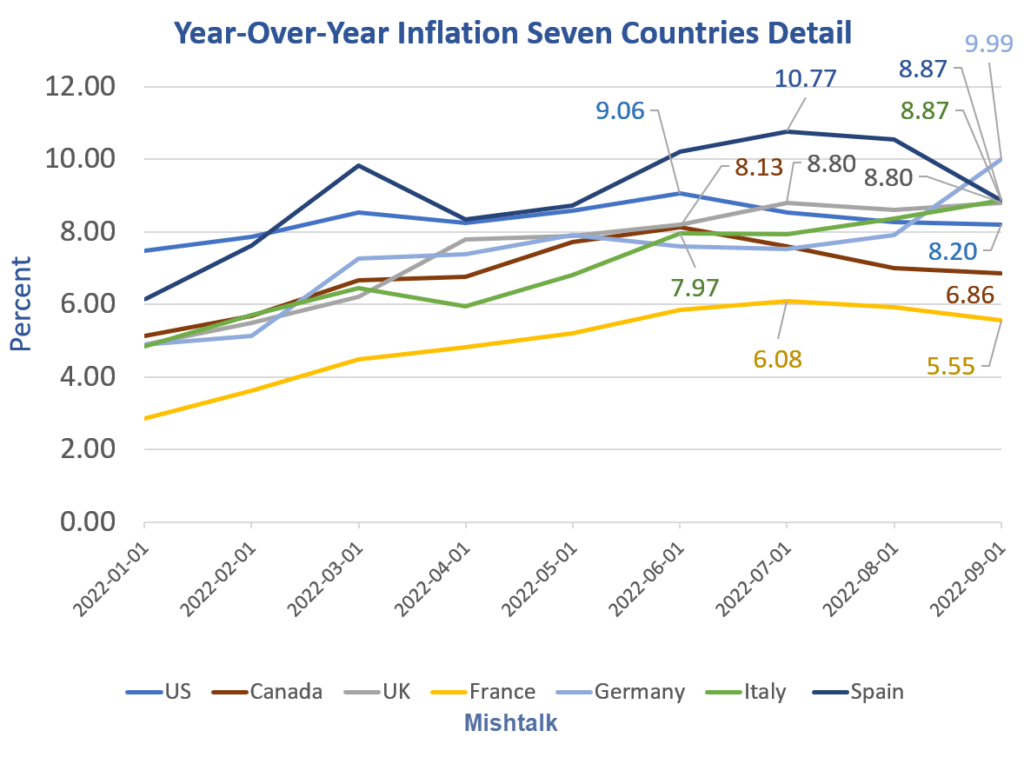
Inflation Around the World: How Does the US Compare to Canada and the EU?

Link: https://mishtalk.com/economics/inflation-around-the-world-how-does-the-us-compare-to-canada-and-the-eu

Graphic:

Excerpt:

  • Inflation in the US was the first to peak.
  • US inflation peaked in June at 9.06 percent and is currently (through September) at  8.20 percent.
  • Inflation in France peaked at the lowest rate, 6.08 percent.
  • France also has the lowest current rate of 5.55 percent.  
  • Inflation in Germany is 9.99 percent and still rising
  • Inflation in Italy is 8.87 percent and still rising
  • Inflation in Spain was the highest peak so far at 10.77 percent
  • Inflation in the UK is 8.80 percent matching the July high.
  • Inflation in Canada peaked at 8.13 percent and is now 6.86 percent

Author(s): Mike Shedlock

Publication Date: 3 Dec 2022

Publication Site: Mish Talk

All of US: a dot density map of the United States

Link: https://all-of-us.benschmidt.org/

Graphic:

Excerpt:

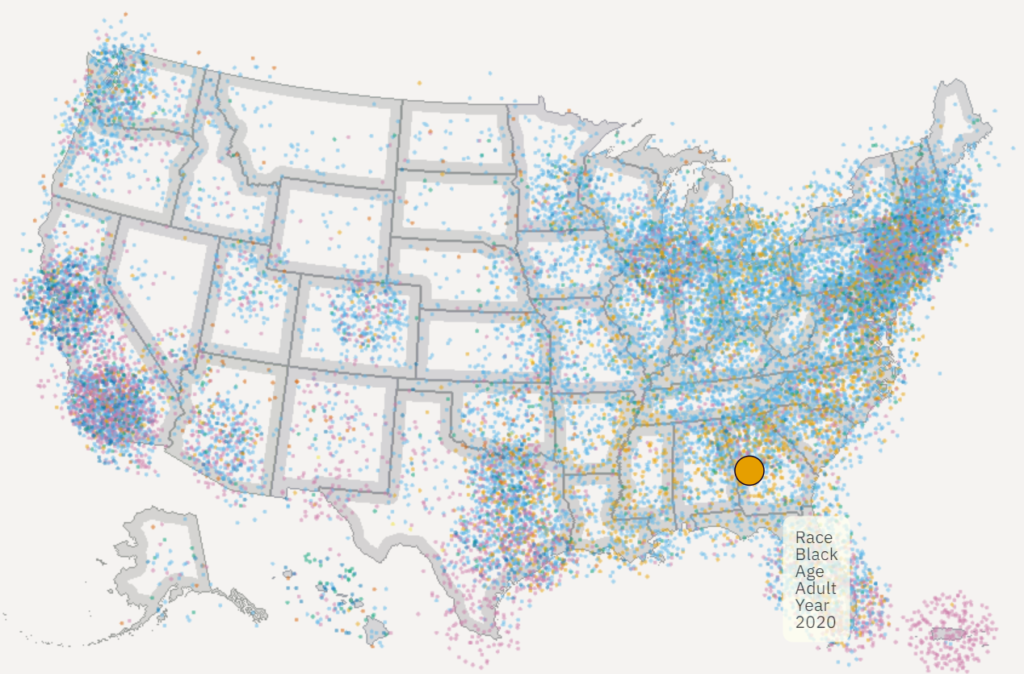
One point per person in the US for the 2010 and 2020 censuses, fully zoomable and interactive using WebGL and [Deepscatter](https://github.com/CreatingData/deepscatter). Since this uses WebGL individual point rendering and quadtiled data, it can be far more responsive than raster-based maps you may have seen in 2010. Plus, if you zoom all the way in in some views it has little person glyphs!

Author(s): Ben Schmidt

Publication Date: accessed 2 Dec 2022

Publication Site: Ben Schmidt’s personal site

Movember 2022: Men and Drug Overdoses (and Giving Tuesday!)

Link: https://marypatcampbell.substack.com/p/movember-2022-men-and-drug-overdoses

Graphic:

Excerpt:

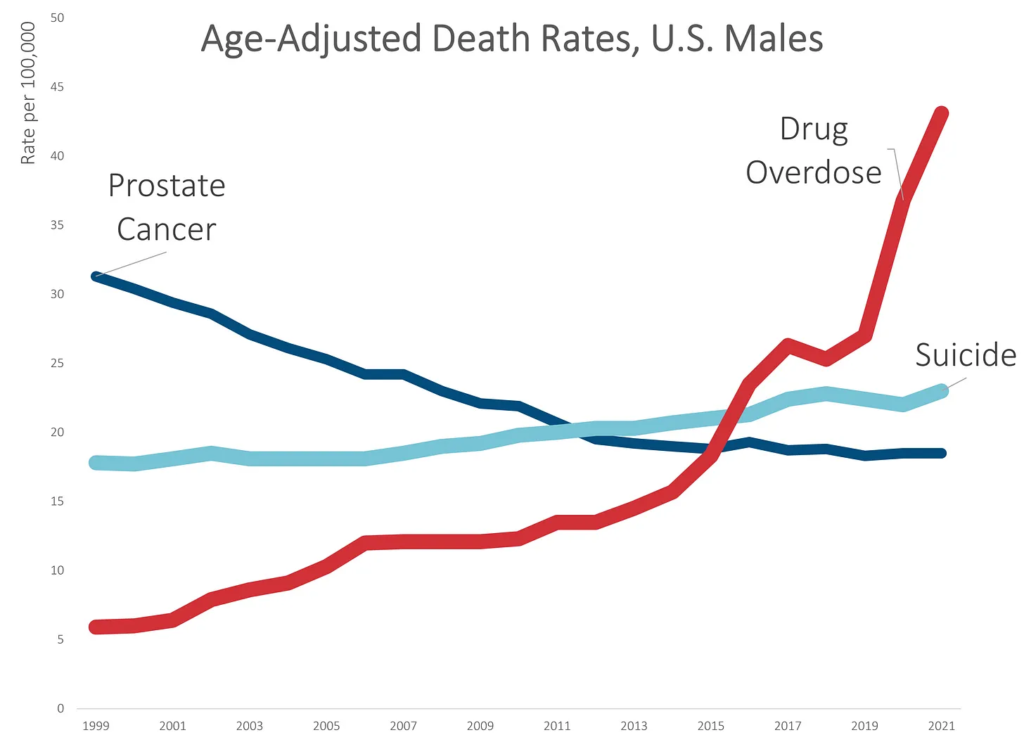
Remember the graph I made showing the suicide trend for men crossing over from prostate cancer?

Let me layer on unintentional drug overdoses:

Yeah, it’s as bad as it looks.

While death rates due to suicide increased by about 30% over the 20-year period, death rates due to unintentional drug overdoses increased by over 500%.

None of this is really a surprise. I’ve written about the drug OD problem many times before, which had a horrible trend before the pandemic and got much, much worse during the pandemic.

Much of the increase came in 2020 and 2021 — over 30% in 2020, and 17% in 2021. These are huge increases on rates that were already bad.

Author(s): Mary Pat Campbell

Publication Date: 29 Nov 2022

Publication Site: STUMP at substack

Organ Donation and Transplants During Major US Motorcycle Rallies

Link: https://jamanetwork.com/journals/jamainternalmedicine/article-abstract/2798550

Excerpt:

Question  Is the incidence of organ donation and transplants higher during major US motorcycle rallies?

Findings  In this cross-sectional study of 10 798 organ donors and 35 329 recipients of these organs from a national transplant registry from 2005 to 2021, there were 21% more organ donors and 26% more transplant recipients per day during motorcycle rallies in regions near those rallies compared with the 4 weeks before and after the rallies.

Meaning  While safety measures to minimize morbidity and mortality during motorcycle rallies should be prioritized, this study showed the downstream association of these events with organ donation and transplants.

Author(s): David C. Cron, MD, MS1,2; Christopher M. Worsham, MD3,4,5; Joel T. Adler, MD, MPH2,6; et al

Publication Date: 28 Nov 2022

Publication Site: JAMA Internal Medicine

JAMA Intern Med. Published online November 28, 2022. doi:10.1001/jamainternmed.2022.5431