SOA Diversity Report

Link: https://www.soa.org/4a79dc/globalassets/assets/files/static-pages/about/diversity-inclusion/summer-2022-diversity-report.pdf

Graphic:

Excerpt:

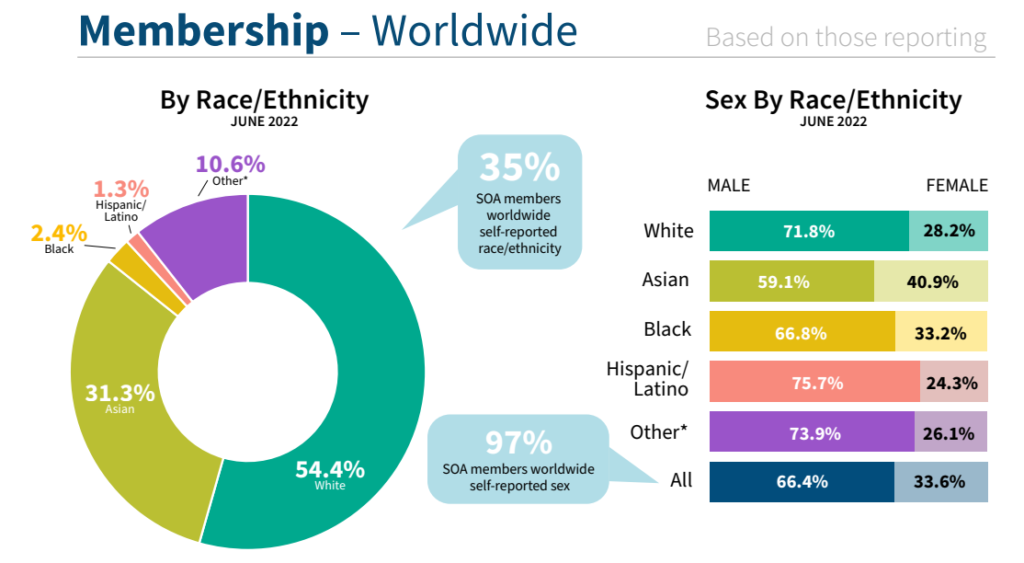
The Society of Actuaries (SOA) leadership and staff work closely with the Diversity, Equity, and Inclusion Committee (DEIC) to support the journey to increase diversity in membership and in the actuarial profession, as part of the SOA’s Long-Term Growth Strategy.

We strive for transparency and accountability in our DEI efforts and are committed to sharing our demographic data and long-term goals to support our pledge and responsibility. We have collected member voluntary demographic data since 2015. With this data, we present an infographic for the pathway from aspiring actuaries to members with ASA or FSA designations.

Author(s): Society of Actuaries

Publication Date: Summer 2022

Publication Site: Society of Actuaries

The Inevitable Financial Crisis

Link: https://www.nakedcapitalism.com/2022/10/the-inevitable-financial-crisis.html

Excerpt:

For months, I have been confident that Europe would suffer a financial crisis and a depression, as in a real economy catastrophe accompanied by a market crash. It might not be as severe and lasting as 1929, but the breadth would mean there would not be 1987 quick bounceback nor a 2008 derivatives crisis concentrated at the heart of the banking system. Even though that looked like financial near-death experience, the same factors that made it more acute in many respects also made it easier for the officialdom to identify and shore up the key institutions that took hits below the water line.

….

That view was based simply on the level of damage Europe seemed determined to suffer via the effect of sanctions blowback on supplies of Russian gas. There are additional de facto and self restrictions on Russian commodities via sanctions on Russian banks and warniness about dealing with Russian ships and counterparties. For instance, Russian fertilizer is not sanctioned; indeed, the US made a point of clearing its throat a couple of months back to say so. Yet that does not solve the problem African (and likely other) buyers suffer They had accounts with now-sanctioned Russian banks and have been unable to come up with good replacement arrangements.

Another major stressor is the dollar’s moon shot. It increased the cost of oil in local currency terms, making inflation even worse. It also will produce pressure, and potentially defaults, in any foreign dollar debtor because he local currency cost of interest payments will rise. Given the generally high state of nervousness in financial markets, anyone who had been expected to roll maturing debt will be in a world of hurt (Satyajit Das in a recent post pointed out that investors typically don’t expect emerging market borrowers to repay).

….

Yet another big concern is hidden leverage, particularly from derivatives. A sudden rise in short term interest rates and increased volatility can blow up derivative counterparties. It’s already happening with European utility companies, many of whom are so badly impaired as to need bailouts.

And the failure of regulators to get tough with banks in the post-crisis period is coming home to roost. Nick Corbishley wrote about how Credit Suisse went from being a supposedly savvy risk manage to more wobbly than Deutsche Bank due to getting itself overly-enmeshed in the Archegos “family office” meltdown and then the Greensill “supply chain finance” scam. Archegos demonstrated a lack of regulatory interest in “total return swaps” which in simple terms allow speculators to create highly leveraged equity exposures. Highly leveraged equity exposures was what gave the world the 1929 crash. The very existence of this product shows the degree to which the officialdom has unlearned big and costly lessons.

Author(s): Yves Smith

Publication Date: 3 Oct 2022

Publication Site: naked capitalism

Death Is Anything but a Dying Business as Private Equity Cashes In

Link: https://khn.org/news/article/funeral-homes-private-equity-death-care/

Excerpt:

Private equity firms are investing in health care from cradle to grave, and in that latter category quite literally. A small but growing percentage of the funeral home industry — and the broader death care market — is being gobbled up by private equity-backed firms attracted by high profit margins, predictable income, and the eventual deaths of tens of millions of baby boomers.

The funeral home industry is in many ways a prime target for private equity, which looks for markets that are highly fragmented and could benefit from consolidation. By cobbling together chains of funeral homes, these firms can leverage economies of scale in purchasing, improve marketing strategies, and share administrative functions.

According to industry officials, about 19,000 funeral homes make up the $23 billion industry in the U.S., at least 80% of which remain privately owned and operated — mostly mom and pop businesses, with a few regional chains thrown in. The remaining 20%, or about 3,800 homes, are owned by funeral home chains, and private equity-backed firms own about 1,000 of those.

….

Robertson said the funeral home industry is different from other sectors that private equity firms might consider investing in, describing it as a calling comparable to working in hospice care. Foundation Partners is fortunate their backers understand the service part of the industry, as well as the financials, he said. “Private equity firms aren’t necessarily known for having deep compassion for people. They’re more known for their financial returns,” he said. “To get both is really important.”

Foundation Partners owns Tulip Cremation, an online service that allows people to order a cremation with just a few clicks — and without having to set foot in a funeral home. Tulip currently operates in nine states where Foundation Partners has funeral homes. The company expects the service to eventually operate nationally.

Author(s): Markian Hawryluk

Publication Date: 22 Sept 2022

Publication Site: Kaiser Health News

Variations On Approximation – An Exploration in Calculation

Link: https://www.soa.org/news-and-publications/newsletters/compact/2014/january/com-2014-iss50/variations-on-approximation–an-exploration-in-calculation/

Graphic:

Excerpt:

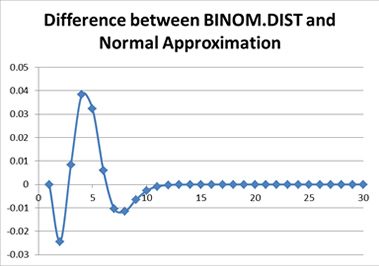
Before we get into the different approaches, why should you care about knowing multiple ways to calculate a distribution when we have a perfectly good symbolic formula that tells us the probability exactly?

As we shall soon see, having that formula gives us the illusion that we have the “exact” answer. We actually have to calculate the elements within. If you try calculating the binomial coefficients up front, you will notice they get very large, just as those powers of q get very small. In a system using floating point arithmetic, as Excel does, we may run into trouble with either underflow or overflow. Obviously, I picked a situation that would create just such troubles, by picking a somewhat large number of people and a somewhat low probability of death.

I am making no assumptions as to the specific use of the full distribution being made. It may be that one is attempting to calculate Value at Risk or Conditional Tail Expectation values. It may be that one is constructing stress scenarios. Most of the places where the following approximations fail are areas that are not necessarily of concern to actuaries, in general. In the following I will look at how each approximation behaves, and why one might choose that approach compared to others.

Author(s): Mary Pat Campbell

Publication Date: January 2014

Publication Site: CompAct, SOA

IFRS 17—The Time Is Now

Link: https://contingencies.org/ifrs-17-the-time-is-now/

Excerpt:

The more fundamental changes affect the measurement of future services (previously termed as “Reserves”). Many insurance accounting regimes have tried to stabilize their financial statements over the years; therefore, they calculated their reserves based on historic information—locked-in assumptions for insurance parameters as well as historic interest rates. The latter, however, are not in line with the use of market values for the asset side of the balance sheet, which is now perceived as the only fair-value representation for the different stakeholders. Therefore, the measurement of the liabilities in IFRS 17 will always be based on current assumptions.

Due to the compound effect over many projected years, the regular update of assumptions (particularly interest rate or discounting assumptions) can make long-term liabilities much more volatile.

Author(s): Michael Winkler and Sunil Kansal

Publication Date: October 2022

Publication Site: Contingencies

UK Pensions Got Margin Calls

Link: https://www.bloomberg.com/opinion/articles/2022-09-29/uk-pensions-got-margin-calls

Excerpt:

I said above that pension funds are unusually insensitive to short-term market moves: Nobody in the pension can ask for their money back for 30 years, so if the pension fund has a bad year it won’t face withdrawals and have to dump assets. Still, pension managers are sensitive to accounting. If your job is to manage a pension, you want to go to your bosses at the end of the year and say “this pension is now 5% less underfunded than it was last year.” And if you have to instead say “this pension is now 5% more underfunded than it was last year,” you are sad and maybe fired; if the pension gets too underfunded your regulator will step in. You want to avoid that.

And so the way you will approach your job is something like:

  1. You will try to beat your benchmark, buying stocks and higher-yielding bonds to try to grow the value of your assets.
  2. You will hedge the risk of rates going down. If rates go down, your liabilities will rise (faster than your assets); you are short gilts. You want to do something to minimize this risk.

The way to do that hedging is basically to get really long gilts in a leveraged way. If you have £29 of assets, you might invest them like this:

  1. £24 in gilts,
  2. £5 in stocks, and
  3. borrow another £24 and put that in gilts too.[5] [5] No science to this number, and you’d probably do a bit less if your stocks are correlated with rates.

That way, if rates go down, the value of your portfolio goes up to match the increasing value of your liabilities. So you are hedged. You were short gilts, as an accounting matter, and you’ve solved that by borrowing money to buy more gilts. In practice, the way you have borrowed this money is probably not by actually getting a loan and buying gilts but by doing some sort of derivative (interest-rate swap, etc.) with a bank, where the bank pays you if rates go down and you pay the bank if rates go up. And you have posted some collateral with the bank, and as interest rates move up or down you post more or less collateral. 

This all makes total sense, in its way. But notice that you now have borrowed short-term money to buy volatile financial assets. The thing that was so good about pension funds — their structural long-termism, the fact that you can’t have a run on a pension fund: You’ve ruined that! Now, if interest rates go up (gilts go down), your bank will call you up and say “you used our money to buy assets, and the assets went down, so you need to give us some money back.” And then you have to sell a bunch of your assets — the gilts and stocks that you own — to pay off those margin calls. Through the magic of derivatives you have transformed your safe boring long-term pension fund into a risky leveraged vehicle that could get blown up by market moves.

I know this is bad but I find something aesthetically beautiful about it. If you have a pot of money that is immune to bank runs, over time, modern finance will find a way to make it vulnerable to bank runs. That is an emergent property of modern finance. No one sits down and says “let’s make pension funds vulnerable to bank runs!” Finance, as an abstract entity, just sort of does that on its own.

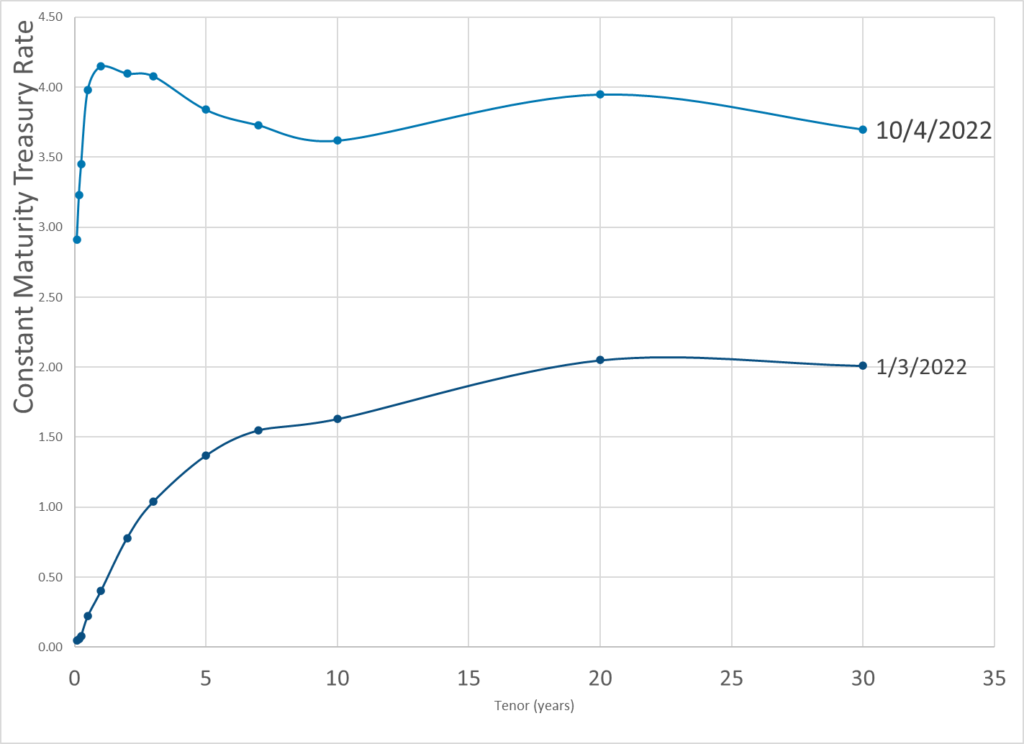
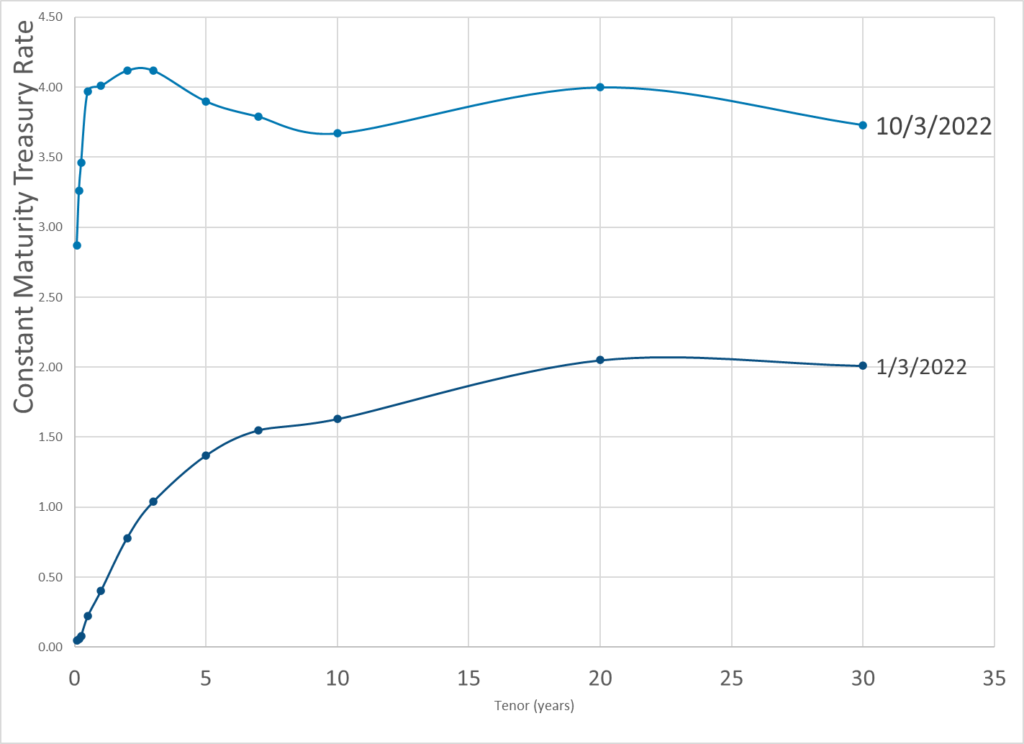
Anyway, as I said above, 30-year UK gilt rates were about 2.5% this summer. They got to nearly 5% this week, and were at about 3.9% at 9 a.m. New York time today. You can fill in the rest.

Author(s): Matt Levine

Publication Date: 29 Sept 2022

Publication Site: Bloomberg
Insurers brace for hit from Florida’s costliest storm since 1992

Link: https://www.aol.com/insurers-brace-hit-floridas-costliest-120339135-182213253.html

Excerpt:

Insurers are bracing for a hit of between $28 billion and $47 billion from Hurricane Ian, in what could be the costliest Florida storm since Hurricane Andrew in 1992, according to U.S. property data and analytics company CoreLogic.

Wind losses for residential and commercial properties in Florida are expected to be between $22 billion and $32 billion, while insured storm surge losses are expected to be an additional $6 billion to $15 billion, according to CoreLogic.

“This is the costliest Florida storm since Hurricane Andrew made landfall in 1992 and a record number of homes and properties were lost,” said Tom Larsen, associate vice president, hazard & risk management, CoreLogic.

Author(s): Noor Zainab Hussain

Publication Date: 30 Sept 2022

Publication Site: Aol (Reuters)

Rising Rates Make Life Insurance Funded With Debt More Costly

Link: https://www.wsj.com/articles/rising-rates-make-life-insurance-funded-with-debt-more-costly-11663849907?st

Excerpt:

Rising interest rates and a falling stock market are putting new pressure on a popular strategy of borrowing to fund the purchase of multimillion-dollar life-insurance policies.

Even before rates started to rise, consumers were being forced to make big payments when strategies failed to deliver the promised returns. Many sued their agents and insurers.

So-called premium financing has been around for decades. It was mostly used by the super rich to fund large policies that act as tax shelters and offer death benefits worth tens of millions of dollars. When interest rates hit zero, many more people borrowed to fund their policies.

The lawsuits claim that agents misled them about the strategy’s risks. The policies are supposed to generate enough income to repay the loans, which can also be repaid through the death benefit. People often take out one- to five-year loans, with interest rates that reset annually. They also face risk of loans not being renewed.

….

In court filings, the agents and insurers, Pacific Life and Lincoln National, deny the allegations, which include misrepresentation. Chad Weaver, an attorney for Wayne L. Weaver, one of the agents, said “the premium-financing strategy was implemented after numerous meetings and disclosures, and was completely consistent with [Mr. Marenzi’s] objectives and financial situation at the time of purchase.”

….

Insurers don’t release information on the use of premium financing. The Life Product Review, an industry publication, said a 2021 survey of about 60% of the premium-financing market identified $800 million of loans at those firms to pay for policies taken out in 2020.

Author(s): Leslie Scism

Publication Date: 22 Sept 2022

Publication Site: WSJ

Introduction to Credit Risk Exposure of Life Insurers

Link: https://www.soa.org/sections/joint-risk-mgmt/joint-risk-mgmt-newsletter/2022/september/rm-2022-09-fritz/

Graphic:

Excerpt:

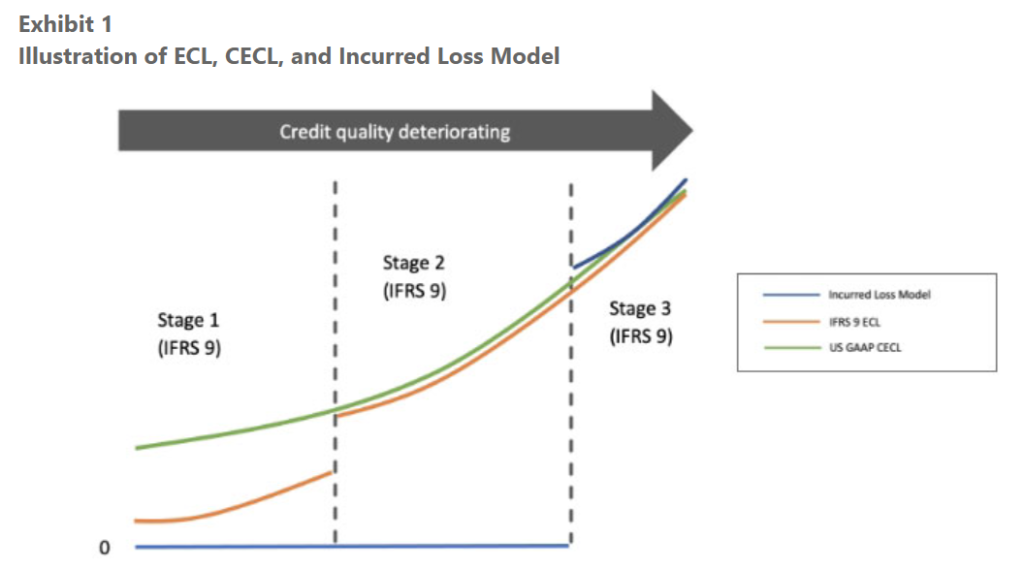
Under the old regime, the impairment was the incurred credit losses, in determining which only past events and current conditions are used. Credit losses were booked after a credit event had taken place, thus the name “incurred.” ECL and CECL require the incorporation of forward-looking information in addition to the past/current info in the calculation of impairment. There will be an allowance for credit losses since initial recognition regardless of the creditworthiness of the investment asset. The allowance can be perceived as the reserve or capital for credit risks. In practice, the allowance could be zero if there are no expected default losses for the instrument, US Treasury bonds, US Agency MBS, just to name a few.

ECL under IFRS 9 is typically calculated as a probability weighted estimate of the present value of cash shortfalls over the expected life of the financial instrument. It Is an unbiased best estimate with all cash shortfalls taking into consideration the collaterals or other credit enhancement. Four typical parameters underlying its calculation are: Probability of default (PD), loss given default (LGD, i.e., 1-Recovery Rate), exposure at default (EAD) and discounting factor (DF). Prepayments, usage given default (UGD) and other parameters can also play a role in the calculations. In the general approach the loss allowance for a financial instrument is 12-month ECL regardless of credit risk at the reporting date, unless there has been a significant increase in credit risk since initial recognition: The PD is only considered for the next 12 months while the cash shortfalls are predicted over the full lifetime; as the creditworthiness deteriorates significantly, the loss allowance is increased to full lifetime ECL in Stage 2, which should always precede stage 3 (credit impairment). Even without change of stages, any credit condition changes should be flowing into the credit loss allowance via updates in some of the underlying parameters. Exhibit 1 has an illustrative comparison between ECL, CECL, and incurred loss model.

CECL is similar to ECL except FASBs doesn’t have so-called staging as IFRS 9, which requires that only 12-month ECL is calculated in stage 1 (in the general model). In other words, CECL requires a full lifetime ECL from Day 1. There are also other differences: IFRS 9 requires certain consideration of time value of money, multiple scenarios, etc., in measurement of ECL while US GAAP CECL doesn’t.

Under US GAAP, different from CECL, currently the impairment for AFS assets, while also recorded as an allowance (with a couple exceptions), is only needed for those whose fair value is less than the amortized cost. Once it is triggered, the credit losses are then measured as the excess of the amortized cost basis over the probability weighted estimate of the present value of cash flows expected to be collected. Only the fair value change related to credit is considered in the calculation of AFS impairment. The quantitative calculation behind the probability weighted best estimate is like CECL/ECL. Both can use discounted cash flow methods with parameters such as PD although one is calculating expected cash shortfalls directly in CECL and the other is calculating the expected collectible cash payments and then is used to back out the impairment.

Author(s): Jing Fritz

Publication Date: September 2022

Publication Site: Risk Management newsletter, SOA

Forward Thinking on talent, state capacity, and being hopeful with Tyler Cowen

Link: https://www.mckinsey.com/capabilities/people-and-organizational-performance/our-insights/forward-thinking-on-talent-state-capacity-and-being-hopeful-with-tyler-cowen

Graphic:

Excerpt:

Michael Chui: Fascinating. You mentioned talent. You recently coauthored a book with Daniel Gross entitled Talent: How to Identify Energizers, Creatives, and Winners Around the World. What was the central thesis of this book?

Tyler Cowen: That talent is remarkably important. That we’re doing a poor job, misallocating talent. And there are a variety of ways, outlined in the book, we can do better. This book tries to be “the” talent book: a one-stop shopping guide to how to think about identifying talent.

Michael Chui: What are the macro implications of [the] lack of good matching? Is this a potential for accelerating productivity, for instance?

Tyler Cowen: We have slower economic growth when we don’t match talent well. We have a lower level of per capita income. When a recession comes, as was the case in 2008, labor markets adjust much more slowly. The consequences for human welfare are considerable.

Author(s): Michael Chui, Tyler Cowen

Publication Date: 28 Sept 2022

Publication Site: McKinsey