$50 to drive to Manhattan. $100 to come into N.J. How a fight over traffic cameras could prove costly.

Link: https://www.nj.com/news/2022/10/50-to-drive-to-manhattan-100-to-come-into-nj-how-a-fight-over-traffic-cameras-could-prove-costly.html

Excerpt:

A war of words between New York and New Jersey legislators over red light cameras could prove costly to commuters who could be slapped with hefty fees to travel between New York City and the Garden State.

New York lawmakers want to slap Jersey drivers with a $50 “non-cooperation fee” when they drive into New York City, in response to a bill that would bar the state Motor Vehicle Commission from helping New York enforce red light and speed camera tickets against Garden State drivers.

If passed by New York State’s senate and assembly, that charge would be on top of the $16 cash toll to cross the Hudson into Manhattan, and could be added to proposed congestion pricing fees for driving south of 60th Street, that might take effect in 2024.

….

O’Scanlon reiterated his long standing opposition to automated enforcement, citing his analysis of National Highway Traffic Safety administration statistics that showed red light camera and other automated enforcement did not translate in to lower death rates in states that had them.

“There is no correlation to safety benefits. Every unbiased assessment showed no benefit,” he said. “It’s a demonstrable fact that automated enforcement and red light camera systems don’t improve safety.”

Author(s): Larry Higgs

Publication Date: 1 Oct 2022

Publication Site: NJ.com
Kentucky Retirement Systems Lawsuit Targets New York Fixer Regina Calcaterra for Alleged Bid Fixing

Link: https://www.nakedcapitalism.com/2022/09/kentucky-retirement-systems-lawsuit-targets-new-york-fixer-regina-calcaterra-for-alleged-bid-fixing.html

Excerpt:

Regina Calcaterra, partner in the law firm Calcaterra Pollack and a notorious New York State fixer is charged with bid rigging. The New York Times published an investigative series about the Moreland Commission, an anti-corruption probe. Calcaterra was its executive director. The commission was disbanded early. The Times reported that Calcaterra harassed investigators, interfered repeatedly in the report drafting process, improperly blocked subpoenas and communicated with Governor Cuomo, with the aim of squashing any findings that might embarrass Cuomo. The New York Board of Elections sued Calcaterra several times for violating campaign finance laws. She was barred from running for office for lying about her residency. To the extent she knows anything about public pension funds, she learned it from her one-time boss, state controller Alan Hevesi, who went to prison in a pay-to-play scandal (note Calcaterra worked for him his earlier role as New York City controller; in that capacity Hevesi was also responsible for the pension investments).

As you can see below, the tenacious legal team that originally represented the so-called Mayberry eight in Mayberry v. KKR has Calcaterra and an alleged co-conspirator at Kentucky Retirements Systems, its now general counsel Vicky Hale, in its cross-hairs for alleged violations of Kentucky procurement statutes, breach of trust and fiduciary duty, and conspiracy claims. A new group of so-called Tier 3 (defined contribution) plaintiffs are seeking to sue the KKR, Blackstone et al for selling overpriced, misrepresented customized hedge funds that underperformed stocks and even cash. The suit against Calcaterra, members of her firm, and Kentucky Retirement Systems’ Hale is a side but nevertheless revealing action.

The filing below perfects allegations previously made against Calcaterra and her apparent partners in misconduct. The first time the Tier 3 attorneys, led by Michelle Lerach, covered much of the same ground in an early 2021 filing and asked for the so-called Calcaterra Report to be released. Judge Philip Shepherd reacted harshly, as if the point of the filing was primarily to dirty up Calcaterra. He also discounted the New York Times investigation, saying more or less than anyone who has held an important job has been on the receiving end of bad stories.

Author(s): Yves Smith

Publication Date: 22 Sept 2022

Publication Site: naked capitalism

S&P Global’s Proposed Capital Model Changes and its Implication to U.S. Life Insurance Companies

Link: https://www.soa.org/sections/financial-reporting/financial-reporting-newsletter/2022/september/fr-2022-09-sun/

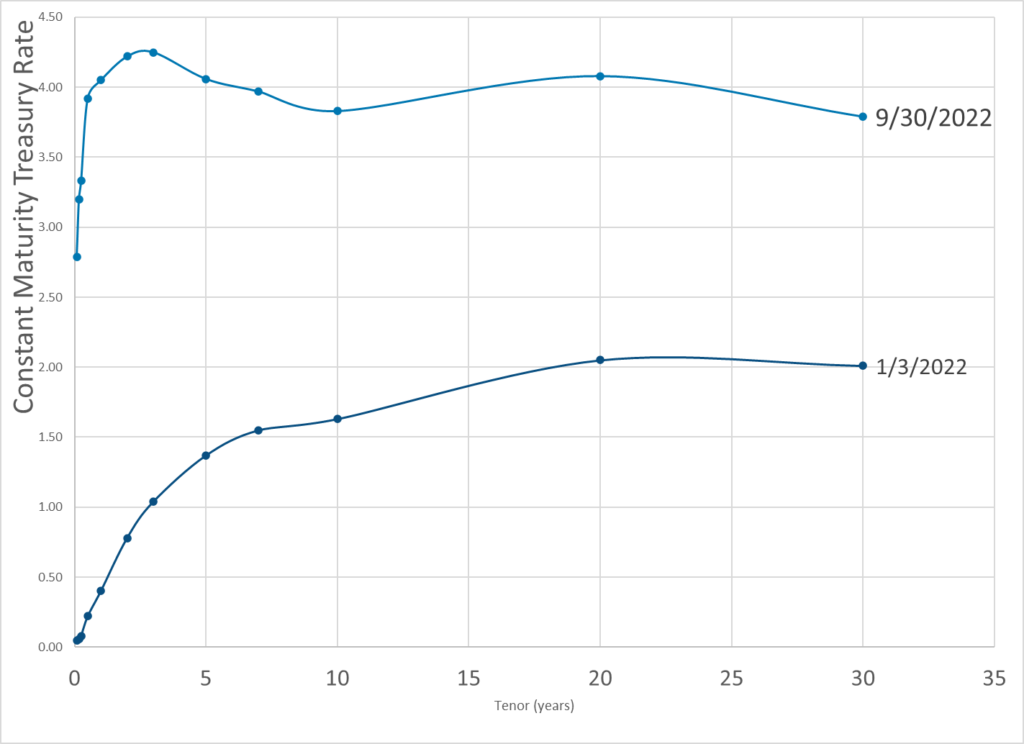
Graphic:

Excerpt:

Life technical risks measure the possible losses from deviations from the best estimate assumptions relating to life expectancy, policyholder behavior, and expenses. The life technical risks are captured through mortality, longevity, morbidity, and other risks. The methodology for calculating the capital adequacy for these four risk categories remains unchanged under the proposed method, apart from the recalibration of capital charges or the consolidation of defining categories within each risk. Comparing to the current GAAP based model, charges have materially increased across all categories partly due to higher confidence intervals, with notable exceptions of longevity risk, with reduced charges across all stress levels (changes applicable to U.S. life insurers are illustrated in Tables A2 to A5 in the Appendix linked at the end of this article). Please note that S&P’s current capital model under U.S. statutory basis does not have an explicit longevity risk charge. However, this article focuses on comparison to current GAAP capital model[1] that is closer to the new capital methodology framework.

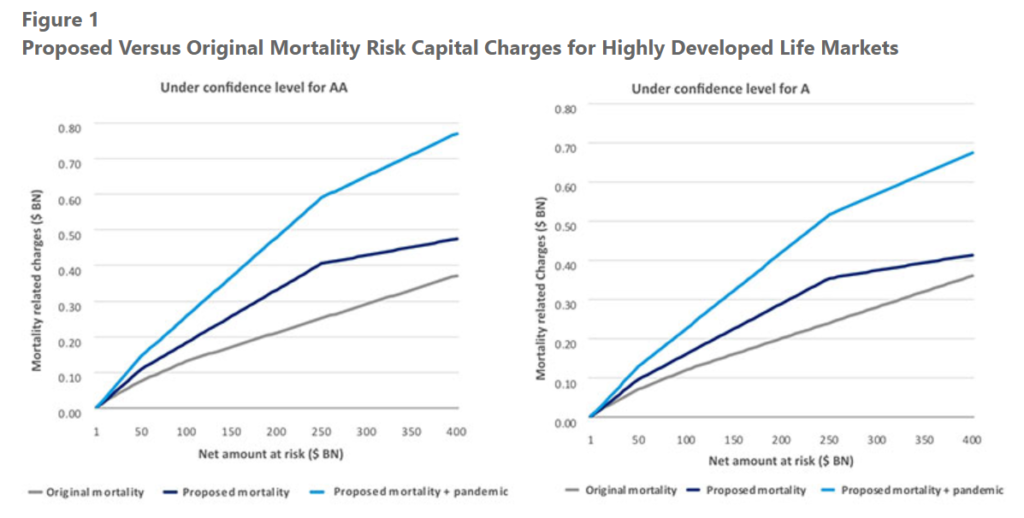
For mortality risk, lower rates are charged for smaller exposures (net amount at risk (NAR) $5 billion or less) with the consolidation of size categories, but higher rates are charged for NAR between $5 billion and $250 billion, with an average increase of 49 percent for businesses under $400 billion NAR. A new pandemic risk charge (Table A3 in the Appendix linked at the end of this article) will further increase mortality related risk charges to be 109 percent higher than original mortality charges under confidence level for company rating of AA, and 93 percent higher for confidence level for company rating of A, respectively, on average (Figure 1). The disability risk charge rates increased moderately for most products, across all eight product types such that the increase of disability premium risk charges is 6 percent under confidence level for AA, and 2 percent for A, respectively. In addition, the proposed model introduced a new charge on disability claims reserve, ranging from 13.7 percent of total disability claims reserves for AAA, to 9.6 percent for BBB. However, the proposed model provides lower capital charge rates in longevity risk and lapse risk.

Author(s): Yiru (Eve) Sun, John Choi, and Seong-Weon Park

Publication Date: September 2022

Publication Site: Financial Reporting newsletter of the SOA

Embedded Bias: How Medical Records Sow Discrimination

Link: https://khn.org/news/article/electronic-medical-records-doctor-bias-open-notes-treatment-discrimination/

Excerpt:

Narrow or prejudiced thinking is simple to write down and easy to copy and paste over and over. Descriptions such as “difficult” and “disruptive” can become hard to escape. Once so labeled, patients can experience “downstream effects,” said Dr. Hardeep Singh, an expert in misdiagnosis who works at the Michael E. DeBakey Veterans Affairs Medical Center in Houston. He estimates misdiagnosis affects 12 million patients a year.

Conveying bias can be as simple as a pair of quotation marks. One team of researchers found that Black patients, in particular, were quoted in their records more frequently than other patients when physicians were characterizing their symptoms or health issues. The quotation mark patterns detected by researchers could be a sign of disrespect, used to communicate irony or sarcasm to future clinical readers. Among the types of phrases the researchers spotlighted were colloquial language or statements made in Black or ethnic slang.

“Black patients may be subject to systematic bias in physicians’ perceptions of their credibility,” the authors of the paper wrote.

That’s just one study in an incoming tide focused on the variations in the language that clinicians use to describe patients of different races and genders. In many ways, the research is just catching up to what patients and doctors knew already, that discrimination can be conveyed and furthered by partial accounts.

Author(s): Darius Tahir

Publication Date: 26 Sept 2022

Publication Site: Kaiser Health News

Bank of England in £65bn scramble to avert financial crisis

Link: https://www.theguardian.com/business/2022/sep/28/bank-of-england-in-65bn-scramble-to-avert-financial-crisis

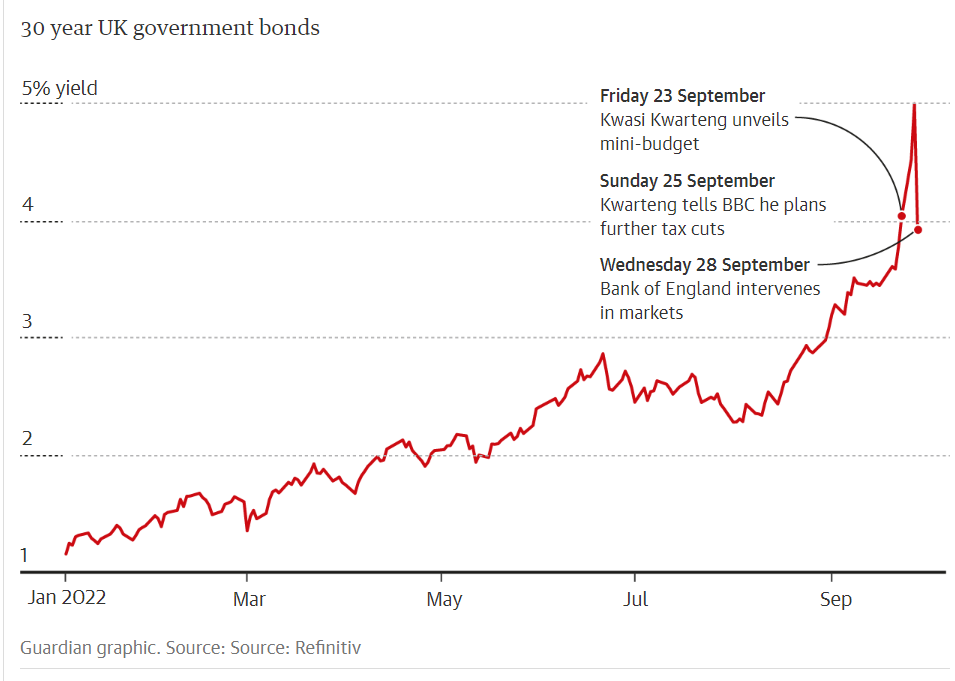
Graphic:

Excerpt:

The Bank of England has been forced into emergency action to halt a run on Britain’s pension funds after the impact of Kwasi Kwarteng’s ill-received mini budget prompted fears of a 2008-style financial crisis.

Threadneedle Street said the fallout from a dramatic rise in government borrowing costs since the chancellor’s statement had left it with no choice but to intervene to protect the UK’s financial system.

City sources said the surprise move, less than a week after Kwarteng’s unfunded tax giveaways, was needed to halt a “doom loop” in the bond markets that risked draining pension funds of cash and leaving them at risk of insolvency.

….

Interest rates on government bonds, or gilts, have risen sharply since the chancellor’s £45bn package of tax cuts – making it punitively expensive for thousands of pensions funds to fund their hedging activities.

Officials in the Financial Services Group of the Treasury were at an away day – said to have been held at the Oval cricket ground in London – on Wednesday, but returned to their desks that afternoon. A source said they were not working on the response to the Bank of England’s announcement.

The Bank’s action helped provide Kwarteng with some respite from the financial markets after three days of turmoil that has seen sterling hit its lowest ever level against the dollar, strong criticism of the mini-budget from the International Monetary Fund, about 1,000 mortgage products pulled and interest rates on UK government bonds hit their highest level since 2008. Bond yields fell while the pound recovered in the currency markets after Threadneedle Street’s announcement.

Author(s): Larry Elliott, Pippa Crerar and Richard Partington

Publication Date: 28 Sep 2022

Publication Site: Guardian

Pension funds crisis forces £65bn bailout by Bank

Link: https://www.telegraph.co.uk/business/2022/09/28/pension-funds-crisis-forces-65bn-bailout-bank/

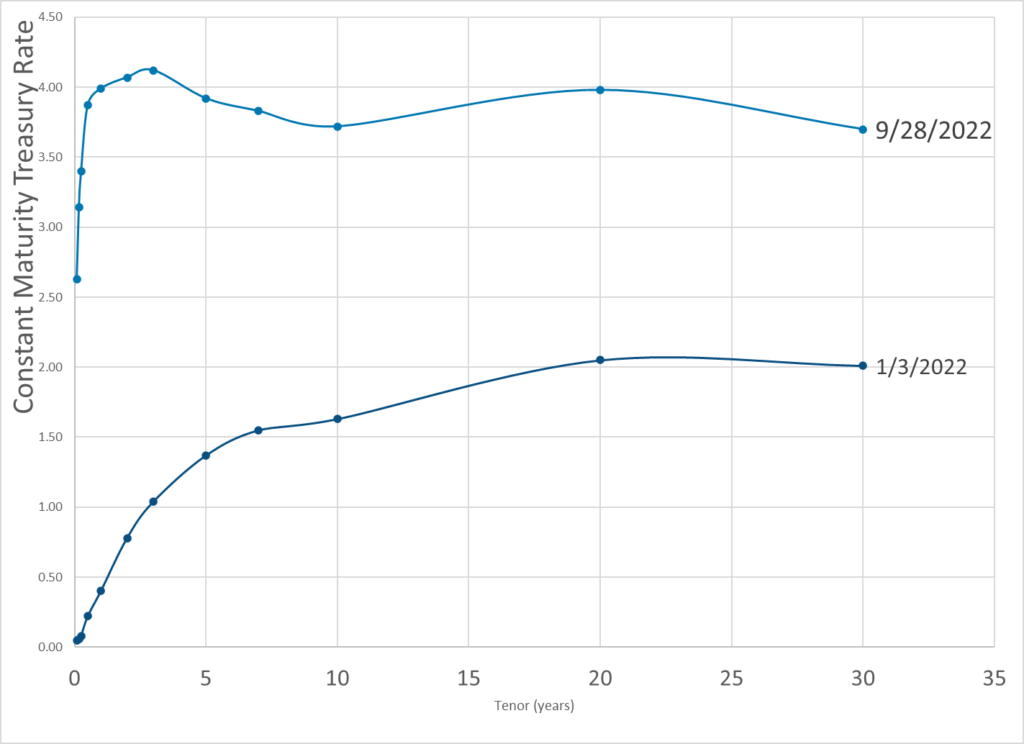
Graphic:

Excerpt:

Britain’s pension funds were on Wednesday at the centre of the financial crisis sparked by the mini-budget forcing the Bank of England to launch a £65 billion emergency bailout. 

The Bank warned of a “material risk to UK financial stability” and stepped in to buy long-term gilts, as plunging markets for UK debt sent borrowing costs spiralling and forced pension funds to dump their assets. Economists compared the crisis to the run of withdrawals that led to the collapse of Northern Rock in the financial crisis. 

However, the move by Governor Andrew Bailey helped restore some calm to markets, and pensions experts said retirement pots were not under threat. Nevertheless, worries that Mr Kwarteng’s radical mini-Budget will trigger further shocks for investors in gilts wiped billions of pounds off the stock market value of Britain’s biggest pension funds.

….

The Bank hopes to halt a domino effect in the City by temporarily suspending plans to offload £80bn of gilts held on its balance sheet. Instead for 13 days it will revert to buying them at a rate of £5bn per day using newly created money in a process known as quantitative easing.

The measures sparked a sharp rally in the market for the 30-year gilts that pension funds had been forced to sell. The cost of such borrowing fell by more than 1 percentage point, a significant downward move. Meanwhile the pound fell initially after the Bank’s announcement on fears of further inflation but recovered to finish roughly flat at nearly $1.09 against the dollar.

Author(s):

Tim Wallace
and
Ben Riley-Smith

Publication Date: 28 Sept 2022

Publication Site: UK Telegraph

Montana Health Officials Aim to Boost Oversight of Nonprofit Hospitals’ Giving

Link: https://khn.org/news/article/montana-health-oversight-nonprofit-hospitals-giving-charity/

Excerpt:

Montana health officials are proposing to oversee and set standards for the charitable contributions that nonprofit hospitals make in their communities each year to justify their access to millions of dollars in tax exemptions.

The proposal is part of a package of legislation that the state Department of Public Health and Human Services will ask lawmakers to approve when they convene in January. It comes two years after a state audit called on the department to play more of a watchdog role and nine months after a KHN investigation found some of Montana’s wealthiest hospitals lag behind state and national averages in community giving.

….

The IRS requires nonprofit hospitals to tally what they spend to “promote health” to benefit “the community as a whole.” How hospitals count such contributions to justify their tax exemptions is opaque and varies widely. National researchers who study community benefits have called for tightening standards for what counts toward the requirement.

Author(s): Katheryn Houghton

Publication Date: 28 Sept 2022

Publication Site: Kaiser Health News

Macron buckles on raising France’s retirement age in budget bill

Link: https://www.ft.com/content/cf3eff53-2dfb-4530-a756-1e1361990d7d

Excerpt:

French president Emmanuel Macron has decided against pushing through a rise in the retirement age to 65 in a budget bill, backing off an idea that had angered labour unions and divided his centrist alliance.

The move signals how Macron has been forced to contend with a stronger opposition in his second term after his party lost its majority in parliament in June.

….

Prime Minister Élisabeth Borne told Agence France-Presse on Thursday that the government would start negotiations with labour unions, employers and other political parties with a view to passing a law over the coming months.

The government still wants to raise the retirement age from 62 at present to 65, one of Macron’s campaign promises that he sees as key to fixing France’s public finances.

Author(s): Leila Abboud

Publication Date: 29 Sept 2022

Publication Site: Financial Times

What to consider when using text in data visualizations

Link: https://blog.datawrapper.de/text-in-data-visualizations/

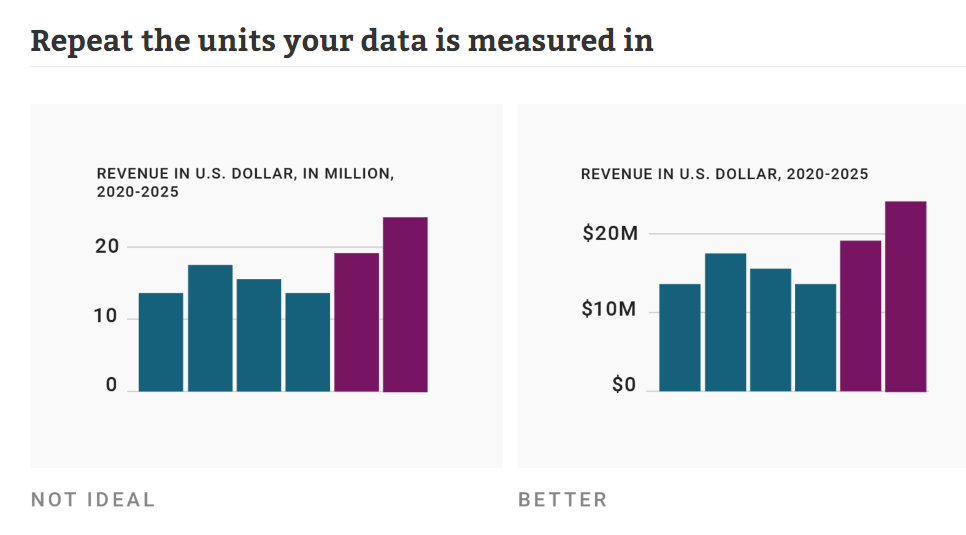
Graphic:

Excerpt:

Text is maybe the most underrated element in any data visualization. There’s a lot of text in any chart or map — titles, descriptions, notes, sources, bylines, logos, annotations, labels, color keys, tooltips, axis labels — but often, it’s an afterthought in the design process. This article explains how to use text to make your visualizations easier to read and nicer to look at.

Show information where readers need it
01 Label directly
02 Repeat the units your data is measured in
03 Remind people what they’re looking at in tooltips
04 Move the axis ticks where they’re needed
05 Emphasize and explain with annotations

Design for readability
06 Use a font that’s easy to read
07 Lead the eye with font sizes, styles, and colors
08 Limit the number of font sizes in your visualization
09 Don’t center-align your text
10 Don’t make your readers turn their heads
11 Use a text outline

Phrase for readability
12 Use straightforward phrasings
13 Be conversational first and precise later
14 Choose a suitable number format

Author(s): Lisa Charlotte Muth

Publication Date: 28 Sept 2022

Publication Site: Datawrapper