Graphic:
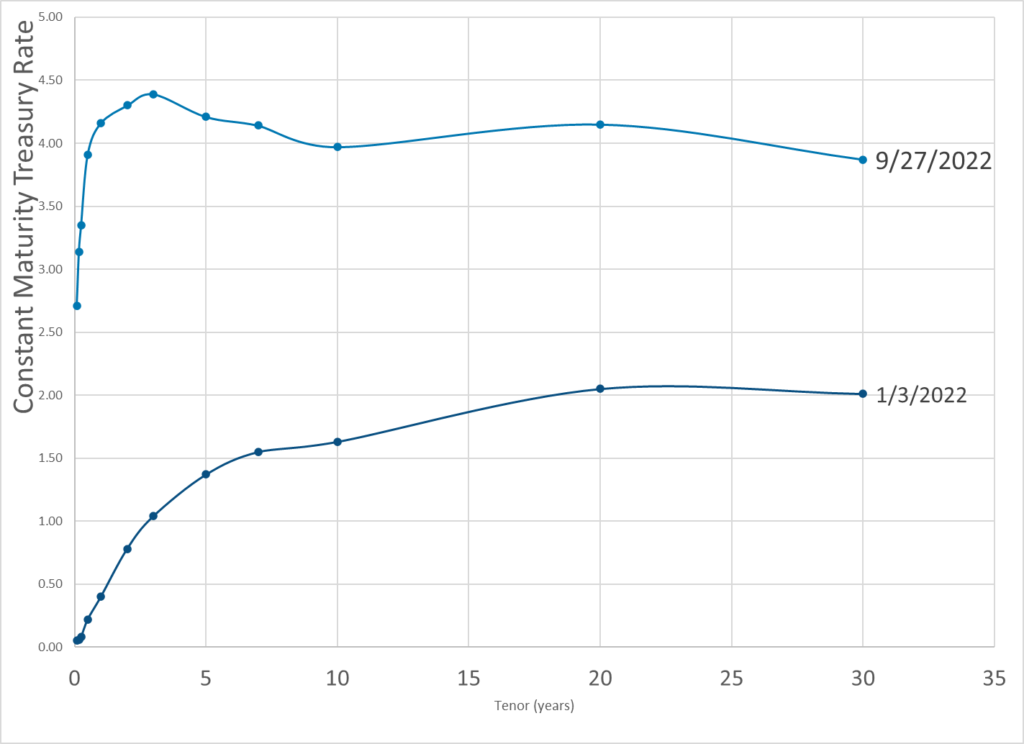
Publication Date: 27 Sept 2022
Publication Site: Department of Treasury
All about risk
Graphic:
Publication Date: 27 Sept 2022
Publication Site: Department of Treasury
Excerpt:
Under LDTI, DAC amortization will no longer obscure the relationship between direct and ceded accounting. It is now possible to align ceded accounting with direct, without any noise from DAC amortization. With poor alignment, distortions within the results reported to management and financial statement users will be different, sometimes greater than before. Whether the goal is to improve reporting or to avoid making it worse, a fresh look can help.
Most of the approaches that have been used to account for UL reinsurance can still be used. One exception is the implicit approach where, in lieu of explicit accounting for reinsurance, the gross profits used to amortize DAC were adjusted to be net of reinsurance. With the elimination of gross profits as an amortization base, this approach no longer has meaning.
For surviving approaches, it is now easier to evaluate their effectiveness in presenting the economic protection provided by reinsurance.
In this article, I begin an evaluation by examining the fundamentals of accounting for the insurance element of universal life. After that, I consider the economic protection provided by reinsurance and look for an ideal—a way to effectively account for that protection.
In a second article to be published later this year, I’ll evaluate several reinsurance approaches in terms of noise from missing the ideal, then end with some thoughts on what might be done to eliminate noise.
The focus of both articles is on the insurance element. Accounting for the deposit element, embedded derivatives, and market risk benefits is beyond the scope of these articles. Also outside of scope is the requirement, in Accounting Standards Codification (ASC) Topic 326, to recognize a current estimate of credit losses from the failure of a reinsurer to reimburse reinsured benefits.
Author(s): Steve Malerich
Publication Date: Sept 2022
Publication Site: Financial Reporting newsletter, SOA
Link: https://www.thinkadvisor.com/2022/09/27/5-worst-states-for-working-age-deaths-in-august/
Graphic:
Excerpt:
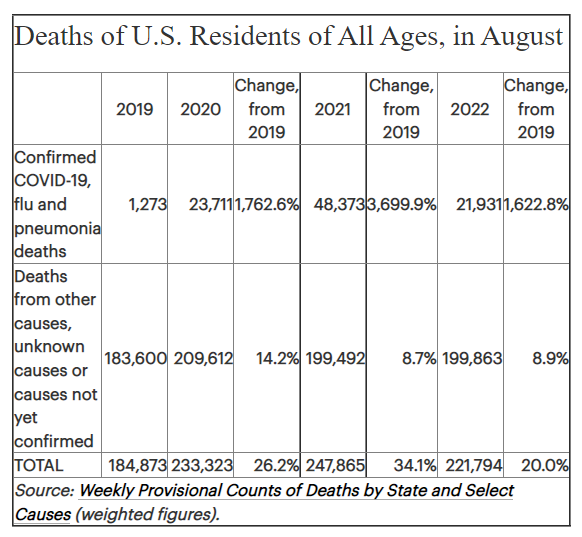
The number of deaths of working-age Americans was lower in August than in August 2021, but it was still much higher than it was in August 2019, before the COVID-19 pandemic began.
Death figures for the period from July 31 through Aug. 27 are just starting to firm up. But very early figures show that at least 53,655 U.S. residents ages 25 through 64 died from COVID-19 and all other causes during that four-week period.
The number of deaths was down sharply from 77,847 in August 2021, but it was still up 6.1% from the total of 50,590 for August 2019.
Author(s): Allison Bell
Publication Date: 27 Sept 2022
Publication Site: Think Advisor
Graphic:
Excerpt:
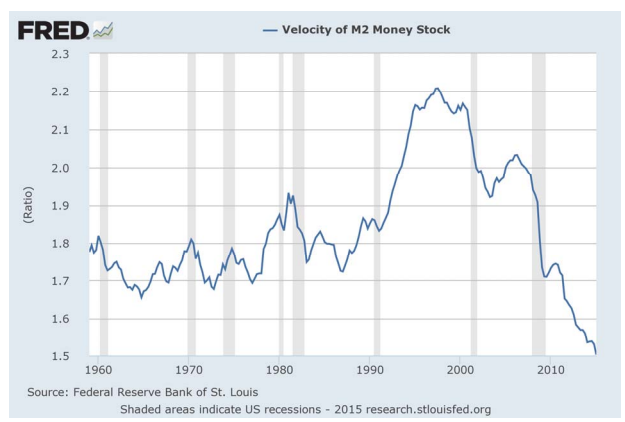
Interest rates cycle over long periods of time. The journey tends to be unpredictable, full of
unexpected twists and turns. This project focuses on the impact of interest rate volatility on life
insurance products. As usual, it brought up more questions than it answered. It points out the
importance of stress testing for a specific block of business and the risk of relying on industry
rules of thumb. Understanding the nuances of models could make the difference between safe
navigation of a stressed environment and a default. Proactive and resilient practices should
increase the odds of success.
Hyman Minsky had it right—stability leads to instability. We live in an era where monetary
policies of central banks steer free markets in an effort to soften the business cycle. Rates have
been low for over 20 years in Japan, reshaping the global economy.The primary goal of this paper is to explore rising interest rates, but that is not possible without
considering that some rates could stabilize at low levels or even decrease. Following this path,
the paper will look at implications of interest rate changes for the life insurance industry, current
stress testing practices, and how a risk manager can proactively prepare for an uncertain future.
A paper published in 2014 focused on why rates could stay low, and some aspects of this paper
are similar (e.g., description of insurance products). This paper also uses a sample model office
to help practitioners look at their own exposures. It includes typical interest-sensitive insurance
products and how they might perform across various scenarios, as well as a survey to establish
current practices for how insurers are testing interest rate risk currently.
Author(s): Max Rudolph, Randy Jorgensen, Karen Rudolph
Publication Date: July 2015
Publication Site: SOA Research Institute
Link: https://www.banking.senate.gov/imo/media/doc/brown_letter_on_insurance_031622.pdf
Excerpt:
Author(s): Sen. Sherrod Brown
Publication Date: 16 March 2022
Publication Site: U.S. Senate Banking Committee
Excerpt:
The state Health Department intentionally “misled the public” regarding the number of COVID-19 deaths in nursing homes under former New York Gov. Andrew Cuomo’s administration, according to a scathing audit from the Comptroller Thomas P. DiNapoli.
When the COVID-19 pandemic swept through New York, the Department of Health was not prepared to respond to the infectious disease outbreaks in nursing homes, according to the audit, which helped lead to the inaccurate virus-related death count in facilities.
Auditors found that health officials undercounted the death toll in nursing homes by at least 4,100 residents and at times more than 50 percent, despite claims from the former governor, who said the state was doing well in protecting seniors.
Author(s): Zak Failla
Publication Date: 17 March 2022
Publication Site: New York Daily Voice
Link: https://news.ambest.com/articlecontent.aspx?AltSrc=104&RefNum=317587
Excerpt:
A new set of revisions to the National Association of Insurance Commissioners requirements that govern real estate investments on the part of life insurers could be teeing up the asset class for growth in the future, as barriers to entry are lowered.
Late last year, the NAIC released a set of changes to its risk-based capital requirements that, for life insurers, lowered the factor for life and health companies. For so-called Schedule A investments—properties owned outright by carriers—the required set-aside was lowered to 11% from 15%. In the case of Schedule BA investments, such as partnerships and funds where the carrier isn’t the sole owner, that figure went down to 13% from 23%.
….
As of 2020, life and annuity insurers had $8.15 trillion in invested assets, with an overall net return on that sum of 4.1%, according to Best’s Rankings US Life/Health—2020 Asset Distribution. Meanwhile, Best’s Rankings US Life/Health—Industry 2020 Investment Returns—2021 Edition reports mortgages had a return of 4.42% compared to 4.22% for bonds.
George Hansen, senior industry research analyst, AM Best, said life insurers traditionally have only placed about 6% of their portfolios in Schedule BA real estate products and less than 1% in Schedule A real estate investments. Whether there’s any increase and by how much will likely be tied to which segments of the industry carriers are in, but Hansen said he doesn’t expect a huge increase.
Author(s): Terence Dopp
Publication Date: March 2022
Publication Site: Best’s Review
Link: https://www.pewtrusts.org/en/research-and-analysis/data-visualizations/2014/fiscal-50
Graphic:
Excerpt:
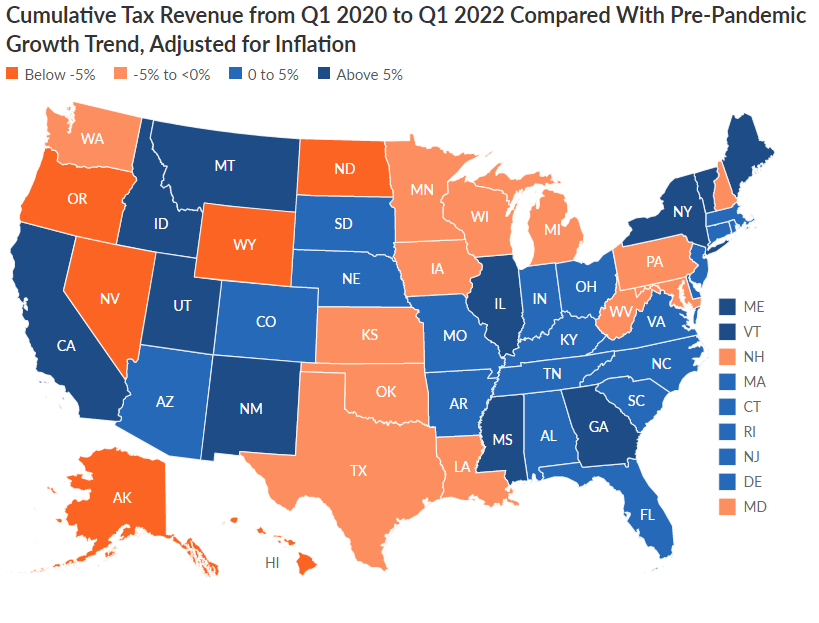
As the first quarter of 2022 came to an end and the United States passed the two-year anniversary of the start of the COVID-19 pandemic, total state tax revenue was at its highest level since just before its historic decline in early 2020. Collections were 18.1% greater than those for the final quarter of 2019, after adjusting for inflation and averaging across four quarters to smooth seasonal fluctuations. Only Wyoming and North Dakota had not taken in enough revenue to surpass their pre-pandemic levels.
Nationwide and in 31 states as of the end of the first quarter of 2022, cumulative tax receipts since the pandemic’s start, adjusted for inflation, were even higher than they would have been if pre-COVID growth trends had continued—despite fallout from the pandemic and a two-month recession. According to Pew estimates, Idaho led all states, with 16% more cumulative tax revenue than it would have collected under its pre-pandemic growth rate. New Mexico was second at 15.5% above the trend. Nationally, combined tax revenue at the end of the first quarter of 2022 was 3% above estimates of what might have been collected had the pandemic not occurred.
However, estimates also show that cumulative tax revenue fell short of its pre-COVID growth trend in slightly more than a third of states since the pandemic’s onset, and most other states’ recoveries largely followed historical trends.
Looking at cumulative totals since the start of the pandemic offers a way to identify states in which tax revenue has over- or underperformed since January 2020, based on pre-COVID trends. This approach also provides a different view of the strength of collections from the often-astonishing quarterly and annual percentage increases that were skewed by this particularly volatile period. For each of the nine quarters from Jan. 1, 2020 to March 31, 2022, Pew calculated the difference between actual tax revenue and estimates of how much each state would have collected had revenue grown at its pre-pandemic, five-year average annual growth rate.
Author(s): Melissa Maynard
Publication Date: 7 Sept 2022
Publication Site: Pew Trusts
Excerpt:
The MBTA’s largest union is challenging an independent arbitrator’s decision that would reshape the rules of the authority’s $1.66 billion retirement system, including slashing the pensions of those who retire before the age of 65.
…..
Still, after more than four years of negotiations over a pension agreement, it’s unclear what exact changes could come to the MBTA’s retirement fund, where the number of retirees has long outpaced the amount of workers paying into it, and MBTA officials have long pressed for sweeping changes.
As of the end of last year, the fund’s unfunded liability hovered at more than $1.3 billion, and, despite changes that went into effect a decade ago to stem what were considered lavish retirement perks, younger retirees have continued to flow into the retirement system, creating more financial pressure.
….
The arbitrator’s decision included a series of changes, most notably in lifting the age at which a retiree would collect an “unreduced” pension. Under the ruling, workers who opt for early retirement — in this case, before the age of 65 — would have 6 percent deducted from their pension benefit for every year of retirement before the age of 65.
Currently, anyone who is 55 and has at least 25 years of service qualifies for a so-called normal monthly pension, calculated at 2.46 percent of the average of a person’s three consecutive highest-earning years, multiplied by years of service.
Author(s): Matt Stout
Publication Date: 26 Sept 2022
Publication Site: Boston Globe
Link: https://www.city-journal.org/remote-work-and-the-state-tax-war
Excerpt:
The Supreme Court’s unwillingness to intervene in a fight among states over taxing income from remote work may spark a jurisdictional revenue war. In August, the Court refused to take up a lawsuit by New Hampshire against Massachusetts’ practice of levying income taxes on Granite State residents employed by Bay State companies but working from home during the Covid lockdowns. Now New Jersey officials, who filed an amicus brief in the case because the state’s telecommuting residents are similarly taxed by New York, have proposed a law that would let the state tax telecommuters, including possibly tens of thousands of Empire State residents now working from home but employed by Garden State companies. The in-your-face legislation also provides incentives for Jersey residents to challenge New York’s law in tax court—one of the only venues left to residents after the Supreme Court decision. Given that several hundred thousand New Yorkers once commuted to other states to work and may now be staying home to telecommute, Albany risks losing revenues.
Beginning in March 2020, Covid restrictions brought a sharp rise in telecommuting, or working remotely from home. Studies have suggested that, during the pandemic’s initial phases, up to 36 percent of all private-sector employees, or about 43 million people, worked at home at least one day a week, and 15 percent, or about 18 million, telecommuted full-time. Census data before the pandemic found that as many as 6 million workers regularly cross state lines to go to their jobs. So it’s likely that several million current telecommuters have jobs with firms in another state. In New Hampshire, about 15 percent of residents with jobs—some 84,000 workers—commuted to Massachusetts pre-pandemic.
Author(s): Steven Malanga
Publication Date: 26 Sept 2022
Publication Site: City Journal
Graphic:
Excerpt:
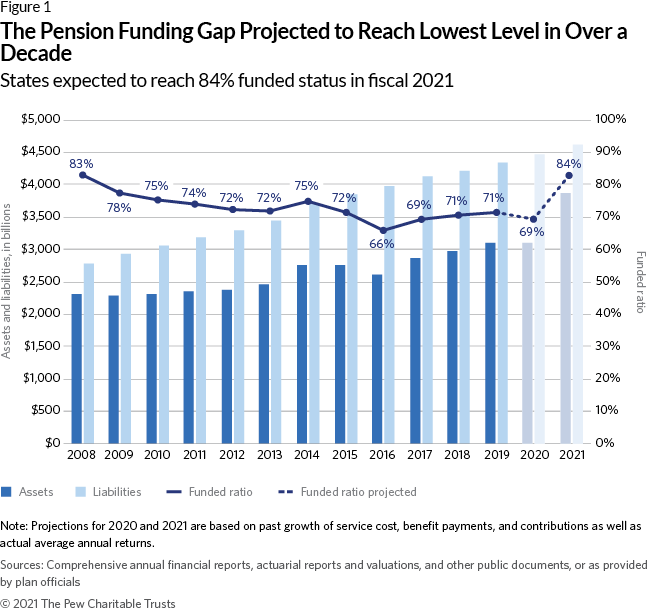
Since the fiscal 2019 reporting period ended, an unprecedented $5 trillion in federal stimulus and other government interventions have buoyed financial markets and strengthened plan balance sheets.2 As a result, state plans earned returns of over 25% in fiscal 2021—a highwater mark not seen since the 1980s. Pew estimates that total unfunded liabilities dropped below $1 trillion by the end of fiscal 2021, which would push state plans to be more than 80% funded for the first time since 2008. (See Figure 1; for more detail, see also Appendix G.) The significant improvement in plans’ fiscal position is due in large part to dramatic increases in employer contributions to state pension funds in the past decade, which boosted assets by more than $200 billion. Since 2010, annual contributions to state pensions have increased by 8% annually, twice the rate of revenue growth. And for the 10 lowest-funded states, the yearly growth in employer contributions averaged 15% over this period. As a result, after decades of underfunding and market losses from risky investment strategies, for the first time this century states are expected to have collectively achieved positive amortization in 2020—meaning that payments into state pension funds were sufficient to pay for current benefits as well as reduce pension debt.
An increase in pension contributions of the size seen over the past decade signals a shift in budget priorities by state policymakers and a recognition that the costs of postponing obligations are untenable if left unaddressed. Although this has improved the outlook for state pension plans, it has also crowded out spending on other important programs and services and left states with less budgetary space to sustain future rises in pension payments.
Author(s): Greg Mennis, David Draine
Publication Date: 14 Sept 2022
Publication Site: Pew Trust
Graphic:
Excerpt:
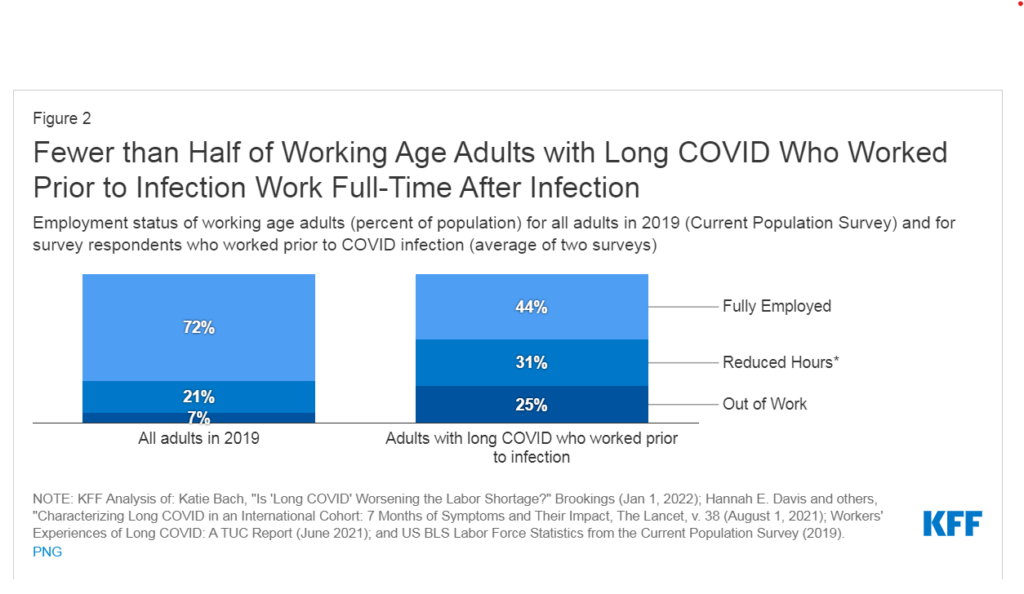
Preliminary evidence suggests there may be significant implications for employment: Surveys show that among adults with long COVID who worked prior to infection, over half are out of work or working fewer hours (Figure 2). Many conditions associated with long COVID—such as malaise, fatigue, or the inability to concentrate—limit people’s ability to work, even if they have jobs that allow for remote work and other accommodations. Two surveys of people with long COVID who had worked prior to infection showed that between 22% and 27% of those workers were out of work after getting long COVID. In comparison, among all working-age adults in 2019, only 7% were out of work. Given the sheer number of working age adults with long COVID, the employment implications may be profound and are likely to affect more people over time. One study estimates that long COVID already accounts for 15 percent of unfilled jobs.
Author(s): Alice Burns
Publication Date: 1 Aug 2022
Publication Site: KFF