Covid-19 Impact on the South African Life Insurance Industry: What Can we Learn?

Link: https://www.soa.org/sections/international/international-newsletter/2022/july/isn-2022-07-hoberg/

Graphic:
Excerpt:

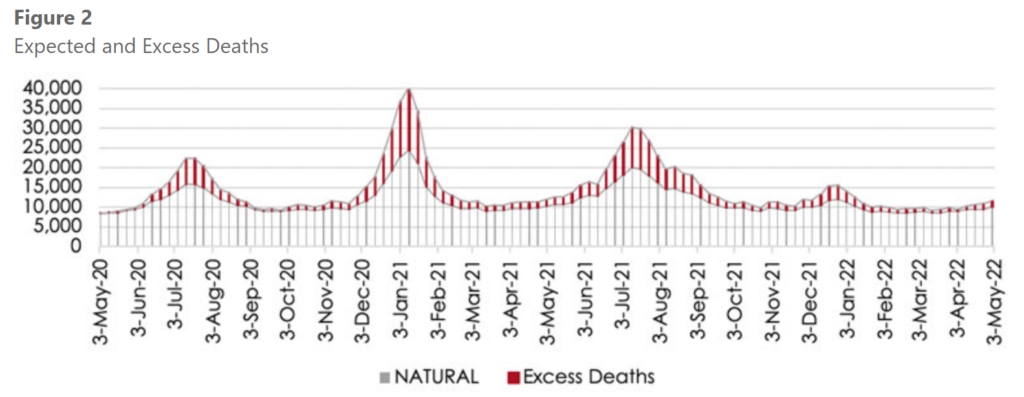
The impact of Covid-19 in South Africa in terms of excess deaths was substantial, when considering the reported excess deaths as published by the South African Medical Research Council (SAMRC).[4] Please note that in this article we will not further consider whether all excess deaths can be directly attributed to Covid-19, however, as per the article “Correlation of Excess Natural Deaths with Other Measures of the Covid-19 Pandemic in South Africa,”[5] it is estimated that 85 percent to 95 percent of excess natural deaths are attributable to Covid-19.

Based on the SAMRC excess deaths, taking the expected plus excess deaths as Actual and expected natural deaths as per their methodology as Expected, we observe an Actual versus Expected (AvE) ratio of 116 percent in 2020, a ratio of 131 percent in 2021, and a ratio of 113 percent in 2022 up to May 1. When we look at the AvE for each wave, we can see that the 2nd wave (predominantly Beta variant) and the 3rd wave (predominantly Delta variant), had the most severe impact on the general population (see figure 2 and figure 3)

Author(s): Idelia Hoberg

Publication Date: July 2022

Publication Site: SOA International News
Missing Americans: Early Death in the United States, 1933-2021

Link: https://www.medrxiv.org/content/10.1101/2022.06.29.22277065v1.full

Graphic:

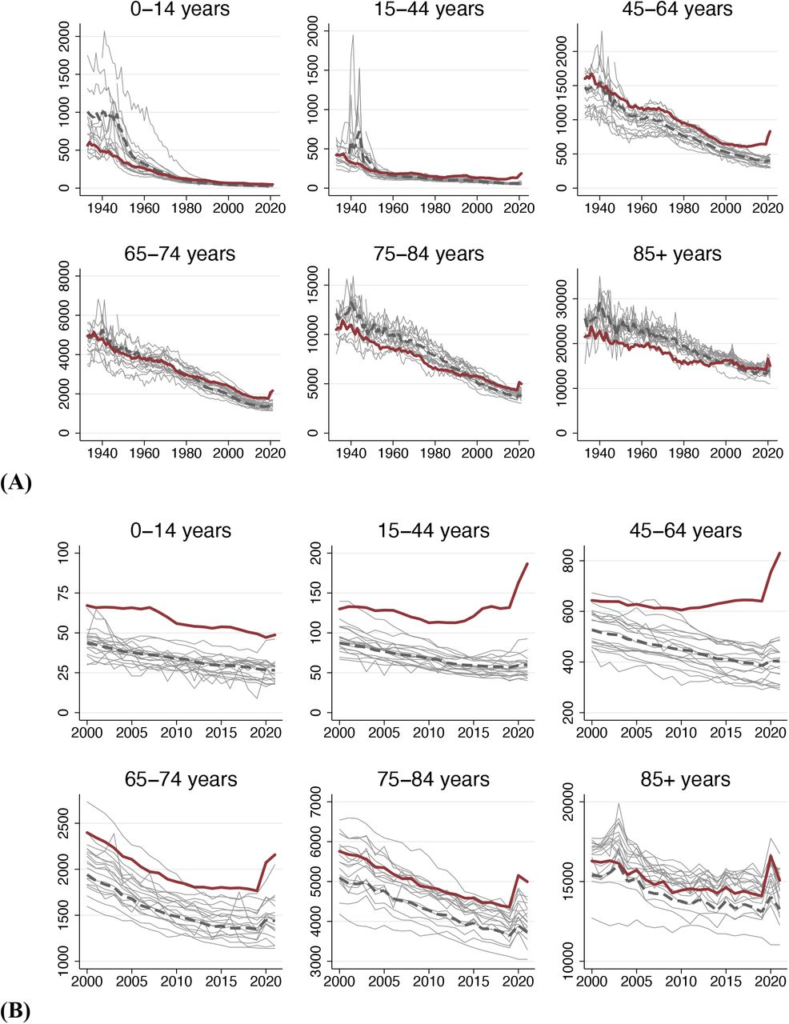
Age-specific mortality trends in the U.S. and other wealthy nations.Source: Human Mortality Database. Note: Figure shows deaths per 100K population, (A) 1933-2021 and (B) 2000-2021. Dark red line is U.S.; pink line is population-weighted average of other wealthy nations; grey lines are country-specific trends for other countries.

Excerpt:

We assessed how many U.S. deaths would have been averted each year, 1933-2021, if U.S. age-specific mortality rates had equaled those of other wealthy nations. The annual number of excess deaths in the U.S. increased steadily beginning in the late 1970s, reaching 626,353 in 2019. Excess deaths surged during the COVID-19 pandemic. In 2021, there were 1,092,293 “Missing Americans” and 25 million years of life lost due to excess mortality relative to peer nations. In 2021, half of all deaths under 65 years and 91% of the increase in under-65 mortality since 2019 would have been avoided if the U.S. had the mortality rates of its peers. Black and Native Americans made up a disproportionate share of Missing Americans, although the majority were White.

One sentence summary In 2021, 1.1 million U.S. deaths – including 1 in 2 deaths under age 65 years – would have been averted if the U.S. had the mortality rates of other wealthy nations.

Author(s):

Jacob Bor, View ORCID ProfileAndrew C. Stokes, Julia Raifman, Atheendar Venkataramani, Mary T. Bassett, David Himmelstein, Steffie Woolhandler


doi: https://doi.org/10.1101/2022.06.29.22277065

Publication Date: 30 Jun 2022

Publication Site: MedRXiV

Millennial Massacre Part 2: Increase In Mortality for Ages 18-39 for 2020-2021 Mainly Driven by Drug Overdoses and COVID

Link: https://marypatcampbell.substack.com/p/millennial-massacre-part-2-increase

Graphic:

Excerpt:

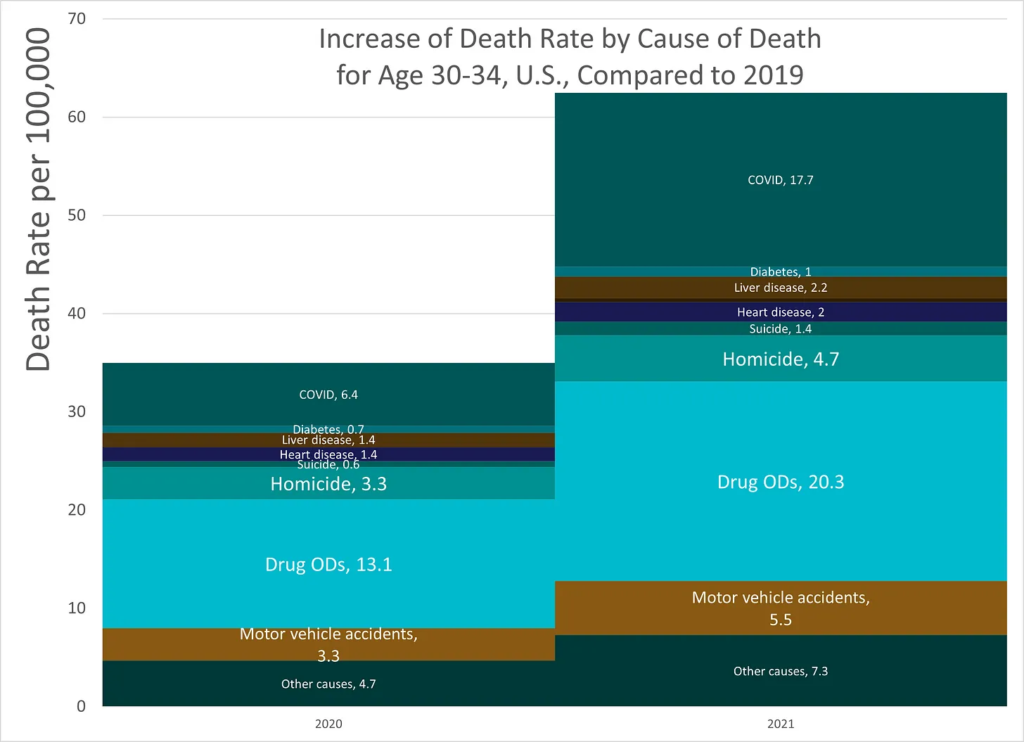
  • About 30% of the contribution to excess mortality for young adults in 2021 came from drug overdoses.
  • The percentage contribution to excess mortality of drug ODs was not that different by age group over the 18-39 age span.
  • COVID as a contribution to excess mortality was higher for older people —- for those age 35-39, 36% of their excess mortality came from COVID in 2021. In contrast, for those age 18-24, only 17% of their excess mortality came from COVID.
  • Indeed, the youngest of the adults (age 18-24) had higher contributions from homicide (20% of excess mortality) and had comparable excess mortality contribution from motor vehicle accidents (16%) in 2021.

Author(s): Mary Pat Campbell

Publication Date: 23 Jul 2022

Publication Site: STUMP at substack

Biden’s ESG Tax on Your Retirement Fund

Link: https://www.wsj.com/articles/bidens-esg-tax-on-your-retirement-fund-pension-planning-regulation-climate-change-investment-returns-portfolios-11658245467?st=4e8f8bvbqr4vurf&reflink=desktopwebshare_permalink

Excerpt:

BlackRock CEO Larry Fink wrote in 2020 that “sustainable investing is the strongest foundation for client portfolios.” Al Gore said in 2021 that “you don’t have to trade values for value. Green can enhance returns.” These claims haven’t aged well: ESG (environmental, social and governance) funds have trailed the market since the beginning of the year and are badly underperforming the sectors they shun, including oil, gas and coal.

That may spur retirement fund managers to reconsider their commitments to ESG funds. But new ESG-favoring regulations may come to the rescue. Last year the U.S. Labor Department proposed a regulation that would tell retirement-fund managers to consider ESG factors such as “climate change” and “collateral benefits other than investment returns” when investing employees’ money.

This would encourage America’s perpetually underfunded pension plans to invest in politically correct but unproven ESG strategies. It would also violate retirees’ basic right to have their money invested solely to advance their financial interests.

….

The new regulation may also expose fiduciaries who don’t consider ESG factors to lawsuits. Already, activist shareholders are pursuing litigation against public companies that don’t take ESG-approved steps. NortonLifeLock was sued for allegedly breaching its fiduciary duties by telling investors it was committed to “diversity” when it had no racial minorities on its board. Exxon was sued for allegedly misleading investors by failing to disclose the likely effect of climate change on its bottom line. To date, courts have generally found that no reasonable investor would make investment decisions based on board diversity or, as one judge put it, “speculative assumptions of costs that may be incurred 20+ or 30+ years in the future.”

Author(s): Vivek Ramaswamy and Alex Acosta

Publication Date: 19 Jul 2022

Publication Site: WSJ

Event: The Private Market for Flood Insurance

Link: https://www.rstreet.org/2022/07/20/event-the-private-market-for-flood-insurance/

Video:

Excerpt:

The private market for flood insurance in the United States measures approximately $300 million in annual premium. This is less than 10 percent of the $3.7 billion in flood insurance premium written by the federal government’s National Flood Insurance Program (NFIP). Private insurers offering flood insurance are not operating on the same playing field because many NFIP policies are subsidized and underpriced. The creativity of private insurers, guided by the dynamics of a free and competitive market, will eventually drive out inefficiency and false price signals, and make available to homeowners and businesses the flood insurance they need at the right cost.

We invite you to an online discussion examining the obstacles and opportunities for private insurers featuring flood insurance entrepreneur Trevor Burgess, and R Street’s Jerry Theodorou and Caroline Melear.

Author(s): Jerry Theodorou, Trevor Burgess, Caroline Melear

Publication Date: 20 Jul 2022

Publication Site: R Street

NHTSA Launches New Campaign to Remind Drivers Speeding Wrecks Lives

Link: https://www.nhtsa.gov/press-releases/nhtsa-launches-new-campaign-remind-drivers-speeding-wrecks-lives

Ad:

Excerpt:

As part of the U.S. Department of Transportation’s comprehensive safety strategy to prevent traffic deaths, the National Highway Traffic Safety Administration is launching a public education campaign across the country to address one of America’s most dangerous driving behaviors. Tomorrow, the agency kicks off the Speeding Wrecks Lives campaign aimed at changing general attitudes toward speeding and reminding drivers of the deadly consequences.

The campaign, which will run July 20-August 14, is supported by an $8 million national media buy featuring English and Spanish-language ads running on television, radio and digital platforms. The ads target drivers ages 18 to 44, who data show are most likely to be involved in speeding-related fatal crashes.

….

According to NHTSA data, 11,258 people died in speeding-related crashes in 2020, and speeding was a contributing factor in 29% of all fatal crashes. Even with fewer cars on the road during the pandemic, 2020 saw a dramatic increase (17%) in speeding-related deaths compared to 2019. The data also showed additional concerning statistics in 2020:

Local roads saw the most speeding, with 87% of all speeding-related traffic fatalities occurring on non-interstate roads. 

Speeding contributed to 37% of the fatal crashes in work zones.

Speeding was a factor in more fatal crashes on wet roads than dry roads. 

Drinking and speeding is the deadliest combination. Of the drivers involved in fatal crashes, 37% were speeding and had a blood alcohol concentration of .08 or higher.

Author(s):

Publication Date: 19 Jul 2022

Publication Site: NHTSA

How AI can revolutionize small commercial underwriting

Link: https://www.dig-in.com/opinion/how-ai-can-revolutionize-small-commercial-underwriting

Excerpt:

Today, small commercial insurers can leverage AI/ML data and analytics as part of a holistic solution to transition from manual underwriting workflows that lean on lengthy applications and web research to one where quotes are issued and most policies are bound automatically and (nearly) instantly.

The journey has three broad phases.

Step 1: Prefill: Leveraging an array of data sources, including unstructured data sourced from computer vision algorithms, insurers can prefill application data on small commercial risks using just a business name and address. Human underwriters can then review this information against underwriting guidelines without having to chase down data through web searches or phone calls. 

Step 2: Selective automation: Based on risk appetite, certain industry classes can be identified for automated underwriting. In this environment, application data is prefilled and then automatically analyzed against insurer underwriting guidelines to determine acceptance or whether additional information is required. 

Step 3: Full-blown automation: As insurers learn from step two, it’s a short leap to step three, which is to fold additional businesses into the automated workflow. Even in a fully automated environment, there are some risk exposures that may trigger manual reviews of submissions. But by leveraging the efficiency gains delivered by application prefill and the automated underwriting of select industry classes, insurers can set themselves up to drive automation across a much wider array of risks than they ever thought possible.

Author(s): Tracey Waller

Publication Date: 29 Jun 2022

Publication Site: Digital Insurance

Mapped: The Top U.S. Exports by State

Link: https://www.visualcapitalist.com/cp/mapped-the-top-us-exports-by-state/

Graphic:

Excerpt:

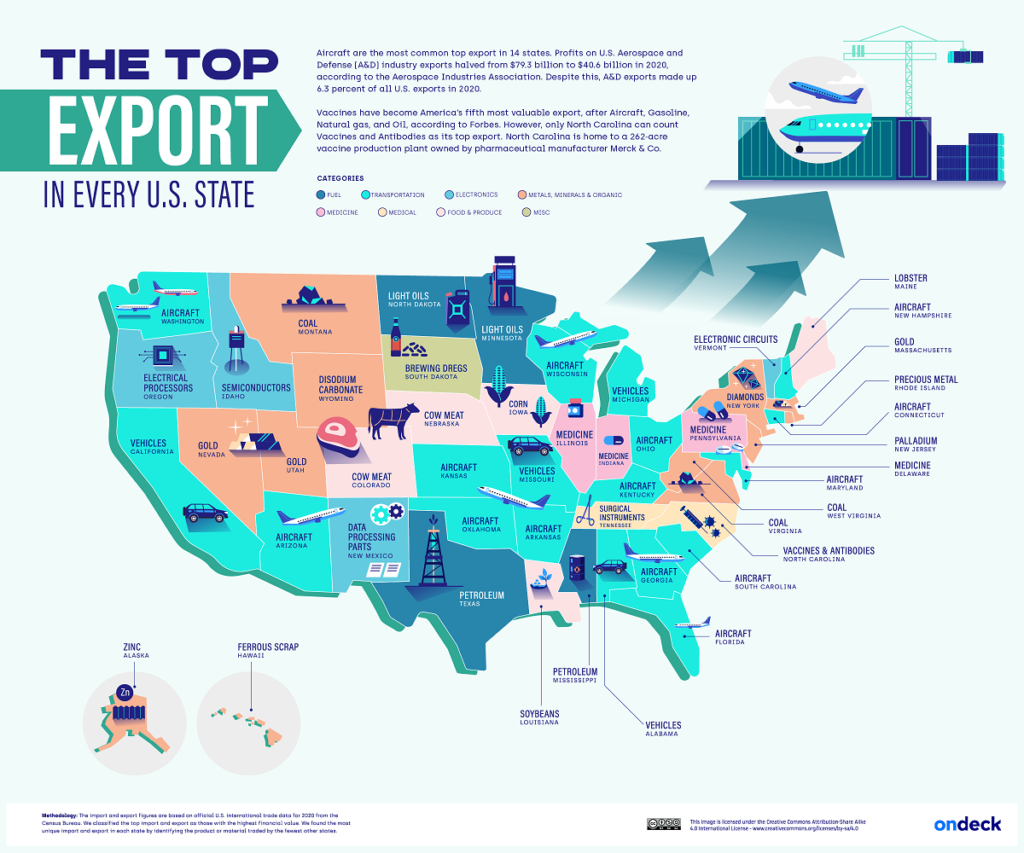
The U.S. exported over $1.3 trillion in goods in 2020, the second-highest amount worldwide.

While refined petroleum was the top export overall at $58.4 billion, aircraft exports were actually the highest across 14 states—more than any other form of export.

This infographic from OnDeck shows America’s top exports by state, using January 2022 data from the U.S. Census Bureau.

Author(s): NeoMam Studios, Dorothy Neufeld

Publication Date: 19 Jul 2022

Publication Site: Visual Capitalist

Fortifying Main Street: The Economic Benefit of Public Pension Dollars in Small Towns and Rural America

Link: https://www.nirsonline.org/reports/mainstreet2022/

PDF: https://www.nirsonline.org/wp-content/uploads/2022/07/FINAL-compresses-fortifyingmainstreet2022_small-compressed.pdf

webinar:

Graphic:

Excerpt:

The report’s key findings are as follows:

  • Public pension benefit dollars represent between one and three percent of GDP on average in the 2,922 counties studied.
  • Rural counties have the highest percentages of their populations receiving public pension benefits.
  • Small town counties experience a greater relative impact in terms of both GDP and total personal income from pension benefit dollars than rural or metropolitan counties.
  • Rural counties see more of an impact in terms of personal income than metropolitan counties, while metropolitan counties and rural counties see an equivalent impact in terms of GDP.
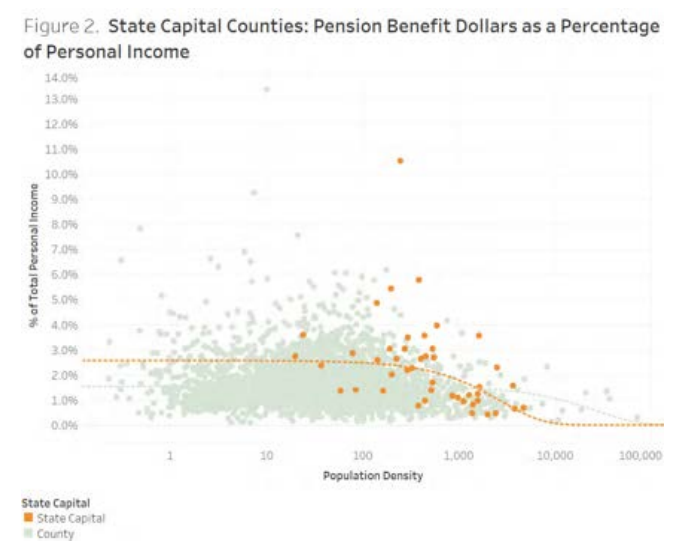
  • Counties that contain state capitals are outliers from other metropolitan counties, likely because there is a greater density of public employees in these counties, most of whom remain in these counties in retirement.
  • On average, rural counties have lost population while small town counties and metropolitan counties have gained population in the period between 2000 and 2018, but the connection between population change and the relative impact of public pension benefit dollars is weak.

Author(s): Dan Doonan and Tyler Bond from NIRS, Nathan Chobo from Linea Solutions Inc.

Publication Date: July 2022

Publication Site: National Institute on Retirement Security

Dangerous by Design 2022

Link: https://smartgrowthamerica.org/wp-content/uploads/2022/07/Dangerous-By-Design-2022-v3.pdf

Graphic:

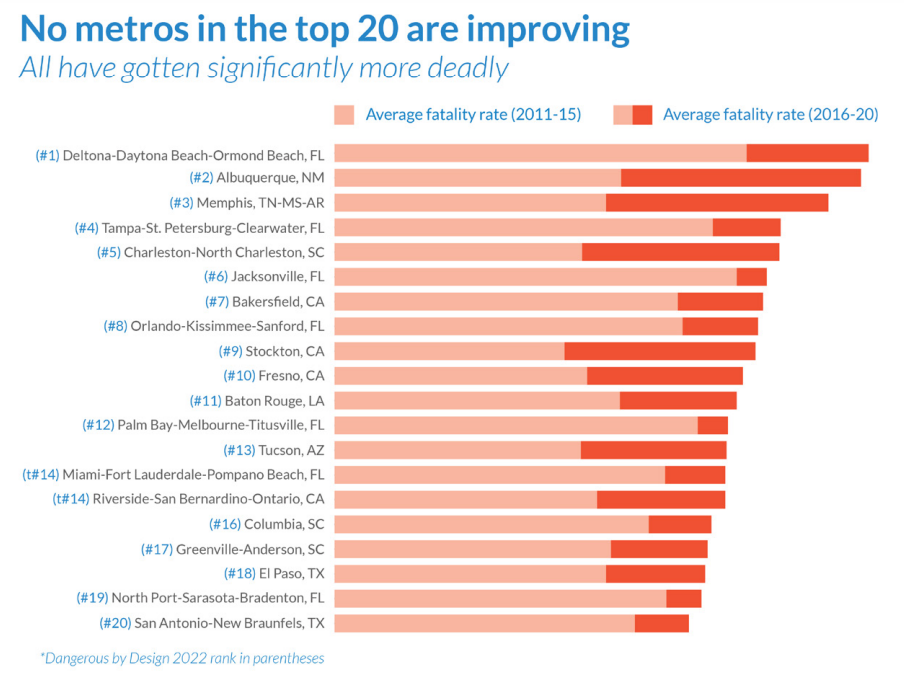
Excerpt:

While the unprecedented COVID-19 pandemic
upended many aspects of daily life, including
how people get around, one terrible, long-term
trend was unchanged: the alarming increase in
people being struck and killed while walking.
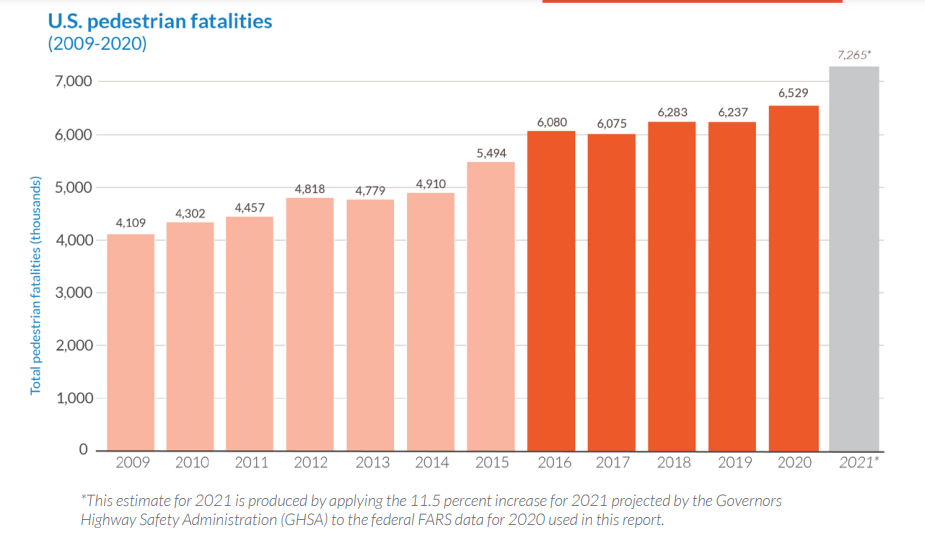
The number of people struck and killed while
walking has been steadily increasing since 2009,
reaching another new high in 2020 and likely a
historic one in 2021.

More than 6,500 people— nearly 18 per day—
were struck and killed while walking in 2020, a
4.7 percent increase over 2019, even as driving
decreased overall because of the pandemic’s
unprecedented disruptions to travel behavior.1

Publication Date: July 2022

Publication Site: Smart Growth America

US pedestrian deaths are reaching a new high

Link: https://www.popsci.com/technology/pedestrian-deaths-spike-us/

Excerpt:

When thinking of traffic accidents, it would be an understandable reaction to imagine a car crash: the National Highway Traffic Safety Administration estimates that nearly 43,000 people died in 2021 on US roads. That’s a 10.5 percent jump from 2020 and the most fatalities since 2005. But pedestrian deaths are another form of traffic accident—and those rates are rising, fast. 

A new study from Smart Growth America, an urban development-focused nonprofit, found that the number of pedestrian fatalities spiked more than 60 percent in the last decade. In 2020 alone, more than 6,500 people were struck and killed by vehicles—a record high that equates to nearly 18 people dying every day. And despite fewer cars on the road during the COVID-19 pandemic, the number of pedestrian deaths might have been even higher in 2021, according to the Governors Highway Safety Association. Preliminary data from GHSA suggests that roughly 7,500 people were killed last year. If confirmed, this would be the highest number in 40 years. 

The study also presents new data identifying the deadliest metro areas and states for pedestrians. That the US experiences more pedestrian deaths than any other high-income nation isn’t random, researchers from Smart Growth America say. It’s by design.

Author(s): MARIA PARAZO ROSE

Publication Date: 16 Jul 2022

Publication Site: Popular Science

Canadian Pension Giant Makes Its First Foray Into Colombian Private Equity

Link: https://www.ai-cio.com/news/canadian-pension-giant-makes-its-first-foray-into-colombian-private-equity/

Excerpt:

The C$539 billion ($431.7 billion) Canada Pension Plan Investment Board has invested $334 million to acquire a 19.3% stake in Colombia-based discount grocery store chain D1, formerly known as Koba Colombia. The deal marks the pension giant’s first direct private equity investment in the country.

D1, which first opened for business in 2009 and officially took on its new name last month, recently announced it has become Colombia’s main food retailer. Citing findings from Nielsen, the company said it had a 9.7% share in the retail market and a 74% share in the so-called “hard discount” sector at the end of 2021. D1 has over 2,000 stores and reported 2021 operating income of more than $10.9 billion, which was a 32% increase from 2020. It also said this year.

Author(s): Michael Katz

Publication Date: 14 July 2022

Publication Site: ai-CIO