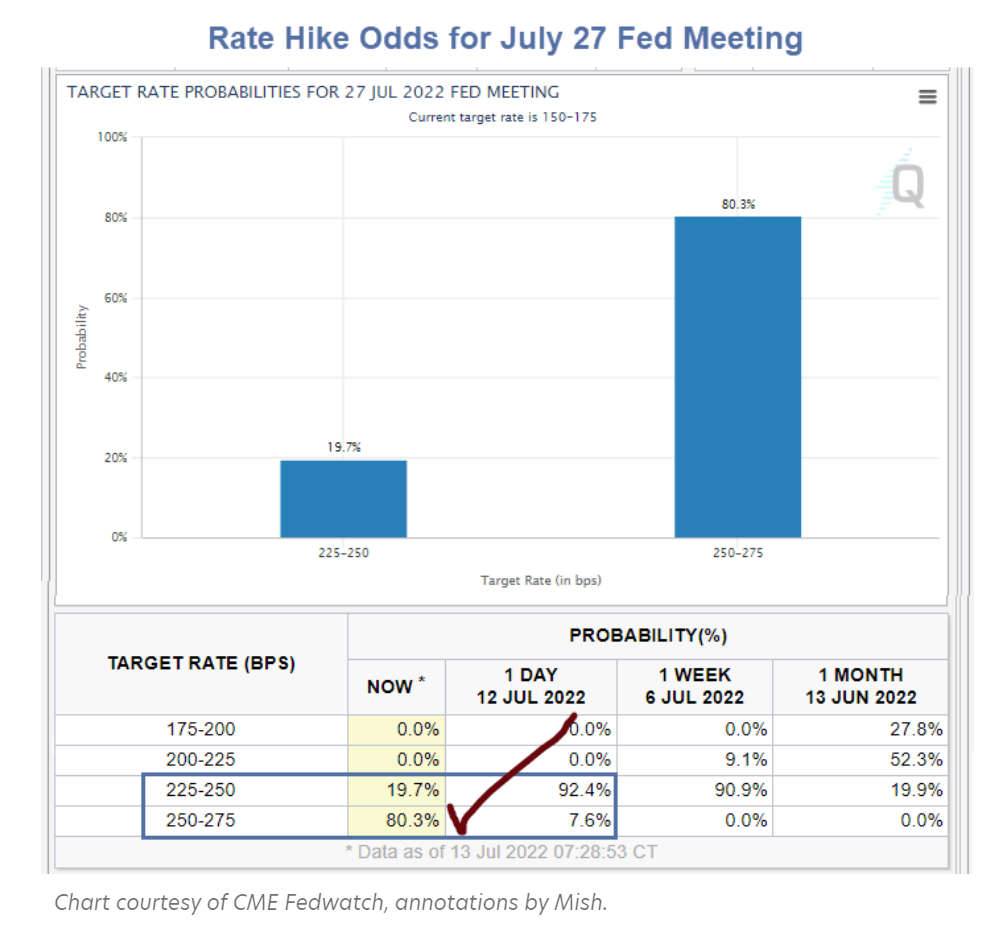
Fed Rate Hike Odds Jump to Full Point After the Hot CPI Report

Link: https://mishtalk.com/economics/fed-rate-hike-odds-jump-to-full-point-after-the-hot-cpi-report

Graphic:

Excerpt:

Yesterday, the market penciled in a three-quarter point hike. Today, the market expectation is for a full point hike.

The WSJ notes that would be the largest hike since the Fed started directly using overnight interest rates to conduct monetary policy in the early 1990s.

Author(s): Mike Shedlock

Publication Date: 13 July 2022

Publication Site: Mish Talk

Inflation Hits 9.1 Percent, Highest Level in 41 Years

Link: https://reason.com/2022/07/13/inflation-hits-9-1-percent-highest-level-in-41-years/?utm_medium=email

Graphic:

Excerpt:

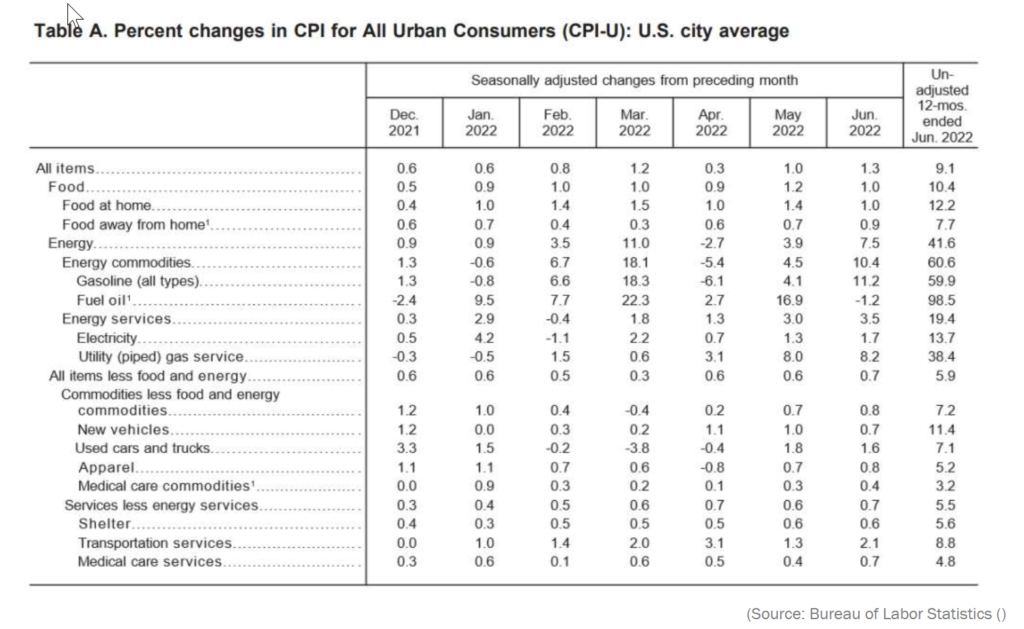
Prices were 9.1 percent higher in June than a year before, exceeding expectations and surging to a 41-year high.

Department of Labor data released Wednesday morning showed that inflation picked up speed in June, rather than slowing. Prices rose by 1.3 percent during the month, up from a 1 percent increase in May. A sharp rise in energy prices, and gasoline prices particularly, helped power the annualized inflation rate to its highest levels in more than four decades. Food prices rose by 1 percent during June, and are up 10.4 percent over the past year.

Author(s): Eric Boehm

Publication Date: 13 July 2022

Publication Site: Reason

CalPERS Cooks the Books While Taking an Unnecessary Loss to Exit $6 Billion of Private Equity Positions

Link: https://www.nakedcapitalism.com/2022/07/calpers-cooks-the-books-while-taking-an-unnecessary-loss-to-exit-6-billion-of-private-equity-positions.html

Excerpt:

CalPERS is up to its old crooked, value-destroying ways. Its sale of $6 billion in private equity positions, at a big discount….because CalPERS was in a hurry despite no basis for urgency, shows yet again the sort of thing the giant fund routinely does that puts it at the very bottom of financial returns for major public pension funds.

Oh, and on top of that, CalPERS admitted to Bloomberg that it is lying in its financial reports for the fiscal year just ended this June 30 by not writing down these private equity assets. As former board member Margaret Brown stated:

In Dawm Lim’s Bloomberg story, Calpers Unloads Record $6 Billion of Private Equity at Discount, CalPERS admits to cooking the books. Not recognizing the sale (the loss in value) in the same fiscal year can only be to play shenanigans with the rate of return. So if, or more likely when, CalPERS again does badly in comparison to CalSTRS and similar funds, remember it would be even worse if CalPERS was accounting honestly.

Author(s): Yves Smith

Publication Date: 8 July 2022

Publication Site: naked capitalism

A Framework for Defining a Role for Insurers in “Uninsurable” Risks: Insights from COVID-19

Link: https://content.naic.org/sites/default/files/JIR-ZA-40-10-EL.pdf

Graphic:

Excerpt:

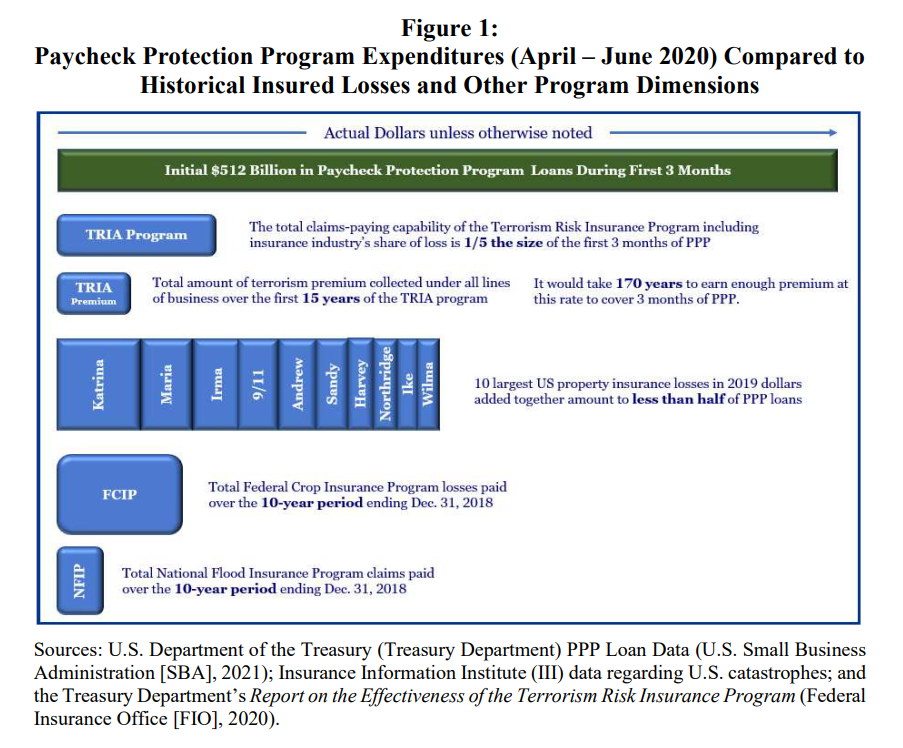
RETHINKING UNINSURABILITY While many have viewed insurability as a binary choice with respect to a risk (i.e., insurable or uninsurable), insurability is more appropriately considered on a continuum, ranging from easy-to-insure, such as automobile or life insurance, to difficult-to-insure, such as pandemic, loss of the electrical grid, and other extreme catastrophic risks.

FRAMEWORK The role of private and public sectors in dealing with risks that are difficult-to-insure should be to develop strategies that enable a greater degree of insurability. To do so, the framework suggests that policymakers consider three fundamental options in dealing with the insurance industry:

Status Quo (SQ) –This option (SQ) contemplates a similar dynamic to that experienced with COVID-19, wherein businesses, nonprofits, and local governments found limited (if any) insurance coverage for their losses and ex post relief programs funded by the government.

Service Provider (SP) – This option (SP) contemplates an administrative, non-risk-bearing role for the insurance industry while the entire cost of claims would be publicly financed.

Service and Risk (SR) –In addition to its role as a service provider as characterized by SP, this option (SR) would expect insurers to commit capital – in an amount that does not threaten their financial viability – to cover a specified layer or other defined element of losses.

Author(s): Howard Kunreuther, Jason Schupp

Publication Date: 2021

Publication Site: NAIC

The Great Attrition is making hiring harder. Are you searching the right talent pools?

Link: https://www.mckinsey.com/business-functions/people-and-organizational-performance/our-insights/the-great-attrition-is-making-hiring-harder-are-you-searching-the-right-talent-pools

Graphic:

Excerpt:

Despite significant changes in the economy since the onset of the Great Attrition (or what many call the Great Resignation), the share of workers planning to leave their jobs remains unchanged from 2021, at 40 percent. That’s two out of five employees in our global sample who said that they are thinking about leaving in the next three to six months.

However, the past year has revealed nuances of the larger trend:

Reshuffling. Employees are quitting and going to different employers in different industries (48 percent of the job leavers in our sample). Some industries are disproportionately losing talent, others are struggling to attract talent, and some are grappling with both.

Reinventing. Many employees leaving traditional employment are either going to nontraditional work (temporary, gig, or part-time roles) or starting their own businesses. Of the employees who quit without a new job in hand, 47 percent chose to return to the workforce. However, only 29 percent returned to traditional full-time employment.

Reassessing. Many people are quitting not for other jobs but because of the demands of life—they need to care for children, elders, or themselves. These are people who may have stepped out of the workforce entirely, dramatically shrinking the readily available talent pool.

Author(s): Aaron De Smet, Bonnie Dowling, Bryan Hancock, and Bill Schaninger

Publication Date: 13 July 2022

Publication Site: McKinsey

Aggregate Lapsation Risk

Link: https://www.nber.org/papers/w30187

Graphic:

Abstract:

We study aggregate lapsation risk in the life insurance sector. We construct two lapsation risk factors that explain a large fraction of the common variation in lapse rates of the 30 largest life insurance companies. The first is a cyclical factor that is positively correlated with credit spreads and unemployment, while the second factor is a trend factor that correlates with the level of interest rates. Using a novel policy-level database from a large life insurer, we examine the heterogeneity in risk factor exposures based on policy and policyholder characteristics. Young policyholders with higher health risk in low-income areas are more likely to lapse their policies during economic downturns. We explore the implications for hedging and valuation of life insurance contracts. Ignoring aggregate lapsation risk results in mispricing of life insurance policies. The calibrated model points to overpricing on average. In the cross-section, young, low-income, and high-health risk households face higher effective mark-ups than the old, high-income, and healthy.

Author(s): Ralph S. J. Koijen, Hae Kang Lee & Stijn Van Nieuwerburgh

WORKING PAPER 30187
DOI 10.3386/w30187

Publication Date: July 2022

Publication Site: NBER

USAA Customers Have a Strong Grip on Their Life Policies: Researchers

Link: https://www.thinkadvisor.com/2022/07/13/usaa-customers-have-a-strong-grip-on-their-life-policies-researchers/

Excerpt:

USAA — a policyholder-owned insurer that has historically focused on serving military veterans and their relatives — may be the big U.S. life insurer with the lowest policy lapse rate.

A team of researchers led by Ralph S.J. Koijen has presented data supporting that conclusion in a new analysis of how economic slumps affect which insureds drop their life insurance.

To conduct that analysis, the Koijen team crunched data from the public financial reports of the 30 biggest U.S. life insurer groups, for a period from 1996 through 2020.

….

Overall, a severe crisis, such as the 2007-2009 Great Recession, might increase a company’s life policy lapse rate by about 1 percentage point or more, after holding other factors considered equal, the researchers concluded.

The researchers found that, after holding factors such as risk class, smoking use and type of coverage equal, being under age 35 increased the risk of letting a life policy lapse by 46%, and being ages 25 through 34 during an economic slump increase lapse risk by an additional 15%.

Author(s): Allison Bell

Publication Date: 13 July 2022

Publication Site: Think Advisor

SEC Adopts Amendments to Proxy Voting Advice Rules

Link: https://www.ai-cio.com/news/sec-adopts-amendments-to-proxy-voting-advice-rules/

Excerpt:

The U.S. Securities and Exchange Commission Wednesday adopted amendments to its rules governing proxy voting advice, representing another step forward in what has been a fraught regulatory process.

SEC Chair Gary Gensler, in a statement said, the final amendments aim to avoid burdens on proxy voting advice businesses that may impair the timeliness and independence of their advice. The amendments also address misperceptions about liability standards applicable to proxy voting advice, Gensler says, while preserving investors’ confidence in the integrity of such advice.

“I am pleased to support these amendments because they address issues concerning the timeliness and independence of proxy voting advice, which would help to protect investors and facilitate shareholder democracy,” Gensler says. “It is critical that investors who are the clients of these proxy advisory firms are able to receive independent and timely advice.”

As outlined in a press release distributed after the vote by the SEC, Wednesday’s final amendments rescind two rules applicable to proxy voting advice businesses that the Commission adopted in 2020. Specifically, the final amendments rescind conditions to the availability of two exemptions from the proxy rules’ information and filing requirements on which proxy voting advice businesses often rely.

Author(s): John Manganaro

Publication Date: 14 July 2022

Publication Site: ai-CIO

Unfunded public pension liabilities are forecast to rise to $1.3 trillion in 2022

Link: https://reason.org/data-visualization/2022-public-pension-forecaster/

Graphic:

Excerpt:

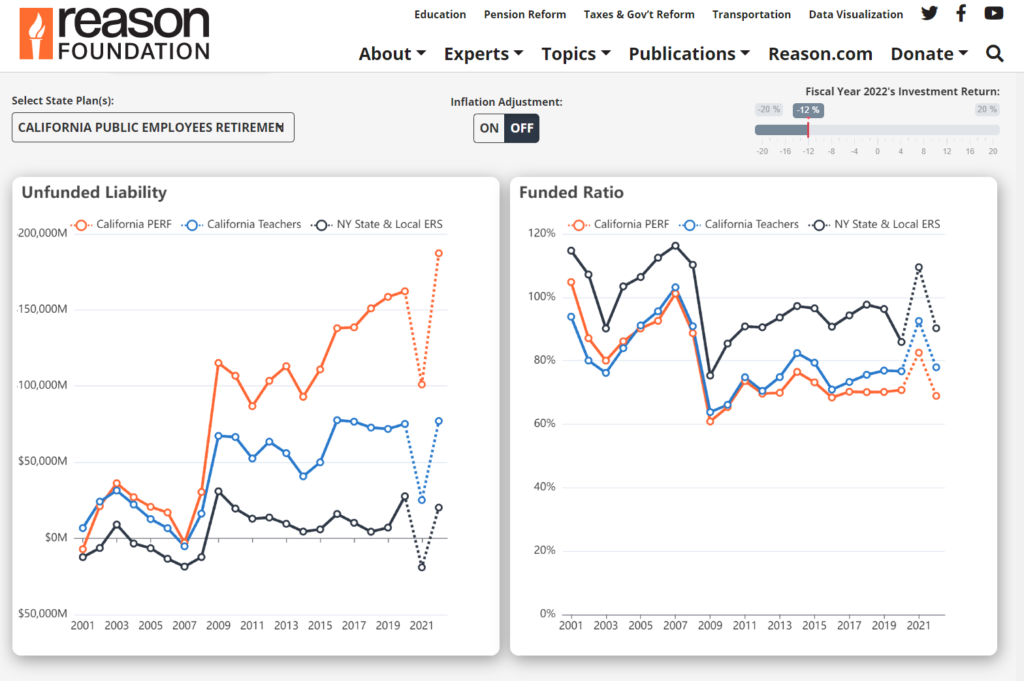
According to forecasting by Reason Foundation’s Pension Integrity Project, when the fiscal year 2022 pension financial reports roll in, the unfunded liabilities of the 118 state public pension plans are expected to again exceed $1 trillion in 2022. After a record-breaking year of investment returns in 2021, which helped reduce a lot of longstanding pension debt, the experience of public pension assets has swung drastically in the other direction over the last 12 months. Early indicators point to investment returns averaging around -6% for the 2022 fiscal year, which ended on June 30, 2022, for many public pension systems.

Based on a -6% return for fiscal 2022, the aggregate unfunded liability of state-run public pension plans will be $1.3 trillion, up from $783 billion in 2021, the Pension Integrity Project finds. With a -6% return in 2022, the aggregate funded ratio for these state pension plans would fall from 85% funded in 2021 to 75% funded in 2022. 

Author(s): Truong Bui, Jordan Campbell, Zachary Christensen

Publication Date: 14 July 2022

Publication Site: Reason

PBGC Finalizes Rescue of Ailing Multiemployer Pension Plans

Link: https://www.ai-cio.com/news/pbgc-finalizes-rescue-of-ailing-multiemployer-pension-plans/

Excerpt:

The Pension Benefit Guaranty Corporation, under the direction of the Biden administration, has published the final rule implementing the American Rescue Plan Act of 2021’s Special Financial Assistance program.

According to supporters of the program, the Special Financial Assistance program, which is already operating on an interim basis, will protect millions of workers in stressed multiemployer union pension plans who previously faced the possibility of significant cuts to their benefits.

….

Initially, the interim final rule applied a single rate of return included in the statute that is higher than could be expected for SFA funds given that they were required to be invested exclusively in safe, but low-return, investment-grade fixed-income products. The final rule uses two different rates of return for SFA and non-SFA assets, so that the interest rate for SFA assets is more realistic given the investment limitations on these funds.

Another change in the final rule allows up to 33% of SFA to be invested in return-seeking assets that are projected to allow plans to receive a higher rate of return on their investments than under the interim final rule, subject to certain protections. Namely, this portion of plans’ SFA funds generally must be invested in publicly traded assets on liquid markets to ensure responsible stewardship of federal funds. These return-seeking investments include equities, equity funds and bonds. The other 67% of SFA funds must be invested in investment-grade fixed-income products.

The third major change is meant to ensure plans can confidently restore both past and future benefits and enter 2051 with rising assets. PBGC designed the final rule to ensure that no “MPRA plan”—a group of fewer than 20 multiemployer plans that remained solvent by cutting benefits pursuant to the Multiemployer Pension Reform Act of 2014—was forced to choose between restoring its benefit payments to previous levels and remaining indefinitely solvent. Instead, the final rule ensures that all MPRA plans avoid this dilemma, supporting them with enough assistance so that these plans can both restore benefits and be projected to remain indefinitely solvent going into 2051.

According to PBGC leadership, these changes collectively ensure that all plans that receive SFA are projected to be solvent and pay full benefits through at least 2051.

Author(s): John Manganaro

Publication Date: 7 July 2022

Publication Site: ai-CIO
Mid-Year 2022 Capital Markets Update

Link: https://content.naic.org/sites/default/files/capital-markets-special-reports-mid-year-2022-update.pdf

Graphic:

Excerpt:

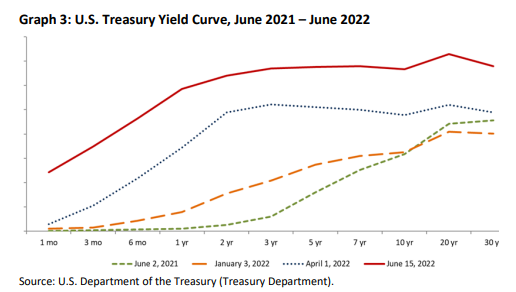
The shape of the Treasury yield curve generally provides insight into the market’s expectations for
interest rates, as well as economic activity. As of June, the yield curve has shifted higher and flattened
compared to the beginning of the year and the last year. The Federal Reserve’s recent aggressive actions
have resulted in the higher Treasury rates and a flattening of the yield curve, as many investors believe
higher rates will push the U.S. economy into a recession. The yield curve also inverted briefly in midJune, which market participants view as a recession signal.

As of year-end 2021, U.S. insurers had exposure to about $316.3 billion in U.S. government bonds across
various maturities, or about 6% of total cash and invested assets. This was an increase from $280.6
billion at year-end 2020, but it was unchanged as a percentage of total cash and invested assets.

Author(s): Jennifer Johnson and Michele Wong

Publication Date: 23 June 2022

Publication Site: NAIC Capital Markets Special Report

Pension Funds Plunge Into Riskier Bets—Just as Markets Are Struggling

Link: https://www.wsj.com/articles/pension-funds-plunge-into-riskier-betsjust-as-markets-are-struggling-11656274270

Graphic:

Excerpt:

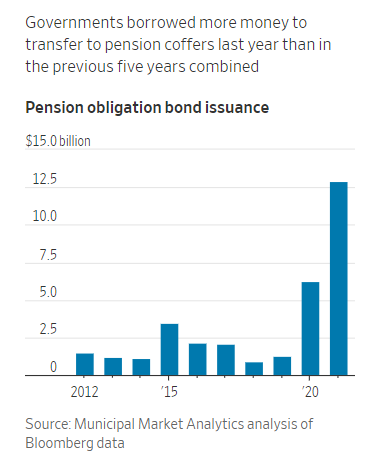
More than 100 state, city, county and other governments borrowed for their pension funds last year, twice the highest number that did so in any prior year, according to a Municipal Market Analytics analysis of Bloomberg data. Nearly $13 billion of these pension obligation bonds were sold last year, which is more than in the prior five years combined.

The Teacher Retirement System of Texas, the U.S.’s fifth-largest public pension fund, began leveraging its investment portfolio in 2019. Next month, the largest U.S. public-worker fund, the roughly $440 billion California Public Employees’ Retirement System, known as Calpers, will add leverage for the first time in its 90-year history.

While most pension funds still avoid investing borrowed money, the use of leverage is spreading faster than ever. Just four years ago, none of the five largest pension funds used leverage.

Investing with borrowed money can juice returns when markets are rising, but make losses more severe in a down market. This year’s steep slump in financial markets will test the funds’ strategy.

It’s too soon to tell how the magnified bets are playing out in the current market, as funds won’t report second-quarter returns until later in the summer. In the first quarter, public pension funds as a whole returned a median minus 4%, according to data from the Wilshire Trust Universe Comparison Service released last month. A portfolio of 60% stocks and 40% bonds—not what funds use—returned minus 5.55% in the quarter, Wilshire said.

Author(s): Dion Rabouin, Heather Gillers

Publication Date: 26 Jun 2022

Publication Site: WSJ