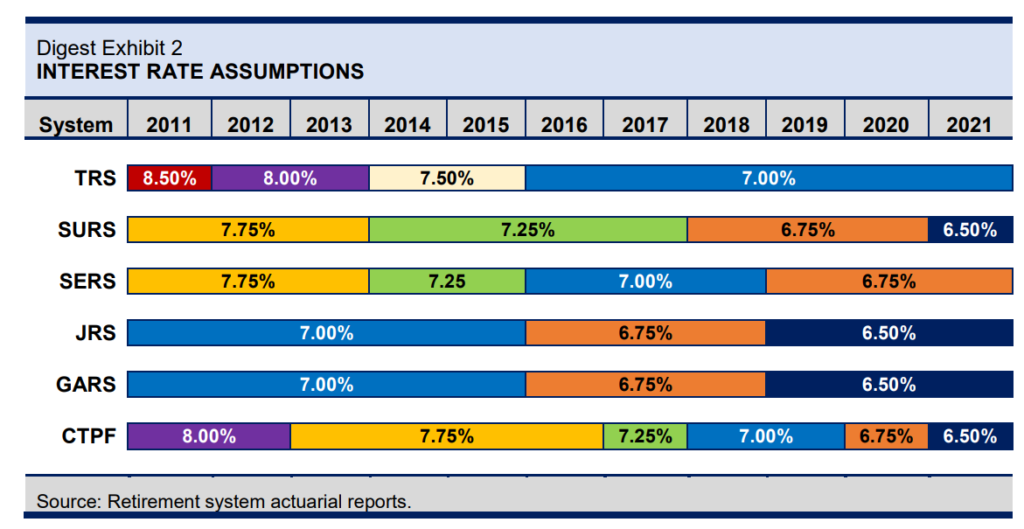
Actuarial Assumptions and Valuations of the State-Funded Retirement Systems

Link:http://www.auditor.illinois.gov/Audit-Reports/Performance-Special-Multi/State-Actuary-Reports/2021-State-Actuary-Rpt-Full.pdf

Graphic:

Excerpt:

The combined total of the required Fiscal Year 2023 State contribution
for the six retirement systems was $10.97 billion, an increase of $0.14
billion over the previous year. Cheiron verified the arithmetic calculations
made by the systems’ actuaries to develop the required State contribution
and reviewed the assumptions on which it was based.

The Illinois Pension Code (for TRS, SURS, SERS, JRS, and GARS)
establishes a method that does not adequately fund the systems, back
loading contributions and targeting the accumulation of assets equal to 90%
of the actuarial liability in the year 2045. This contribution level does not
conform to generally accepted actuarial principles and practices. Generally
accepted actuarial funding methods target the accumulation of assets equal to
100% of the actuarial liability, not 90%.

According to the systems’ 2021 actuarial valuation reports, the funded
ratio of the retirement systems ranged from 47.5% (CTPF) to 19.3%
(GARS), based on the actuarial value of assets as a ratio to the actuarial
liability. If there is a significant market downturn, the unfunded actuarial
liability and the required State contribution rate could both increase
significantly, putting the sustainability of the systems further into question.

Author(s): Frank J. Mautino

Publication Date: 22 Dec 2021

Publication Site: Office of the Auditor General, State of Illinois
Life and Annuity Issuers Watch for Interest Rate Hike Sunshine

Link:https://www.thinkadvisor.com/2022/02/04/life-and-annuity-issuers-watch-for-interest-rate-hike-sunshine/

Excerpt:

Executives are hoping that Fed interest rate increases could increase the yields on insurers’ huge investment portfolios.

Higher rates could be a good thing for Prudential, the company’s vice chairman told analysts.

MetLife’s CEO said higher short-term rates could mean a flatter yield curve that would be less favorable to life insurers.

Author(s): Allison Bell

Publication Date: 4 Feb 2022

Publication Site: Think Advisor

Why Interest Rates Could Drive a Debt Crisis

Link:https://www.nationalreview.com/2022/02/why-interest-rates-could-drive-a-debt-crisis/

Excerpt:

The average interest rate paid by Washington on its debt has fallen from 8.4 percent to 1.5 percent over the past three decades. However, economic variables tend to fluctuate, and only a fool would assume that a current economic trend will last forever. In the past, economic forecasts and markets told us that high inflation and high unemployment cannot happen simultaneously, that the late-1990s tech-stock bubble wouldn’t burst, and that national housing prices can never fall. Just last year, the Federal Open Market Committee consistently underestimated current-year inflation by three full percentage points. Interest-rate forecasts have proven spectacularly wrong for 50 years.

But now, economic commentators assure us that soaring federal debt is affordable because interest rates will remain low forever.

By contrast, the Congressional Budget Office projects that rates will nudge up to 4.6 percent over three decades. That is easily possible. After all, a broad range of studies show that the projected 100 percent of GDP increase in federal debt over the next three decades should, by itself, add three percentage points to interest rates. Added federal debt over the past 15 years also put upward pressure on interest rates, but this was offset by low productivity, baby-boomer savings, and Federal Reserve policies that pushed rates downward. For interest rates to remain low, those offsetting factors would have to accelerate much further to counteract the three-percentage point effect of future debt.

Author(s): Brian Riedl

Publication Date: 4 Feb 2022

Publication Site: National Review

Opinion: The ‘interest rate comet’ is about to slam into the U.S. economy

Link:https://www.cnbc.com/2022/01/27/opinion-the-interest-rate-comet-is-about-to-slam-into-the-us-economy.html

Excerpt:

According to the U.S. Treasury, in fiscal 2021, the amount of interest paid on the national debt was $562 billion including government transfers. The amount actually paid out to holders of U.S. securities was $413 billion.

That figure alone, which is over 20% of what we paid in income taxes in FY 2021, should be alarming when compared to other government expenditures.

Compare the $413 billion we pay in interest to holders of these securities to the annual budgets of other parts of the government. The State Department annual budget is “only” $35 billion and the Justice Department $39 billion.

….

Interest rates are still near an all-time low. According to the Monthly Treasury Statement, in 2001, interest paid on the national debt was an average of 5.4%, about 3½ times what it is now.

If we get back to that rate, which is far from inconceivable, interest on the debt would cost American taxpayers $1.4 trillion, based on our present level of national debt. That is twice the budget of the Defense Department.

Author(s): Peter Tanous

Publication Date: 27 Jan 2022

Publication Site: CNBC

How High Are Federal Interest Payments?

Link:https://www.crfb.org/papers/how-high-are-federal-interest-payments

Graphic:

Excerpt:

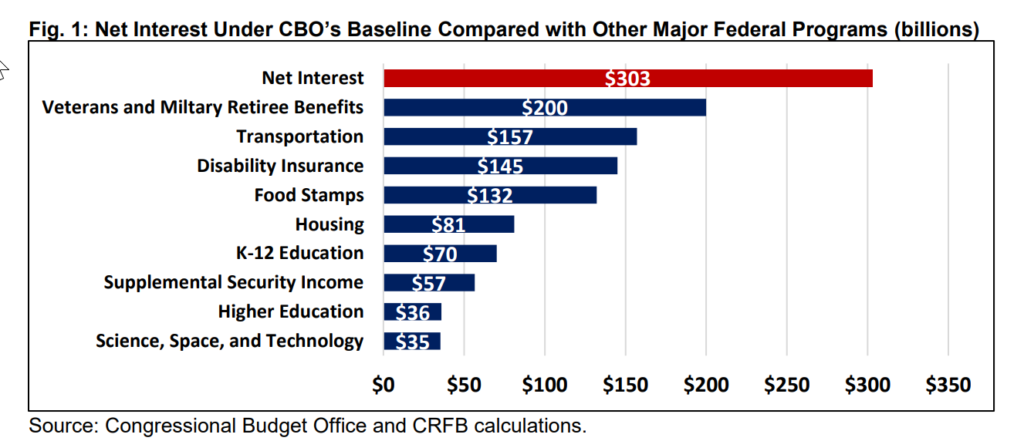
Even with exceptionally low interest rates, the federal government is projected to spend just over $300 billion on net interest payments in fiscal year 2021. This amount is more than it will spend on food stamps and Social Security Disability Insurance combined. It is nearly twice what the federal government will spend on transportation infrastructure, over four times as much as it will spend on K-12 education, almost four times what it will spend on housing, and over eight times what it will spend on science, space, and technology. 

Publication Date: 10 Mar 2021

Publication Site: Committee for a Responsible Federal Budget

Visualizing the 700-Year Fall of Interest Rates

Link: https://www.visualcapitalist.com/700-year-decline-of-interest-rates/

Graphic:

Excerpt:

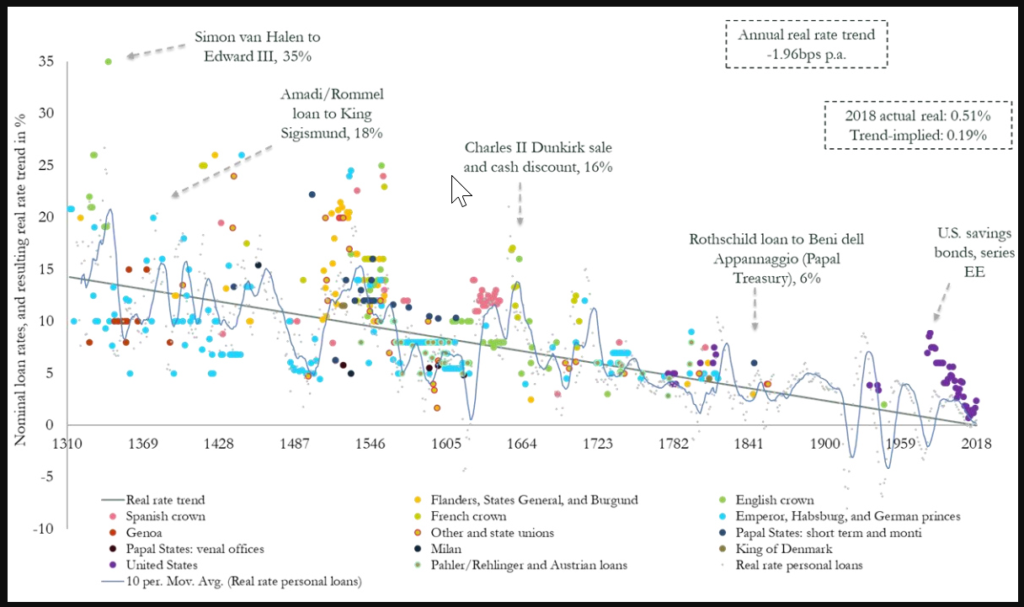
Today’s graphic from Paul Schmelzing, visiting scholar at the Bank of England (BOE), shows how global real interest rates have experienced an average annual decline of -0.0196% (-1.96 basis points) throughout the past eight centuries.

The Evidence on Falling Rates

Collecting data from across 78% of total advanced economy GDP over the time frame, Schmelzing shows that real rates* have witnessed a negative historical slope spanning back to the 1300s.

Displayed across the graph is a series of personal nominal loans made to sovereign establishments, along with their nominal loan rates. Some from the 14th century, for example, had nominal rates of 35%. By contrast, key nominal loan rates had fallen to 6% by the mid 1800s.

Author(s): Dorothy Neufeld

Publication Date: 4 Feb 2020

Publication Site: Visual Capitalist

Bond Yields Surge to Start 2022, What’s Ahead?

Link: https://mishtalk.com/economics/bond-yields-surge-to-start-2022-whats-ahead

Graphic:

Excerpt:

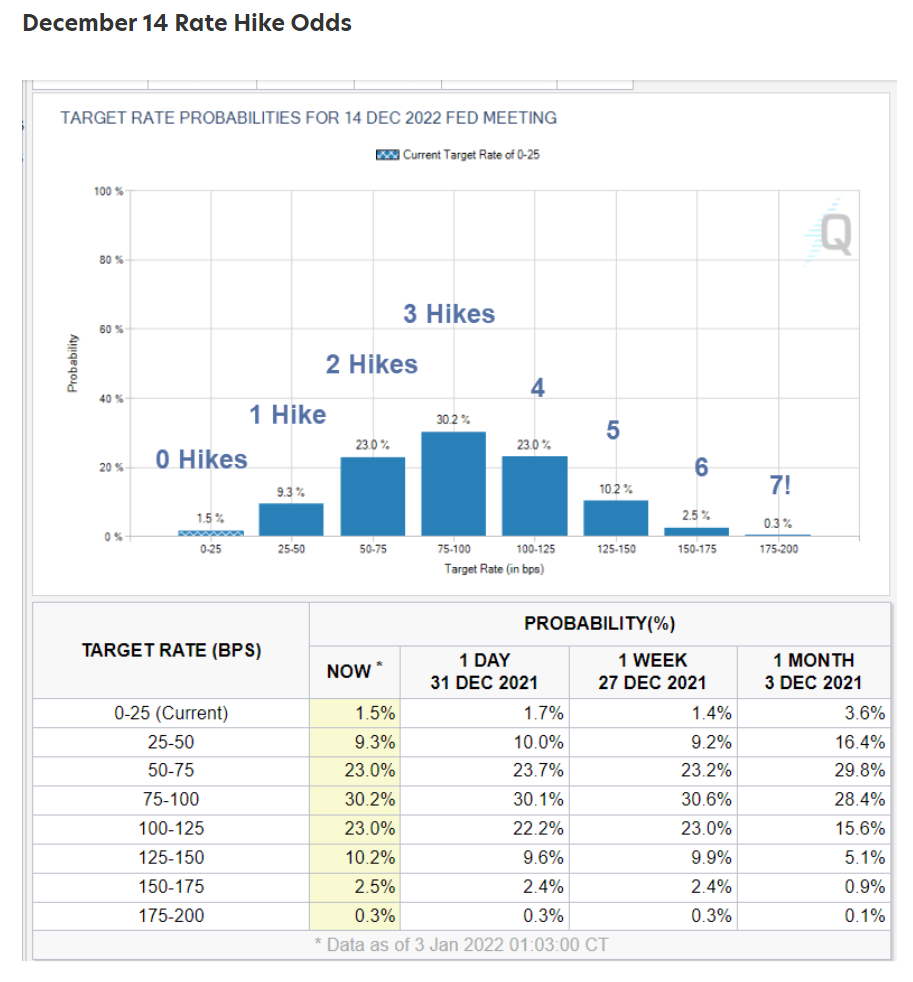
I find the prospect of 7 rate hikes in 2022 more than a bit amusing.  Here’s a good way of looking at things.

0 to 2 hikes: 33.8%

3 hikes: 30.2% 

4 or more hikes: 36.0%

The median projection is now a bit more than 3 hikes this year. 4 and 2 rate hikes are at nearly equal odds, but 5, 6, an 7 hikes rated a combined 13% vs 0 to 1 hike at a combined 10.8%

The change in rate hike odds today reflect the surge in yields that also happened today.

Author(s): Mike Shedlock

Publication Date: 3 Jan 2022

Publication Site: Mish Talk

The Fed’s Doomsday Prophet Has a Dire Warning About Where We’re Headed

Link:https://www.politico.com/amp/news/magazine/2021/12/28/inflation-interest-rates-thomas-hoenig-federal-reserve-526177

Excerpt:

In May of 2020, Hoenig published a paper that spelled out his grim verdict on the age of easy money, from 2010 until now. He compared two periods of economic growth: The period between 1992 and 2000 and the one between 2010 and 2018. These periods were comparable because they were both long periods of economic stability after a recession, he argued. The biggest difference was the Federal Reserve’s extraordinary experiments in money printing during the latter period, during which time productivity, earnings and growth were weak. During the 1990s, labor productivity increased at an annual average rate of 2.3 percent, about twice as much as during the age of easy money. Real median weekly earnings for wage and salary employees rose by 0.7 percent on average annually during the 1990s, compared to only 0.26 percent during the 2010s. Average real gross domestic product growth — a measure of the overall economy — rose an average of 3.8 percent annually during the 1990s, but by only 2.3 percent during the recent decade.

The only part of the economy that seemed to benefit under quantitative easing and zero-percent interest rates was the market for assets. The stock market more than doubled in value during the 2010s. Even after the crash of 2020, the markets continued their stellar growth and returns. Corporate debt was another super-hot market, stoked by the Fed, rising from about $6 trillion in 2010 to a record $10 trillion at the end of 2019.

Author(s): Christopher Leonard

Publication Date: 28 Dec 2021

Publication Site: Politico

Year-End 2021 Capital Markets Wrap-Up

Link:https://content.naic.org/sites/default/files/capital-markets-special-report-YE%202021%20wrap%20up.pdf

Graphic:

Excerpt:

The U.S. economy has made a solid recovery as COVID-19 vaccinations were made increasingly
available, social distancing began to ease, and businesses gradually reopened.
The International Monetary Fund (IMF), among other forecasters, expects the U.S. economy to
grow by about 6% in 2021, after contracting about 3.4% in 2020.
• Inflation reached a 39-year high of 6.8% in November following a strong rebound from the COVID19-induced recession.
• The ‘stronger for longer’ inflation rates prompted the Federal Reserve to accelerate the tapering
of its asset purchases and to suggest the likelihood of three rate hikes in 2022.
• The 10-year U.S. government bond yield has generally ranged between 1.3% and 1.7% in 2021,
increasing from less than 1% in 2020, due in part to fiscal stimulus aiding in economic recovery.
• Credit spreads have been muted in 2021 given robust global economic growth, favorable funding
conditions, and overall solid corporate performance despite higher costs and supply disruptions.
• Global stocks have achieved relatively high returns; in the U.S., the Standard & Poor’s (S&P) 500
posted seven record closing highs in November alone.
• The price of oil reached a seven-year high of $85 per barrel in 2021 as demand for oil normalized
while the global supply market tightened.

Author(s): : Jennifer Johnson and Michele Wong

Publication Date: 22 Dec 2021

Publication Site: NAIC Capital Markets Bureau Special Reports

Major Divergences: ECB Says No Hikes in 2022, Fed Sees 3 Hikes, BOE Hiked Today

Link:https://mishtalk.com/economics/major-divergences-ecb-says-no-hikes-in-2022-fed-sees-3-hikes-boe-hiked-today

Graphic:

Excerpt:

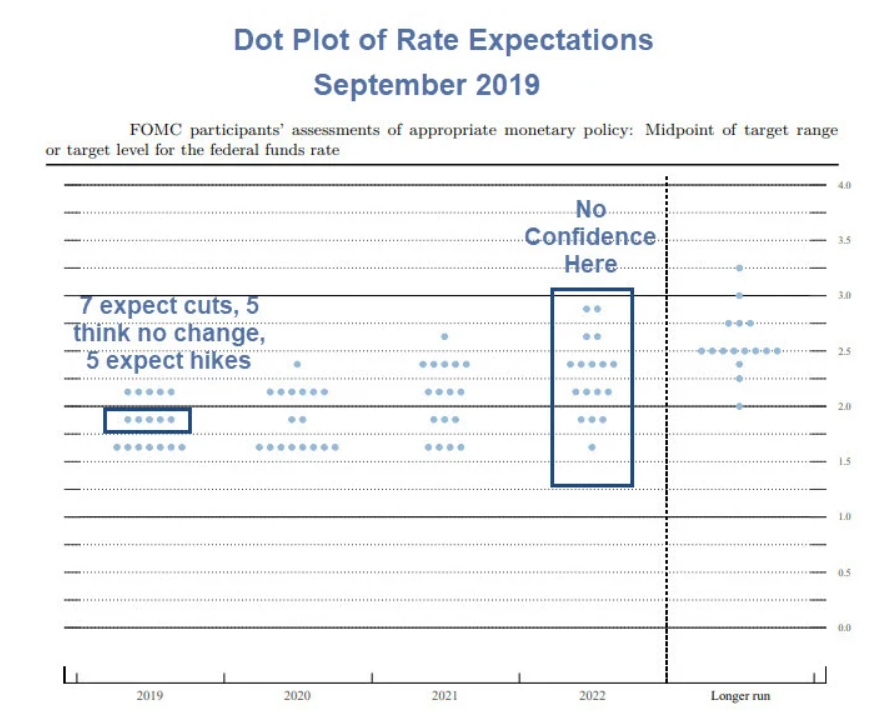
How many rate hikes are coming? The Fed thinks 6 by the end of 2023. I am unconvinced the Fed gets in any hikes in 2022 and certainly not 6 by the end of 2023.

These ridiculous predictions assume there will not be another recession in “the longer run”. 

Central banks like to pretend they will hike, but by the time comes, they have delayed so long they find an excuse to no do so. 

Possible excuses: A recession, stock market plunge, another pandemic, global warming, global cooling, or an asteroid crash. 

Central banks will find some excuse to delay hikes. But the most likely excuse is a recession or stock market crash. 

Author(s): Mike Shedlock

Publication Date: 16 Dec 2021

Publication Site: Mish Talk

September 19-25, 1921

Link: https://roaring20s.substack.com/p/september-19-1921

Graphic:

Excerpt:

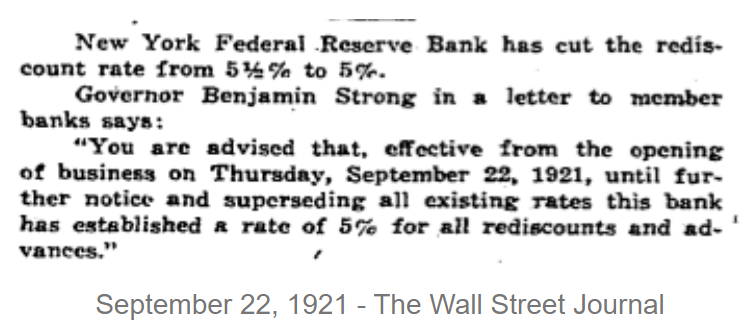
The Federal Reserve of New York lowers rates from 5.5% to 5% on September 21. The rest of the Fed branches match in tandem. The powerful New York Federal Reserve President (Governor pre-1935), Benjamin Strong, delivers a terse statement to the Journal. Equities seem nonplussed and drop the next day. The aggregate yield on high quality debt rallies from 4.8% to 4.5%.

Author(s): Tate

Publication Date: 19 Sept 2021

Publication Site: Roaring 20s at substack

What explains the decline in r∗? Rising income inequality versus demographic shifts

Link: https://www.kansascityfed.org/documents/8337/JH_paper_Sufi_3.pdf

Graphic:

Excerpt:

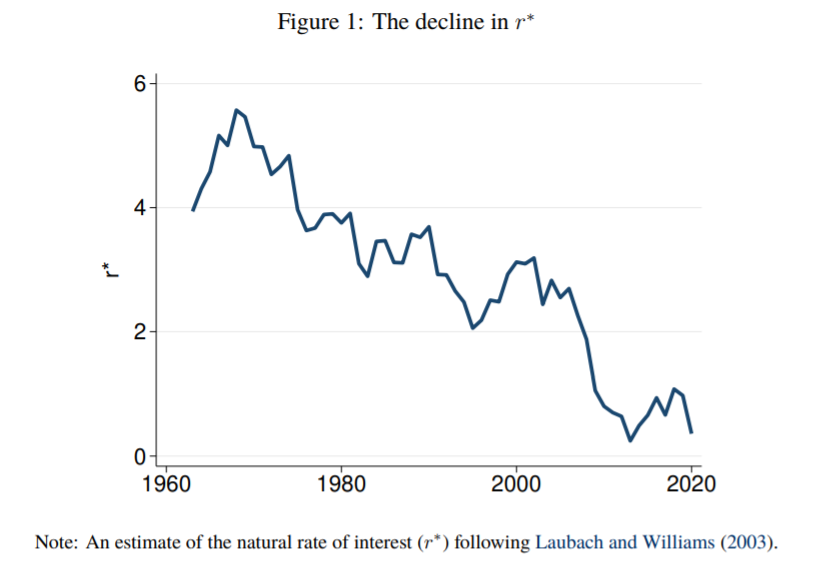
Downward pressure on the natural rate of interest (r∗) is often attributed to an increase in saving. This study uses microeconomic data from the SCF+ to explore the relative importance of demographic shifts versus rising income inequality on the evolution of saving behavior in the United States from 1950 to 2019. The evidence suggests that rising income inequality is the more important factor explaining the decline in r∗. Saving rates are significantly higher for high income households within a given birth cohort relative to middle and low income households in the same birth cohort, and there has been a large rise in income shares for high income households since the 1980s. The result has been a large rise in saving by high income earners since the 1980s, which is the exact same time period during which r∗ has fallen. Differences in saving rates across the working age distribution are smaller, and there has not been a consistent monotonic shift in income toward any given age group. Both findings challenge the view that demographic shifts due to the aging of the baby boom generation explain the decline in r∗.
.

Author(s): Atif Mian, Ludwig Straub, Amir Sufi

Publication Date: August 2021

Publication Site: Kansas City Federal Reserve