85% of new Utah COVID-19 cases are among unvaccinated

Link: https://www.ksl.com/article/50192791/85-of-new-utah-covid-19-cases-are-among-unvaccinated

Graphic:

Excerpt:

The Utah Department of Health reported 462 new cases of COVID-19, one new death and 7,412 new vaccinations administered in Utah Thursday.

It also released a new dataset for the first time that shows the number of “breakthrough” cases, hospitalizations and deaths for those who aren’t vaccinated account for a vast majority of recent trends. It also shows rate of new COVID-19 vaccinations is very slowly rising.

Utah’s rolling seven-day average for new positive cases in the state is now at 324, which is a slight increase from 312 Wednesday. The number of new cases is still well below any of the previous increases experienced since March 2020.

Author(s): Carter Williams, KSL.com

Publication Date: 24 June 2021

Publication Site: KSL.com
The State of Health for Blacks in Chicago

Link: https://www.chicago.gov/content/dam/city/depts/cdph/CDPH/Healthy%20Chicago/CDPH_BlackHealth7c_DIGITAL.pdf

Graphic:

Excerpt:

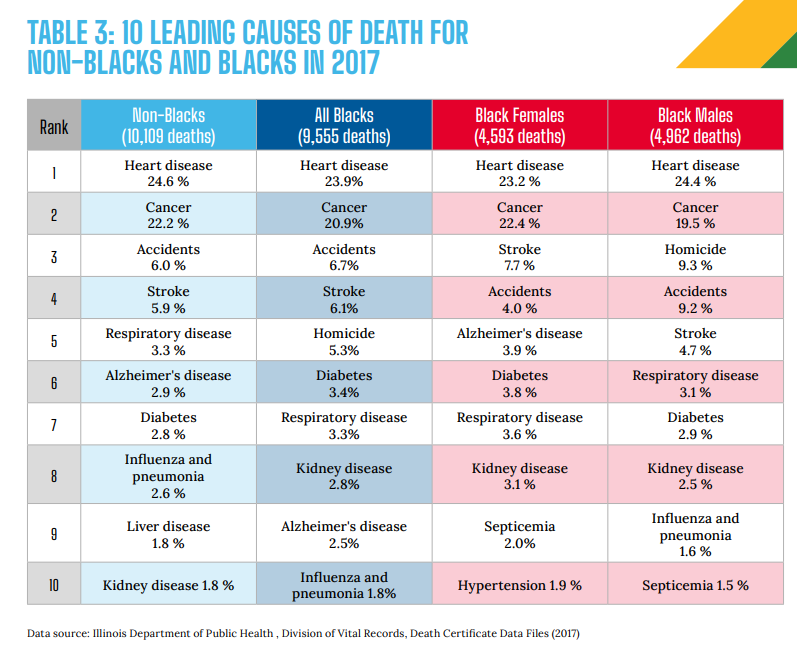
Leading causes of death among Blacks differ by sex. Among Black males, homicide and accidents (such as drug overdoses and motor vehicle accidents) combined make up almost as many deaths as deaths due to cancer. Stroke and kidney disease cause higher proportion of deaths among Black females compared to males and non-Blacks.

Author(s): Chicago Department of Public Health

Publication Date: June 2021

Publication Site: City of Chicago

Black life expectancy gap in Chicago continues to get worse, report finds

Link: https://chicago.suntimes.com/2021/6/15/22535760/black-life-expectancy-gap-state-health-blacks-chicago

Graphic:

Excerpt:

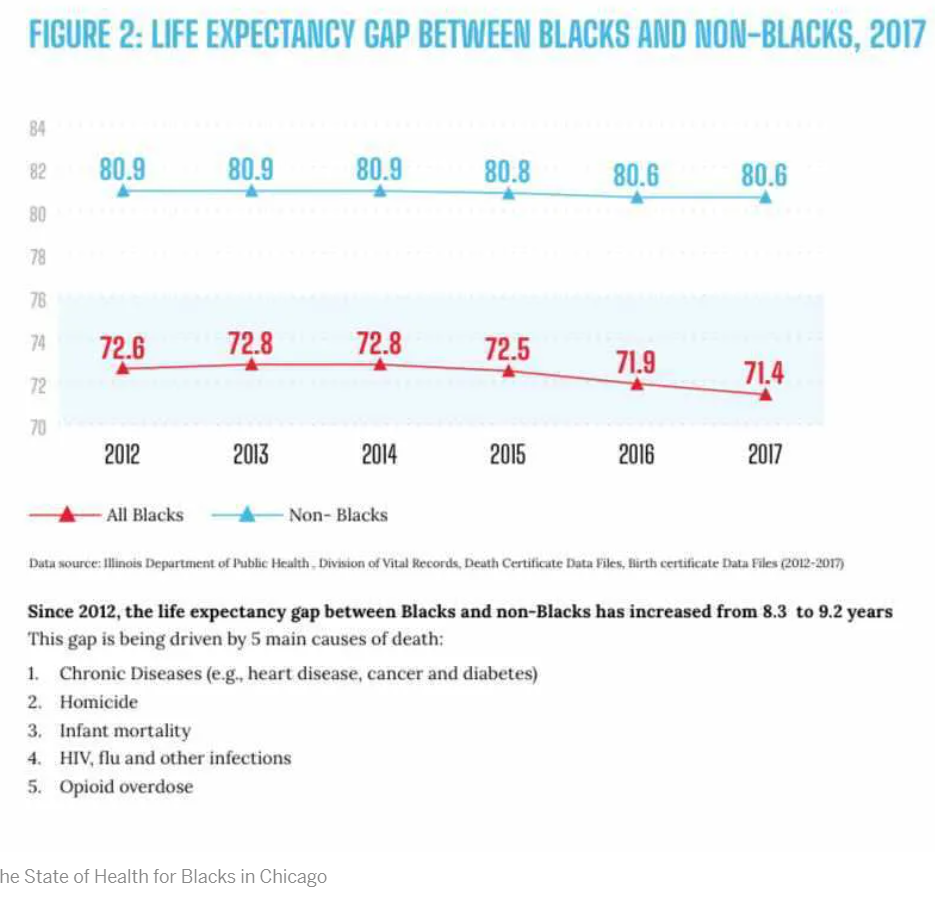
Black Chicagoans are expected to live more than nine years less than non-Black residents — and that gap in life expectancy is only growing, according to a report released Tuesday.

The report by the Chicago Department of Public Health presents a grim but unsurprising outlook on how inequities in housing, income, access to healthy food and trauma have contributed to the disparity in the city.

From 2012 to 2017, the life expectancy gap between Black residents and non-Black residents grew from 8.3 years to 9.2 years, the report found.

Black Chicagoans on average live 71.4 years while non-Black residents live 80.6 years. While non-Blacks saw their life expectancy drop by more than three months in those five years, life expectancy dropped for Blacks by more than 14 months. The report cites five main factors: chronic diseases, homicide, infant mortality, opioid overdoses and HIV, flu or other infections.

Author(s): Manny Ramos

Publication Date: 15 June 2021

Publication Site: Chicago Sun-Times

Restoring Politician Pension Pork

Excerpt:

Jobs as judges, prosecutors, and municipal business administrators are the crock of gold at the end of a politician’s rainbow here and with bailouts, unlimited debt, and an apathetic tax base ripe for plucking politicians have an opportunity to sweeten the pots. According to politicoNJ that is exactly what they are planning on doing with five bills (one already enacted).

A4313: transfers Administrative Law Judges from the Defined Contribution Retirement Program to the Public Employees’ Retirement System. The Office of Legislative Services (OLS) estimates that this bill will lead to annual State cost increases resulting from the transfer of Administrative Law Judges from the Defined Contribution Retirement Program to the Public Employees’ Retirement System. The first-year cost could approximate $2million.In subsequent fiscal years, the annual State cost will grow as a function of increases in judges’ salaries and other economic factors. The bill may also make Administrative Law Judges eligible for healthcare benefit sat retirement that are not available in the Defined Contribution Retirement Program.

….

S3197: Clarifies eligibility for deferred retirement for certain judges in JRS. PoliticoNJ guessed at who could benefit:

The bill appears to have been written with Middlesex County Prosecutor Yolanda Ciccone in mind, as she otherwise would have to leave the prosecutor’s position when she reaches the mandatory judicial retirement age of 70 in 2024 in order to collect her judicial pension. It also could potentially apply to Judge William Daniel, whom Murphy nominated last week as the next Union County prosecutor.

Author(s): John Bury

Publication Date: 19 June 2021

Publication Site: burypensions

NAIC Forms Work Group To Better Regulate Index-Linked Annuities

Excerpt:

A National Association of Insurance Commissioners’ task force today created a subgroup to focus solely on the index-linked annuity products.

“These products are exclusively filed in the states as variable annuities and are funded through non-unitized separate accounts,” read a notice to the task force from Pete Weber, chief life actuary at the Ohio Department of Insurance. “The task force has discussed developing a draft standard for minimum interim values for these products and providing direction for implementing the standard.”

Regulators gave the Index-Linked Variable Annuity Subgroup a 2021 charge to: Provide recommendations and changes, as appropriate, to nonforfeiture, or interim value requirements related to Index-Linked Variable Annuities.

Author(s): John Hilton

Publication Date: June 2021

Publication Site: insurancesnewsnet

These States Lead the Way on Pension Reform

Link: https://www.wsj.com/articles/these-states-lead-the-way-on-pension-reform-11624038916

Excerpt:

Arizona and Michigan have enacted more than a dozen substantive pension reform bills over the past five years. Credit-rating agencies and national retirement experts have cited Arizona’s public-safety pension reforms. Moody’s Investors Service gave Michigan’s teacher retirement reform a “credit positive” review because the state and participating local governments “will no longer carry the entire burden of investment performance risk for new employee pensions.”

Pension reform need not be partisan. After gaining input and buy-in from unions for police officers, firefighters and other public employees, New Mexico Gov. Michelle Lujan Grisham, a Democrat, overhauled her state’s public-employee pension plan for workers who aren’t teachers. “We must make changes now—the alternative is to saddle New Mexicans with unacceptable risk,” Ms. Grisham said, urging fellow Democrats to pass reforms. In 2018, Colorado legislators bridged their differences in a divided government to pass comprehensive reforms that increased employee and employer contributions, reduced cost-of-living adjustments, raised the retirement age, and expanded the use of defined-contribution plans for future employees to address the chronic structural underfunding of the state’s main public pension system.

Author(s): Leonard Gilroy, Steven Gassenberger

Publication Date: 18 June 2021

Publication Site: WSJ

Young American Adults Are Dying — and Not Just From Covid

Link: https://www.bloomberg.com/opinion/articles/2021-06-18/young-american-adults-are-dying-and-not-just-from-covid

Graphic:

image
image
image

Excerpt:

The observation that downward mortality trends have reversed in recent years for some groups of Americans is not new. Economists Ann Case and Angus Deaton helped start the discussion with their 2015 paper on rising mortality among middle-aged, non-Hispanic White Americans, and subsequently gave the phenomenon a resonant name: “deaths of despair.” Research has also identified those without college degrees and rural Americans as especially troubled.

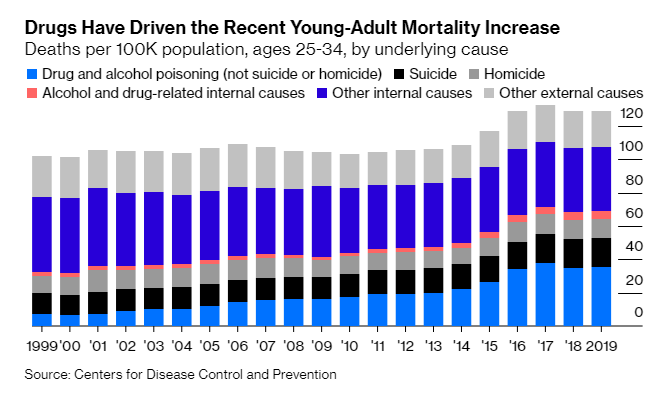
In March, a National Academies of Sciences, Engineering, and Medicine committee summed up the current state of knowledge in a 475-page report on “High and Rising Mortality Rates Among Working-Age Adults.” Advances in overall life expectancy stalled in the U.S. after 2010 even while continuing in other wealthy countries, the committee summed up, attributing this mainly to (1) rising mortality due to external causes such as drugs, alcohol and suicide among those aged 25 through 64 and (2) a slowing in declines in deaths from internal causes, chiefly cardiovascular diseases.

Author(s): Justin Fox

Publication Date: 18 June 2021

Publication Site: Bloomberg

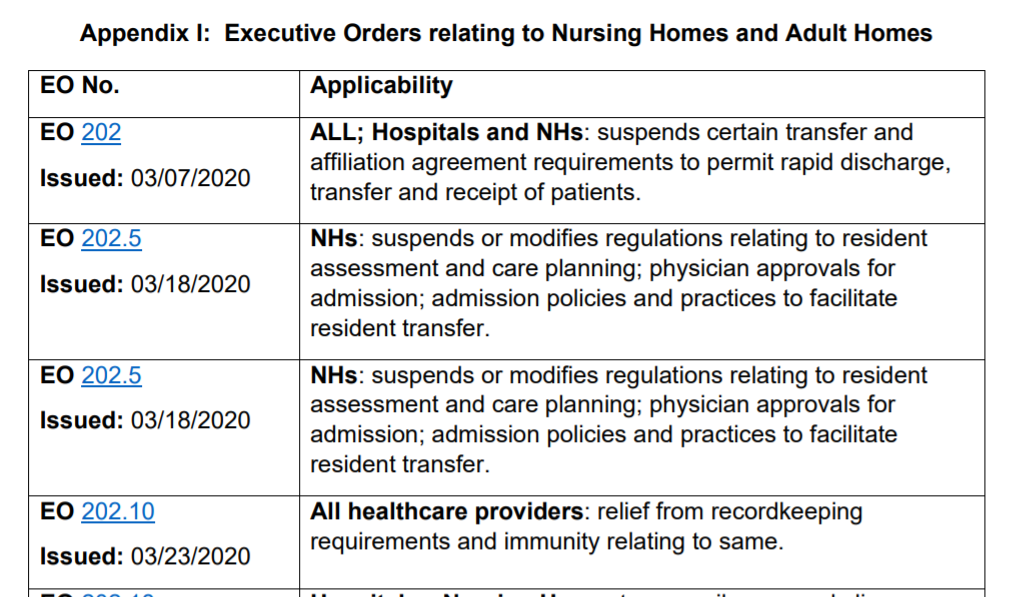
Report and Recommendations of the Task Force on Nursing Homes and Long-Term Care

Link: https://nysba.org/app/uploads/2021/06/11.-Task-Force-on-Nursing-Home-and-Long-Term-Care-Report-staff-memo-and-comments-6.11.2021.pdf

Graphic:

Excerpt:

Because of the anticipated need for large numbers of hospital beds, the Governor, in his first Executive Order issued under his emergency powers, authorized hospitals to “rapidly discharge” patients47. An especially important event in terms of the State’s health care capacity occurred on March 23rd. On that date, Governor Cuomo issued an Executive Order requiring that all hospitals cancel elective surgeries to free up hospital beds, and urged that hospitals go beyond the order and increase their capacity by 100%. Health officials said that day that New York had 53,000 hospital
beds with an anticipated need due to COVID-19 of 113,000. Officials also stated that New York had 3,000 ICU beds with an anticipated need due to COVID-19 of 18,000.


Two days later, on March 25th, the Department of Health issued the now infamous Advisory to nursing homes. The Advisory was explicitly issued out of concern for hospital capacity. It said so in its second sentence. “There is an urgent need to expand hospital capacity in New York State to be able to meet the demand for patients
with COVID-19 requiring acute care.” The Advisory went on to state the expectations for nursing homes.

Author(s): New York State Bar Association Task Force on COVID-19 in New York Nursing Homes and Long-Term Care

Publication Date: June 2021

Publication Site: New York State Bar Association

In landmark move, Maine becomes first state to pass legislation to divest from fossil fuels

Excerpt:

In what environmental advocates called an important step forward for climate justice, Maine became the first state to commit through legislation to divest from fossil fuel companies after Gov. Janet Mills signed a bill this week.

The legislation, LD 99, sponsored by Rep. Maggie O’Neil (D-Saco), “directs the $17 billion Maine Public Employee Retirement System to divest $1.3 billion from fossil fuels within five years” and directs the state treasurer to “do the same with other state funds,” according to a news release by 350 Maine. The bill was amended to grant the retirement system some flexibility in pursuing a gradual divestment from fossil fuels. 

The move comes as momentum for fossil fuel divestment is building around the country, including in states such as New York as well as some cities. All in all, more than 1,300 institutions with a total of $14 trillion in assets have committed to some form of fossil fuel divestment. 

Author(s): Evan Popp

Publication Date: 19 June 2021

Publication Site: Maine Beacon

Death rates for young American adults rise due to overdoses, traffic accidents

Link: https://thepostmillennial.com/death-rates-for-young-american-adults-rise-due-to-overdoses-traffic-accidents

Excerpt:

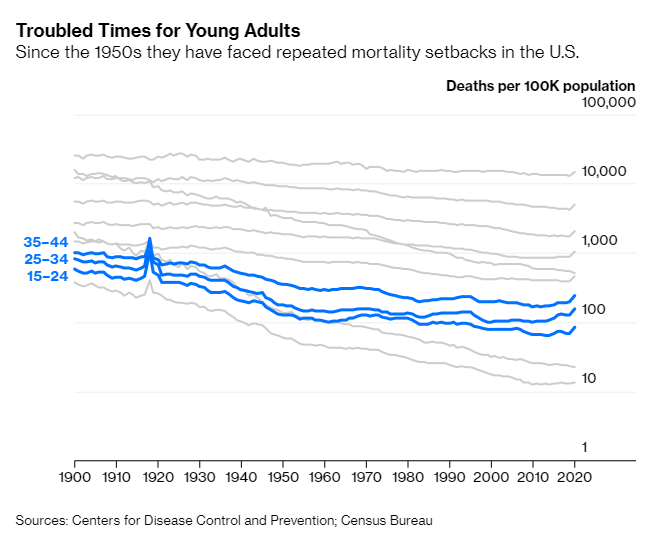
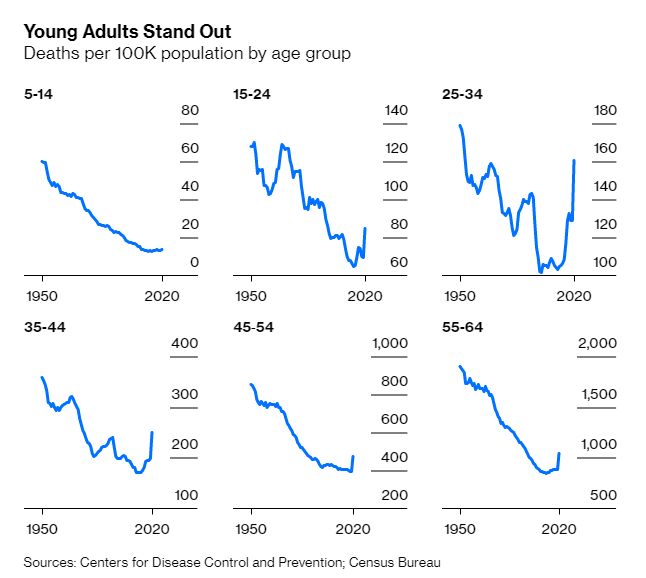
Those aged 15-to-44 have seen fluctuating mortality rates since the 1950s, deviating from all other age groups that have seen steady decreases over the years. The age group’s mortality rate for the COVID-19 pandemic “pales in comparison” to the 1918 pandemic, according to Bloomberg.

“In March, a National Academies of Sciences, Engineering, and Medicine committee summed up their findings in a report titled ‘High and Rising Mortality Rates Among Working-Age Adults.’ Advances in overall life expectancy stalled in the US after 2010 even while continuing in other wealthy countries, the committee summed up, attributing this mainly to (1) rising mortality due to external causes such as drugs, alcohol and suicide among those aged 25 through 64 and (2) a slowing in declines in deaths from internal causes, chiefly cardiovascular diseases,” wrote Bloomberg.

Author(s): Hannah Nightingale

Publication Date: 18 June 2021

Publication Site: The Post Millennial

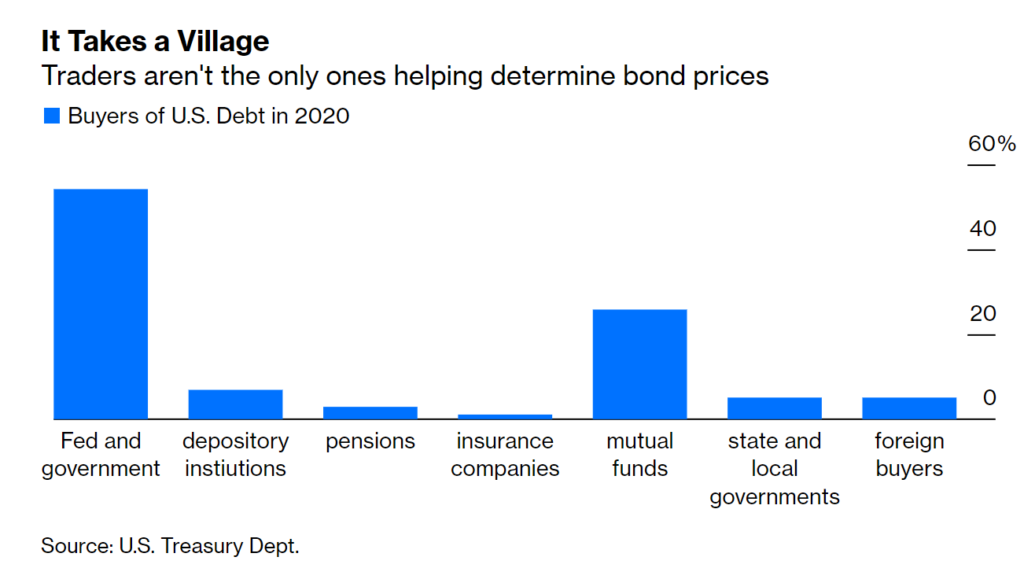
Not Even Bond Traders Can Predict the Future

Link: https://www.bloomberg.com/opinion/articles/2021-06-18/bond-traders-can-t-predict-inflation-any-better-than-anyone-else

Graphic:

Excerpt:

Historically, bond yields have not been very good at predicting inflation.

In the last 70 years, bond yields rarely rose ahead of inflation, going up only after inflation takes hold.  One study indicated that past inflation trends were a better predictor of bond rates than what future inflation turned out to be.

Does this mean bond traders are wrong? Not necessarily. It may just reflect that inflation is unpredictable and bond traders don’t know any more about the future than the rest of us. All they have is the past data and current prices to make their predictions, too. So when inflation suddenly spikes — as it has in the past — bond traders are as surprised as everyone else.

Author(s): Allison Schrager

Publication Date: 18 June 2021

Publication Site: Bloomberg

Recent inflation figures should not be ignored

Link: https://thehill.com/opinion/finance/559121-recent-inflation-figures-should-not-be-ignored

Excerpt:

The sharp increase in consumer prices this Spring may be a blip but may also be a sign that inflation is returning as a chronic problem. For those of us who can accurately recall the 1970s economy, it is a frightening prospect. Everyone else would benefit from reading contemporaneous news coverage.

Recent events call into question pronouncements of the leading Modern Monetary Theorists who thought that the U.S. could sustain much larger deficits without triggering major hikes in the cost of living. Instead, it appears that the traditional rules of public finance still hold: deficit spending financed by Federal Reserve money creation is inflationary.

Analogies between today’s situation and the 1970s are not quite on target. By the early 70s, inflation was well underway. Instead, we should be drawing lessons from the year 1965, when price inflation began to take off. Prior to that year, inflation seemed to be under control with annual CPI growth ranging from 1.1 percent to 1.5 percent annually between 1960 and 1964 — not unlike the years prior to this one.

Author(s): Marc Joffe

Publication Date: 18 June 2021

Publication Site: The Hill